
Norbert Hintermeier
12 Trauerlieder
für Trompete
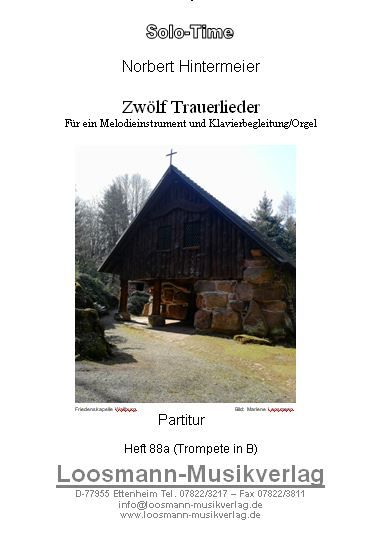
Norbert Hintermeier
12 Trauerlieder
für Trompete
- Instrumentation Trumpet and Piano
- Optional Instrumentation Trumpet
- Composer Norbert Hintermeier
-
Difficulty Level
- Edition Score
- Publisher Loosmann Musikverlag
- Order no. LOOSMANN-S0799A
 ships within 2-4 weeks

Description:
Foreword:
The organization of funeral services and burials has become a challenge in recent years. The coronavirus pandemic, the decline in the number of choirs and the diverse forms of these ceremonies were and are the reasons for this situation. Therefore, these arrangements and pieces of music on popular "funeral hymns" are intended to help two musicians to create a comforting and reassuring farewell ceremony and, above all, an appealing church service. As can be seen from the brief introduction to the selected chorales, individual songs and arrangements can also be used at services throughout the year.
No. 1: "Wenn meine Glieder" (Josefslied): This song was sent to me by the publisher Josef Loosmann, as it is very often sung at funerals in parishes in south-west Germany. As is well known, St. Joseph is invoked and venerated as the patron saint of the dying and for a good death. As this traditional song is not found in today's hymn books, the first verse will be reproduced as a representative to familiarize you with the content of the song:
"When my limbs no longer dare, my hands freeze cold. My feet no longer carry me, my career comes to an end. Then St. Joseph help me, that God may be merciful to me!"
This song is set as a short partita with chorale prelude, chorale and concluding meditation (you can of course then play the chorale again).
No. 2: "Above the stars, there it will once be day": This song is very well known among many church choirs, but also secular choirs as a funeral and burial song. It was written by the composer Franz Abt and is taken from his Lieder Op. 374. The text of the chorale, which was written by Ida Hahn-Hahn (1805-1880), describes the hope in the "all-loving Father".
The chorale is preceded by a calm meditation as an introduction.
No. 3: "Harre, meine Seele": This chorale also dates from the 19th century. Cesar Malan wrote this popular funeral hymn to the text by the hymn poet Friedrich Raeder, which ends with the plea: "...save our soul too, you faithful God!"
After a calm prelude, the solemn chorale is performed with its characteristic dotting. This chorale can also be played twice if necessary.
No. 4: "So nimm denn meine Hände": The well-known Silcher song is also represented in the current Protestant hymnal. The text of the song was written by Julie von Hausmann (1826-1901). She became world-famous with this poem.
The chorale is followed by an improvisation.
No. 5: "Amazing grace": This well-known English-language hymn ("Erstaunliche Gnade") is popular all over the world. The song was written by John Newton (1725-1807).
An introductory meditation leads to the following chorale.
No. 6: "O world, I must leave thee": The melody dates back to the 15th century. Heinrich Isaac wrote it with the text "Innsbruck, I must leave you". However, this melody was already being used in sacred music from around 1500. Joh. Seb. Bach wrote several chorales with different texts. Today, this melody is sung as a death song with "O Welt, ich muss dich lassen", as an evening song "Nun ruhen alle Wälder" and also as a communion song "O heilige Seelenspeise". This arrangement can therefore also be played all year round. For example, as an evening hymn or during the distribution of communion in a church service.
After the chorale follows a postlude in the form of an improvisation.
No. 7: "Abide with me": The English Anglican composer William Henry Monk (1823-1889) wrote this song in 1861 with the text by the Scottish poet Henry Francis Lyte (1793-1847). In the current "Gotteslob" of the Catholic Church, the melody has been included with two different texts: as the evening hymn "Bleib bei uns, Herr" (GL No. 94) and as the Easter hymn "Bleibe bei uns, du Wandrer durch die Zeit" (GL No. 325, as the "Emmauslied").
After the chorale, the following meditation gives time for reflection.
No. 8: "Wenn ich einmal soll scheiden": This is the beginning of the 7th verse of the Passion hymn "O Haupt voll Blut und Wunden" by Paul Gerhardt (1656). The melody comes from a song by Hans Leo Haßler (1601). Joh. Seb. Bach uses this verse in his St. Matthew Passion after the description of Christ's crucifixion.
This chorale arrangement begins with a dialog between the melody instrument and the accompanying instrument as a chorale prelude. The chorale then follows.
No. 9: "Nearer, my God, to thee": This song, originally in English, is one of the most common funeral songs today. The melody was written by Lowell Mason in 1859 and the popularity of the chorale was increased by the filming of the sinking of the "Titanic" (1912). The song is said to have been played by the band (or a string quartet). The song was also included in the hymnal and prayer book "Gotteslob" (GL No. 502).
The chorale is followed by an "Aria" as a meditative postlude.
No. 10: "The day Thou gavest": This melody only became known again through its inclusion in the hymnals of both the Protestant and Catholic churches. In the "Gotteslob", the text "Nun lässt den Tag, o Gott, nun enden..." by Raymund Weber is set to this melody by Clement Cotterill Scholefield (1874). The last two verses of this evening hymn are well suited to be sung at a funeral. (GL No. 96)
After an introduction as a prelude, the chorale follows (can be repeated ad lib); finally, a postlude (or interlude between the chorale repetitions) is to be played.
No. 11: "Jesus, dir leb' ich, Jesus, dir sterb' ich": The words "führ uns, o Jesus, in deine Seligkeit" from the second verse of the Jesuslied (GL No. 367) identify this song as a suitable hymn for the funeral service. The song was written by the Swabian Benedictine monk Franz Bihler (or Bühler), who was appointed cathedral choirmaster in Augsburg in 1801.
A meditative chorale prelude is followed by the chorale (which can also be repeated due to its brevity). If desired, bars 9-16 can also be played again as a postlude.
No. 12: "Above the stars dwells God's peace": This dirge with words by Friedrich Gottlieb Klopstock, the poet of "Empfindsamkeit" (1724-1803) became famous with the choral setting by Friedrich Ferdinand Flemming (1778-1813). This melody, which is over 200 years old, is one of the best-known funeral chorales today.
A prelude in the form of a fantasia precedes the heartfelt chorale.
These pieces of music for the various songs and chorales are primarily intended to provide comfort and contribute to the solemnity of a commemoration of the dead. As can be seen from the comments on the individual hymns, some can also be used in several ways: e.g. as evening music (therefore suitable for vespers and evening services), as Passion music and communion music.
My thanks go to the music publisher Loosmann in Ettenheim and the instrumentalists. In addition to an organ, a harmonium, piano or harp are also suitable as accompanying instruments.
Norbert Hintermeier
The organization of funeral services and burials has become a challenge in recent years. The coronavirus pandemic, the decline in the number of choirs and the diverse forms of these ceremonies were and are the reasons for this situation. Therefore, these arrangements and pieces of music on popular "funeral hymns" are intended to help two musicians to create a comforting and reassuring farewell ceremony and, above all, an appealing church service. As can be seen from the brief introduction to the selected chorales, individual songs and arrangements can also be used at services throughout the year.
No. 1: "Wenn meine Glieder" (Josefslied): This song was sent to me by the publisher Josef Loosmann, as it is very often sung at funerals in parishes in south-west Germany. As is well known, St. Joseph is invoked and venerated as the patron saint of the dying and for a good death. As this traditional song is not found in today's hymn books, the first verse will be reproduced as a representative to familiarize you with the content of the song:
"When my limbs no longer dare, my hands freeze cold. My feet no longer carry me, my career comes to an end. Then St. Joseph help me, that God may be merciful to me!"
This song is set as a short partita with chorale prelude, chorale and concluding meditation (you can of course then play the chorale again).
No. 2: "Above the stars, there it will once be day": This song is very well known among many church choirs, but also secular choirs as a funeral and burial song. It was written by the composer Franz Abt and is taken from his Lieder Op. 374. The text of the chorale, which was written by Ida Hahn-Hahn (1805-1880), describes the hope in the "all-loving Father".
The chorale is preceded by a calm meditation as an introduction.
No. 3: "Harre, meine Seele": This chorale also dates from the 19th century. Cesar Malan wrote this popular funeral hymn to the text by the hymn poet Friedrich Raeder, which ends with the plea: "...save our soul too, you faithful God!"
After a calm prelude, the solemn chorale is performed with its characteristic dotting. This chorale can also be played twice if necessary.
No. 4: "So nimm denn meine Hände": The well-known Silcher song is also represented in the current Protestant hymnal. The text of the song was written by Julie von Hausmann (1826-1901). She became world-famous with this poem.
The chorale is followed by an improvisation.
No. 5: "Amazing grace": This well-known English-language hymn ("Erstaunliche Gnade") is popular all over the world. The song was written by John Newton (1725-1807).
An introductory meditation leads to the following chorale.
No. 6: "O world, I must leave thee": The melody dates back to the 15th century. Heinrich Isaac wrote it with the text "Innsbruck, I must leave you". However, this melody was already being used in sacred music from around 1500. Joh. Seb. Bach wrote several chorales with different texts. Today, this melody is sung as a death song with "O Welt, ich muss dich lassen", as an evening song "Nun ruhen alle Wälder" and also as a communion song "O heilige Seelenspeise". This arrangement can therefore also be played all year round. For example, as an evening hymn or during the distribution of communion in a church service.
After the chorale follows a postlude in the form of an improvisation.
No. 7: "Abide with me": The English Anglican composer William Henry Monk (1823-1889) wrote this song in 1861 with the text by the Scottish poet Henry Francis Lyte (1793-1847). In the current "Gotteslob" of the Catholic Church, the melody has been included with two different texts: as the evening hymn "Bleib bei uns, Herr" (GL No. 94) and as the Easter hymn "Bleibe bei uns, du Wandrer durch die Zeit" (GL No. 325, as the "Emmauslied").
After the chorale, the following meditation gives time for reflection.
No. 8: "Wenn ich einmal soll scheiden": This is the beginning of the 7th verse of the Passion hymn "O Haupt voll Blut und Wunden" by Paul Gerhardt (1656). The melody comes from a song by Hans Leo Haßler (1601). Joh. Seb. Bach uses this verse in his St. Matthew Passion after the description of Christ's crucifixion.
This chorale arrangement begins with a dialog between the melody instrument and the accompanying instrument as a chorale prelude. The chorale then follows.
No. 9: "Nearer, my God, to thee": This song, originally in English, is one of the most common funeral songs today. The melody was written by Lowell Mason in 1859 and the popularity of the chorale was increased by the filming of the sinking of the "Titanic" (1912). The song is said to have been played by the band (or a string quartet). The song was also included in the hymnal and prayer book "Gotteslob" (GL No. 502).
The chorale is followed by an "Aria" as a meditative postlude.
No. 10: "The day Thou gavest": This melody only became known again through its inclusion in the hymnals of both the Protestant and Catholic churches. In the "Gotteslob", the text "Nun lässt den Tag, o Gott, nun enden..." by Raymund Weber is set to this melody by Clement Cotterill Scholefield (1874). The last two verses of this evening hymn are well suited to be sung at a funeral. (GL No. 96)
After an introduction as a prelude, the chorale follows (can be repeated ad lib); finally, a postlude (or interlude between the chorale repetitions) is to be played.
No. 11: "Jesus, dir leb' ich, Jesus, dir sterb' ich": The words "führ uns, o Jesus, in deine Seligkeit" from the second verse of the Jesuslied (GL No. 367) identify this song as a suitable hymn for the funeral service. The song was written by the Swabian Benedictine monk Franz Bihler (or Bühler), who was appointed cathedral choirmaster in Augsburg in 1801.
A meditative chorale prelude is followed by the chorale (which can also be repeated due to its brevity). If desired, bars 9-16 can also be played again as a postlude.
No. 12: "Above the stars dwells God's peace": This dirge with words by Friedrich Gottlieb Klopstock, the poet of "Empfindsamkeit" (1724-1803) became famous with the choral setting by Friedrich Ferdinand Flemming (1778-1813). This melody, which is over 200 years old, is one of the best-known funeral chorales today.
A prelude in the form of a fantasia precedes the heartfelt chorale.
These pieces of music for the various songs and chorales are primarily intended to provide comfort and contribute to the solemnity of a commemoration of the dead. As can be seen from the comments on the individual hymns, some can also be used in several ways: e.g. as evening music (therefore suitable for vespers and evening services), as Passion music and communion music.
My thanks go to the music publisher Loosmann in Ettenheim and the instrumentalists. In addition to an organ, a harmonium, piano or harp are also suitable as accompanying instruments.
Norbert Hintermeier