
Thomas Stevens
Changing Meter Studies
Studies with alternating time signatures

PDF
view
Recommend
recommend item
Thomas Stevens
Changing Meter Studies
Studies with alternating time signatures
- Instrumentation Trumpet
- Edition Sheet Music
-
Difficulty Level
- Composer Thomas Stevens
- Publisher Editions Bim
- Order no. BIM-TP1
incl. tax,
excl. shipping costs
 ships within 3-6 working days

Description:
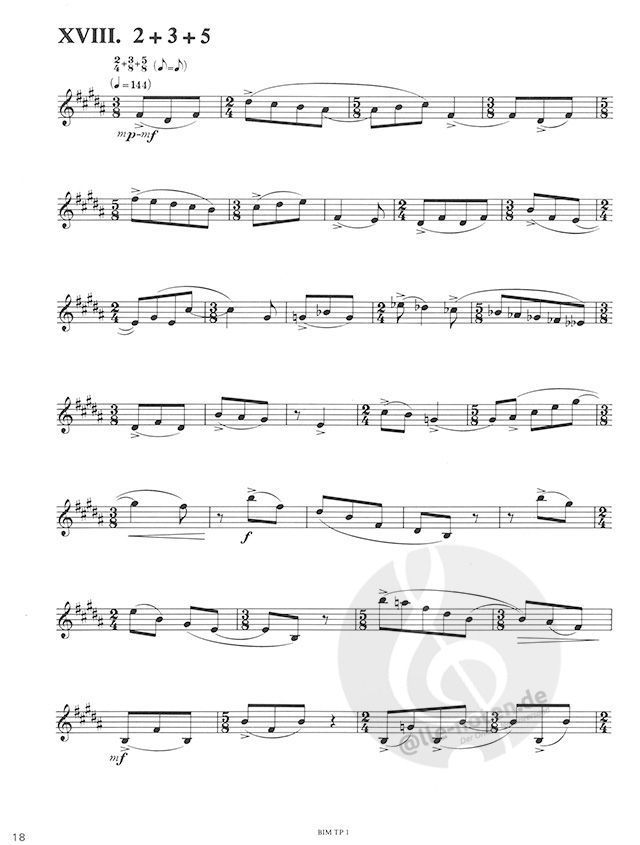
The studies with alternating time signatures are practical exercises in changing time signatures as they occur in contemporary literature.
Studies I-XIV are regular metrical sequences, those from XV-XXI irregular. The time signatures used consist of no more than six units. If more were used, it would only be a matter of joining together smaller units.
The main emphasis was placed on the problem of the bars, so I have tried, where possible, to use the basic counting units of the bars, rather than introducing complicated subdivisions into the given time signatures. The counting units remain the same in all studies.
The following page of examples illustrates not only how to keep to these bar units, but also shows how the different bars can be linked together correctly. To this end, examples I, III and X show the conventional conducting signs that Pierre Boulez used in 'Le Marteau sans Maître' to distinguish between even and odd metrical movements (I-III) and/or the subdivisions of intermediate bars (X).
The main concern is the change of time signature: the studies are therefore not technically demanding and have been constructed in such a way that it should seem 'natural' and logical.
Thomas Stevens (1978)
Customers rated this product:
Sheet music shipping since 1969

Since 1969, over 500,000 customers have trusted us. With a huge selection of over 1,000,000 sheet music titles, we are one of the largest providers in Europe. Thanks to our large stock we can often ship sheet music within 24 hours. No matter what sheet music you are looking for: you are in the right place!
Yours, Stefanie Reichert
Head of Customer Service

Related products:


- Trumpet
- Sheet Music Download
- Editions Bim
-
-
immediately available
|
Download immediately after ordering
- Instant download
Other customers also bought:

- Horn
- Sheet Music
-
ships within 3-6 working days

- Horn and Piano
- Piano reduction with part(s)
-
in stock
|
ships within 1-2 working days

Martin Hackleman
- Horn
- Sheet Music
-
in stock
|
ships within 1-2 working days
- Also available for download!

Richard Strauss, Eric Terwilliger
for Horn solo, freely after Richard Strauss
- Horn
- Sheet Music
-
in stock
|
ships within 1-2 working days

Thomas Stevens
- Trumpet
- Sheet Music
-
ships within 1-2 weeks
- Also available for download!

Anthony Plog
- Trumpet
- Sheet Music
-
in stock
|
ships within 1-2 working days
- Also available for download!

George Antheil
- Trumpet and Piano
- Sheet Music
-
ships within 3-6 working days

Igor Strawinsky
- Trumpet and Piano
- Piano Score and Part(s)
- Daniel-Ben Pienaar
-
in stock
|
ships within 1-2 working days





Chris Gekker
- Trumpet
- Sheet Music
-
ships within 3-6 working days

Thomas Stevens
- Trumpet
- Sheet Music
-
ships within 1-2 weeks