
Max Charles Davies
Laying Demons to Rest
for Trumpet and piano
Max Charles Davies
Laying Demons to Rest
for Trumpet and piano
- Instrumentation Trumpet and Piano
- Composer Max Charles Davies
-
Difficulty Level
- Edition Piano Score and Part(s)
- Publisher Warwick Music
- Order no. WARWTR062
 ships within 2-4 weeks

Description:
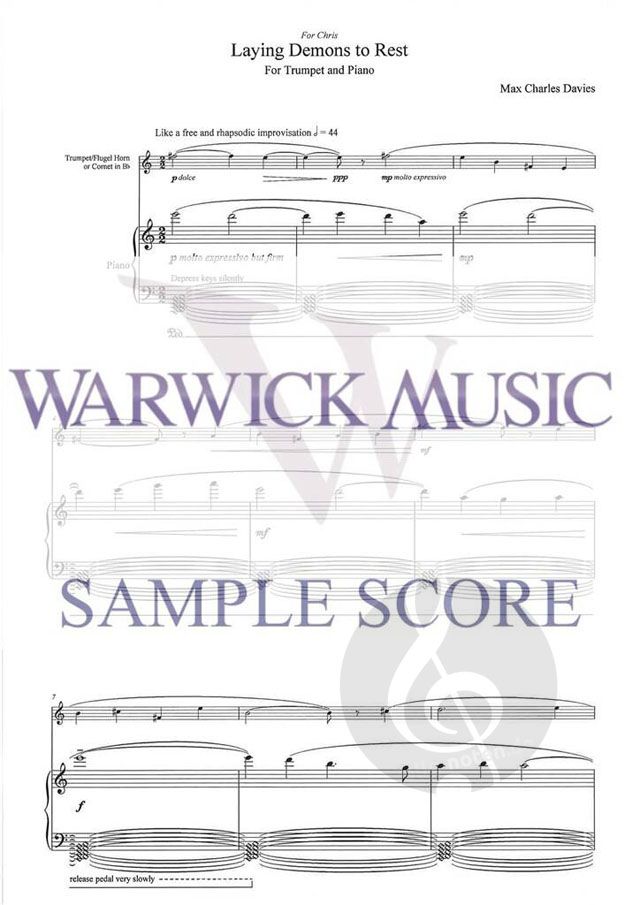
The work opens with long, high melody in the Oboe/Trumpet that moves very slowly and is totally diatonic. It is accompanied by a similar melody in the piano, and the two melodies interweave. Also, the pianist is instructed to depress silently an octave of white notes in the bass register of the piano and the resulting harmonics that are generated create a very transparent, very pure sound world. Gradually, the two melodies become more rhythmically active, and move down in register. The second section is a different treatment of the melodic material. It is still purely diatonic, but much more rhythmically vital, and marked in the score as 'like a dance episode'. Once again, the piano has a single line accompaniment. Then follows a transition passage where for the first time chromatic harmony is heard in the form of violent attacks of black-note chords in the piano. They only appear briefly and act as a sign of things to come in terms of harmonic direction. The following section develops the previous melodic material into a piano chorale under a more focussed melody from the Oboe/Trumpet. After a brief recitative played into the body of the piano, the music unfolds into the key of D major. The melodic material here is placed briefly within a tonal context, and gradually becomes more adventurous chromatically, and eventually, more dissonant. Another dance episode follows, but this time the harmony begins as very dissonant clusters, and the gradually unfold to the climax of the work, which is a statement of the D major melody. A brief, very fast and technically challenging coda follows, bringing the work to a sudden close. Max Charles Davies