
Leoš Janáček
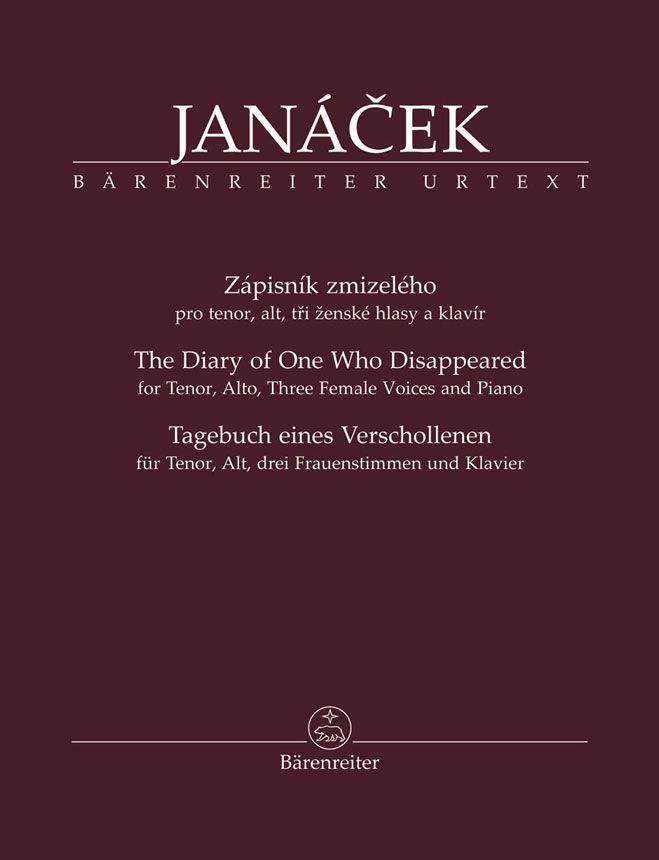
The Diary of One Who Disappeared
for Tenor, Alto, Three Female Voices and Piano

Leoš Janáček
The Diary of One Who Disappeared
for Tenor, Alto, Three Female Voices and Piano
- Instrumentation Soloists (AT), Female Choir (SSA) and Piano
- Composer Leoš Janáček
- Series Bärenreiter Urtext
- Editor Jiří Zahrádka
-
Difficulty Level
- Edition Piano Score
- Publisher Bärenreiter Verlag
- Order no. BA9575
 in stock
ships within 1-2 working days
incl. tax,
excl. shipping costs
Not available in all countries. Learn more

Description:
> First Urtext edition with a detailed Foreword (Cz/Eng/Ger) and Critical Commentary (Eng) by the editor
> Singing translations in German (by Max Brod) and English (by Bernard Keefe)
> Numbers 9 to 11 which include the alto and three female voices also available online
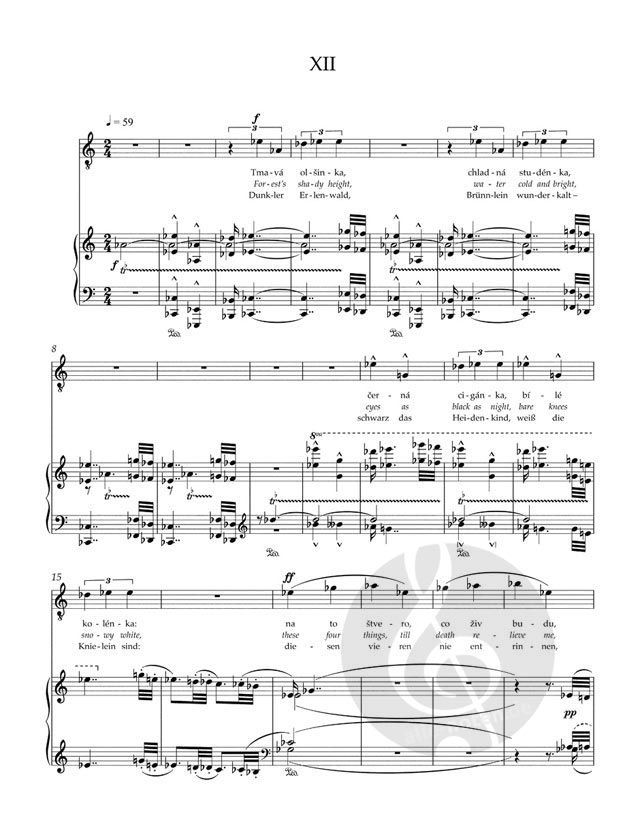
Janácek's intimate chamber-music drama about the passionate love of a simple farm boy for a beautiful gypsy girl is one of his great vocal masterpieces.
This cycle of 22 songs for tenor (an alto and three female voices are added in three numbers) was composed on a setting of poems that were published anonymously. It was not until 80 years later that their author was identified as the regional poet and writer Ozef Kalda. The cycle also contains theatrical elements, such as the alto entrance and exit cues and lighting effects. Composed in 1917-19, the 'Diary' was premièred in Brno in 1921 from a manuscript prepared by Gustav Homola.
The same manuscript served as a basis for the first edition which was issued by the Brno publisher Oldrich Pazdírek in 1921 as well as for this current first Urtext edition.
> Singing translations in German (by Max Brod) and English (by Bernard Keefe)
> Numbers 9 to 11 which include the alto and three female voices also available online
Janácek's intimate chamber-music drama about the passionate love of a simple farm boy for a beautiful gypsy girl is one of his great vocal masterpieces.
This cycle of 22 songs for tenor (an alto and three female voices are added in three numbers) was composed on a setting of poems that were published anonymously. It was not until 80 years later that their author was identified as the regional poet and writer Ozef Kalda. The cycle also contains theatrical elements, such as the alto entrance and exit cues and lighting effects. Composed in 1917-19, the 'Diary' was premièred in Brno in 1921 from a manuscript prepared by Gustav Homola.
The same manuscript served as a basis for the first edition which was issued by the Brno publisher Oldrich Pazdírek in 1921 as well as for this current first Urtext edition.
Customers rated this product:
Manufacturer Information:
Bärenreiter-Verlag Karl Vötterle GmbH & Co. KG
Heinrich-Schütz-Allee 35-37
34131
Kassel
Deutschland
Other customers also bought:
- Soloists (SA), Female Choir (SSAA) and Organ
- Organ Reduction
- Ingo Bredenbach Malcolm Bruno
-
in stock
ships within 1-2 working days - Also available for download!
Fanny Hensel
- Women's Choir (SSA)
- Score
-
ships within 4-8 working days
- Women's Choir (SSA)
- Score
-
in stock
ships within 1-2 working days
Felix Mendelssohn Bartholdy
- Women's Choir (SSA)
- Sheet Music
-
ships within 2-4 weeks
Leoš Janáček
- Piano
- Sheet Music (Urtext)
-
in stock
ships within 1-2 working days - Also available for download!
- Soloists, Mixed Choir (SATB), Organ and Orchestra
- Study Score
- Paul Wingfield
-
in stock
ships within 1-2 working days
- Soloists, Mixed Choir (SATB) and Chamber Orchestra
- Piano Reduction
-
in stock
ships within 1-2 working days


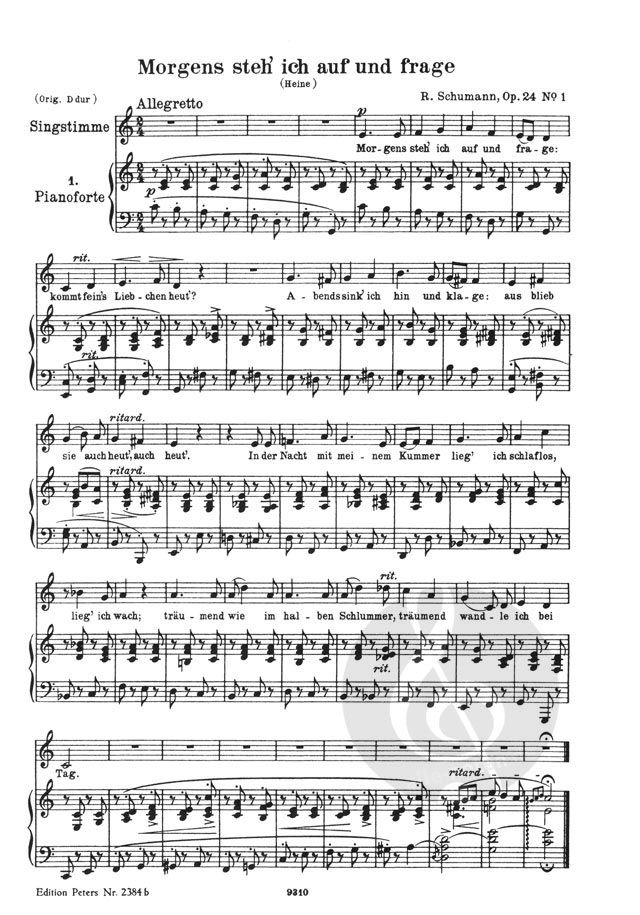
- Medium Voice and Piano
- Sheet Music
-
in stock
ships within 1-2 working days
- Mixed Choir (SATB)
- Sheet Music
-
ships within 2-4 weeks