
Wolfgang Amadeus Mozart
Requiem
completed



Wolfgang Amadeus Mozart
Requiem
completed
- Instrumentation Solo Voices (SATB), Mixed Choir (SATB) and Orchestra
- Composer Wolfgang Amadeus Mozart
- Editor Michael Ostrzyga
- Series Bärenreiter Urtext
- Editor Michael Ostrzyga
- Edition Score (Urtext) Download
- Publisher Bärenreiter Verlag
- Order no. BA11310-DL
 immediately available
Download immediately after ordering
incl. tax,
excl. shipping costs
Not available in all countries. Learn more
Description:
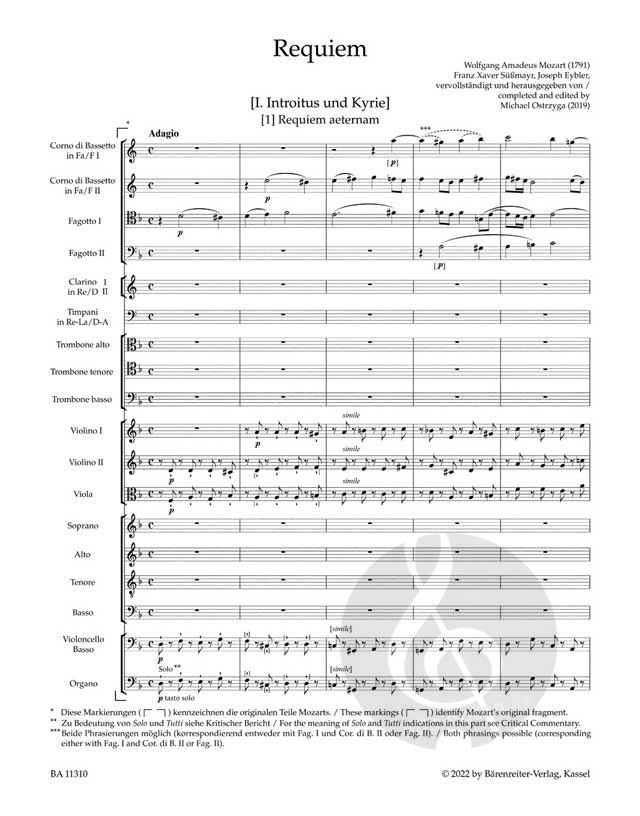
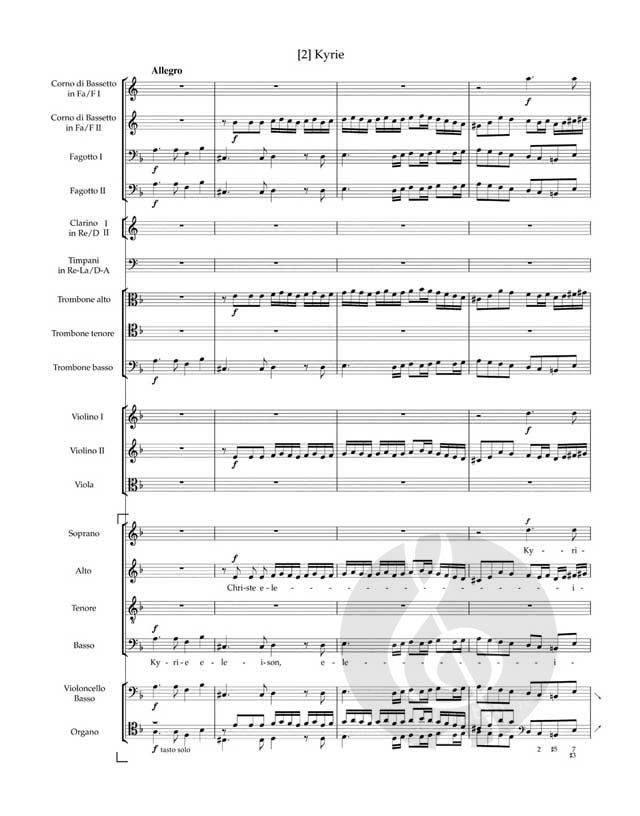
This edition offers both a source-critical edition of Mozart's Requiem fragment and an alternative to Süßmayr's traditional version. It enables the performance of (1) the fragment, which is identified in the printed score and parts, (2) the authentic parts that were not completed by Mozart in a stylistically appropriate instrumentation and (3) those parts that are completely missing from the fragment in a completion in Mozart's style based on the historical additions by Süßmayr and Eybler.
In completing the fragment, the editor relies on comprehensive comparative-analytical studies of Mozart's church style and his compositional technique. The influence of Handel and Bach, which manifested itself in Mozart's later years, particularly in the fragment of the Requiem, is also taken into account in the parts to be completed and added.
Alternative movements or movement parts are available in two places, as here, based on Süßmayr's historical version, two divergent scenarios cannot be weighed against each other and both could have corresponded to Mozart's intentions: The "Lacrimosa" can be concluded with or without the Amen fugue, while the "Sanctus" can begin in D major as usual or in D minor. Above all, this makes it possible to preserve the B flat major "Hosanna" from Süßmayr's autograph, which has not yet been recognized as a technically flawless movement.
> Source-critical edition of the Requiem fragment
> Performance material prepared for the performance of the fragment, a merely supplemented version of the authentic Mozart parts or a completion based on Mozart's tonal language
> Recourse to other church music fragments by Mozart for missing parts
> Consideration of the influences of Bach and Handel already recognizable in the fragment in the parts to be supplemented and added
> Alternative performance options for Lacrimosa, Sanctus and Benedictus
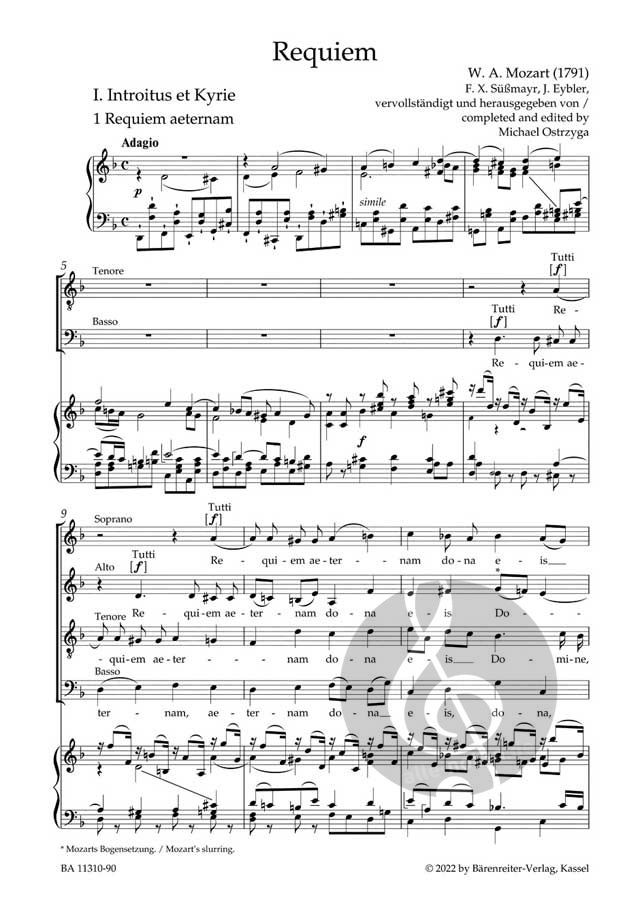
> Easily playable piano reduction
> With extensive preface on history and reception, on analytical-stylistic-critical discussion and on modern additions (German/Engl./English) and with a detailed Critical Report (English) - partly available online via the Bärenreiter website
> Already proven in numerous performances, including at Harvard University, the Rheingau Music Festival, the Monadnock Music Festival (New Hampshire), Salt Lake City (Utah), in radio broadcasts (NDR, SWR, WDR), CD recording with Concerto Köln, the Chorwerk Ruhr and Florian Helgath (e.g. Le Disque classique du du Hautes de la République). including Le Disque classique du jour at francemusique.fr and nominated three times for the Opus Klassik 2021, as "Ensemble", "Choral Work Recording" and "Editorial Achievement" of the year.)
Here you will find the detailed prospectus for the new completion of the Mozart Requiem.
In completing the fragment, the editor relies on comprehensive comparative-analytical studies of Mozart's church style and his compositional technique. The influence of Handel and Bach, which manifested itself in Mozart's later years, particularly in the fragment of the Requiem, is also taken into account in the parts to be completed and added.
Alternative movements or movement parts are available in two places, as here, based on Süßmayr's historical version, two divergent scenarios cannot be weighed against each other and both could have corresponded to Mozart's intentions: The "Lacrimosa" can be concluded with or without the Amen fugue, while the "Sanctus" can begin in D major as usual or in D minor. Above all, this makes it possible to preserve the B flat major "Hosanna" from Süßmayr's autograph, which has not yet been recognized as a technically flawless movement.
> Source-critical edition of the Requiem fragment
> Performance material prepared for the performance of the fragment, a merely supplemented version of the authentic Mozart parts or a completion based on Mozart's tonal language
> Recourse to other church music fragments by Mozart for missing parts
> Consideration of the influences of Bach and Handel already recognizable in the fragment in the parts to be supplemented and added
> Alternative performance options for Lacrimosa, Sanctus and Benedictus
> Easily playable piano reduction
> With extensive preface on history and reception, on analytical-stylistic-critical discussion and on modern additions (German/Engl./English) and with a detailed Critical Report (English) - partly available online via the Bärenreiter website
> Already proven in numerous performances, including at Harvard University, the Rheingau Music Festival, the Monadnock Music Festival (New Hampshire), Salt Lake City (Utah), in radio broadcasts (NDR, SWR, WDR), CD recording with Concerto Köln, the Chorwerk Ruhr and Florian Helgath (e.g. Le Disque classique du du Hautes de la République). including Le Disque classique du jour at francemusique.fr and nominated three times for the Opus Klassik 2021, as "Ensemble", "Choral Work Recording" and "Editorial Achievement" of the year.)
Here you will find the detailed prospectus for the new completion of the Mozart Requiem.
Related products:
Here is how the download works:
1 Buy download sheet music
Purchase the download score from our online store
2 Order confirmation with download link
Immediately after completing your order, you will receive an order confirmation by email listing all items. You will find the download link next to each item. You can use this link to start the download right away. Please also check your spam folder if necessary.
Customers rated this product:
Manufacturer Information:
Bärenreiter-Verlag Karl Vötterle GmbH & Co. KG
Heinrich-Schütz-Allee 35-37
34131
Kassel
Deutschland
Other customers also bought:
- Mixed Choir
- Score
-
ships within 2-4 weeks

Johannes Brahms
- Mixed Choir (SATB) and Orchestra
- Score
-
in stock
ships within 1-2 working days
- Mixed Choir (SATB) and Piano
- Piano Reduction
-
in stock
ships within 1-2 working days
- Soloists (SATB), Mixed Choir (SATB) and Orchestra
- Piano Reduction (Urtext)
-
in stock
ships within 1-2 working days - Also available for download!