
Johann Strauss (Sohn)
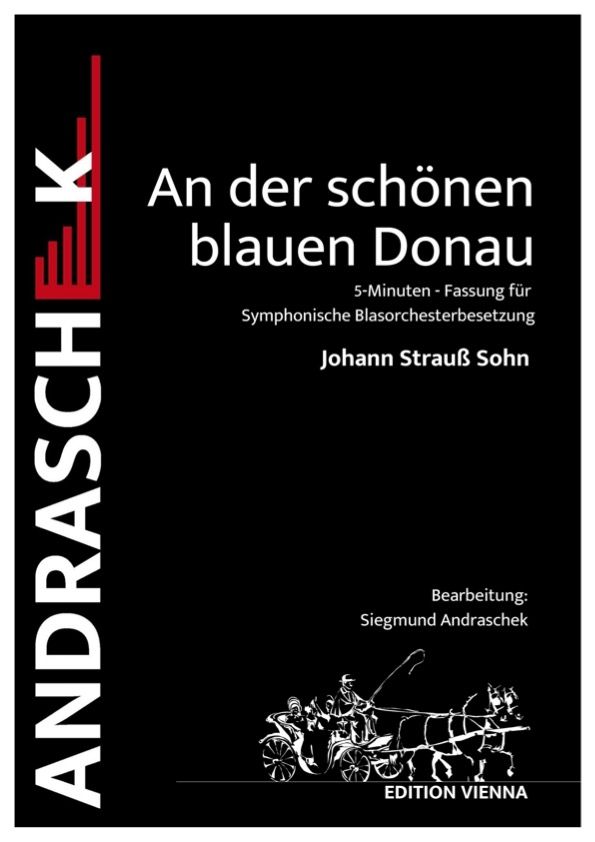
An der schönen blauen Donau
5 minutes version
PDF
view
Johann Strauss (Sohn)
An der schönen blauen Donau
5 minutes version
- Instrumentation Concert Band
- Composer Johann Strauss (Sohn)
- Editor Siegmund Andraschek
-
Difficulty Level
- Edition Sheet Music
- Publisher Andraschek Musikverlag
- Order no. AND00064
 ships within 4-8 working days
incl. tax,
excl. shipping costs
Not available in all countries. Learn more

Description:
For recordings in the 1960s, it was common practice to simply shorten concert waltzes and overtures. The reason for this is simple. The record length was limited, so some repetitions simply had to be deleted or entire parts omitted.
This 5-minute version was commissioned by Upper Austria Tattoo 2023 / Kons. Mag. Dr. Harald Haselmayr.
This "compact version" has the following sequence: Waltz 1 is started without an introduction, immediately after Waltz 2 there is a jump into the coda part. What is omitted? Waltzes 3-5 are skipped completely without damaging the composition. However, part of waltz 3 is played faithfully in the coda, before the reprise of waltz 1 follows and leads into the finale. The Danube Waltz is rarely found on wind orchestra programs due to its difficult introduction and length. This compact version will change that in many ways. The audience will like it, after all, the simple D major triad of the 1st waltz has probably made it into the "Hall of Fame" of the most famous motifs in music history.
This 5-minute version was commissioned by Upper Austria Tattoo 2023 / Kons. Mag. Dr. Harald Haselmayr.
This "compact version" has the following sequence: Waltz 1 is started without an introduction, immediately after Waltz 2 there is a jump into the coda part. What is omitted? Waltzes 3-5 are skipped completely without damaging the composition. However, part of waltz 3 is played faithfully in the coda, before the reprise of waltz 1 follows and leads into the finale. The Danube Waltz is rarely found on wind orchestra programs due to its difficult introduction and length. This compact version will change that in many ways. The audience will like it, after all, the simple D major triad of the 1st waltz has probably made it into the "Hall of Fame" of the most famous motifs in music history.