
Camille Saint-Saëns
The Carnival of the Animals
Selection for Concert Band
Video
view
PDF
view
Camille Saint-Saëns
The Carnival of the Animals
Selection for Concert Band
- Instrumentation Concert Band
- Composer Camille Saint-Saëns
- Editor Ofburg
-
Difficulty Level
- Edition Score and Parts
- Publisher Scomegna Edizioni Musicali
- Order no. SCO-B1749-20

Description:
The Carnival of the Animals was composed in 1886 and privately performed the following year during Mardi Gras. At the composer’s explicit request, the work was only performed publicly and published after his death in 1923.
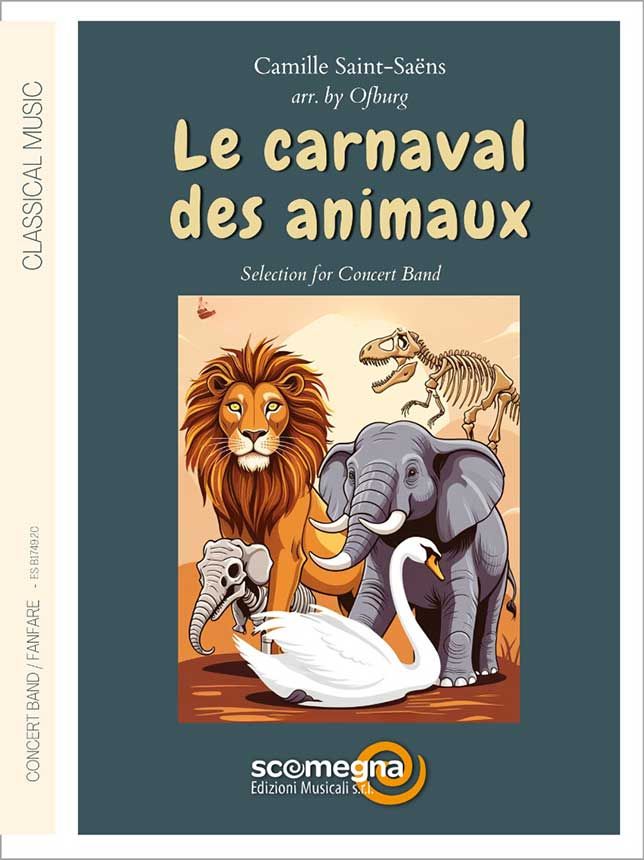
This piece, known for its sharp irony, incorporates quotes from well-known melodies to vividly and humorously depict various animals.
The arranger has selected five of the original 14 movements, creating an instrumental suite adapted for small wind bands with an accessible level of difficulty.
Here are the five movements included:
1 - ROYAL MARCH OF THE LION
The first movement depicts the solemn and majestic stride of a lion.
2 - THE ELEPHANT
This clumsy animal is portrayed using the deep sounds of lower-pitched instruments. The piece features a playful quotation from Hector Berlioz’s Dance of the Sylphs, contrasting the light, graceful sylphs with the elephant's heaviness.
3 - FOSSILS
Fossils are represented by the xylophone, evoking the sound of clattering bones. The lively themes include quotes from Saint-Saëns’s Danse Macabre and Gioachino Rossini’s The Barber of Seville. Through this movement, Saint-Saëns humorously pokes fun at music critics.
4 - THE SWAN
Undoubtedly Saint-Saëns’s most famous theme, it is deeply expressive and was the only movement performed publicly before the composer’s death.
5 - FINALE
This rondo alternates a new, lighthearted theme with references to previous movements, serving as a playful recap of the entire work.
This piece, known for its sharp irony, incorporates quotes from well-known melodies to vividly and humorously depict various animals.
The arranger has selected five of the original 14 movements, creating an instrumental suite adapted for small wind bands with an accessible level of difficulty.
Here are the five movements included:
1 - ROYAL MARCH OF THE LION
The first movement depicts the solemn and majestic stride of a lion.
2 - THE ELEPHANT
This clumsy animal is portrayed using the deep sounds of lower-pitched instruments. The piece features a playful quotation from Hector Berlioz’s Dance of the Sylphs, contrasting the light, graceful sylphs with the elephant's heaviness.
3 - FOSSILS
Fossils are represented by the xylophone, evoking the sound of clattering bones. The lively themes include quotes from Saint-Saëns’s Danse Macabre and Gioachino Rossini’s The Barber of Seville. Through this movement, Saint-Saëns humorously pokes fun at music critics.
4 - THE SWAN
Undoubtedly Saint-Saëns’s most famous theme, it is deeply expressive and was the only movement performed publicly before the composer’s death.
5 - FINALE
This rondo alternates a new, lighthearted theme with references to previous movements, serving as a playful recap of the entire work.
Customers rated this product:
Manufacturer Information:
Scomegna Edizioni Musicali S.r.l.
Via Campassi 41
10040
LA LOGGIA
Italien
Other customers also bought:
- Concert Band
- Score and Parts
- Johny Ocean
-
 in stock
ships within 1-2 working days
- Concert Band
- Score and Parts
- Paul Murtha
-
in stock
ships within 1-2 working days
Peter Iljitsch Tschaikowsky
- Concert Band
- Score and Parts
- Ofburg
-
in stock
ships within 1-2 working days

- Concert Band
- Score and Parts Download
- Peter King
-
immediately available
Download immediately after ordering


Udo Jürgens
- Concert Band
- Score and Parts
- Mnozil Brass
-
in stock
ships within 1-2 working days