
Wolfgang Amadeus Mozart
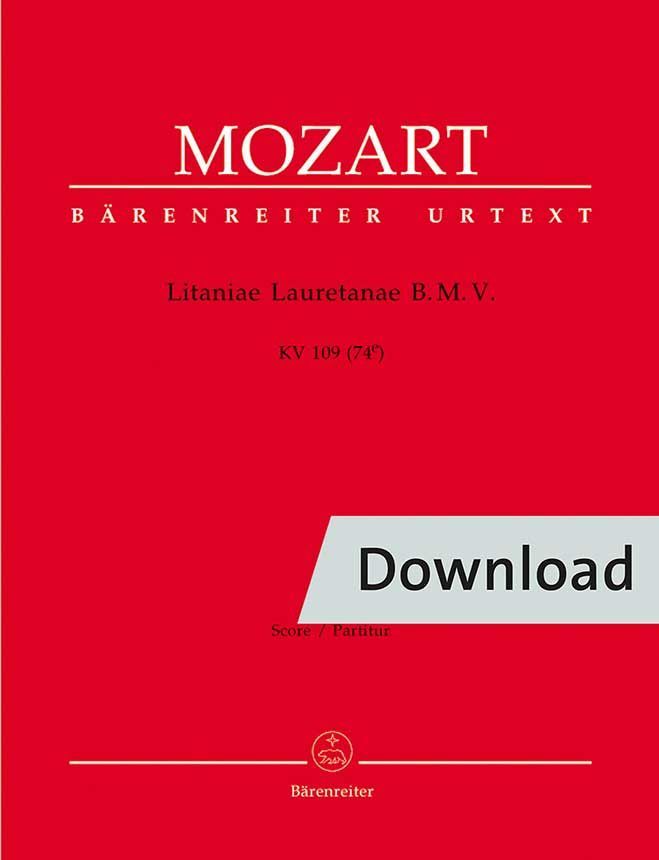
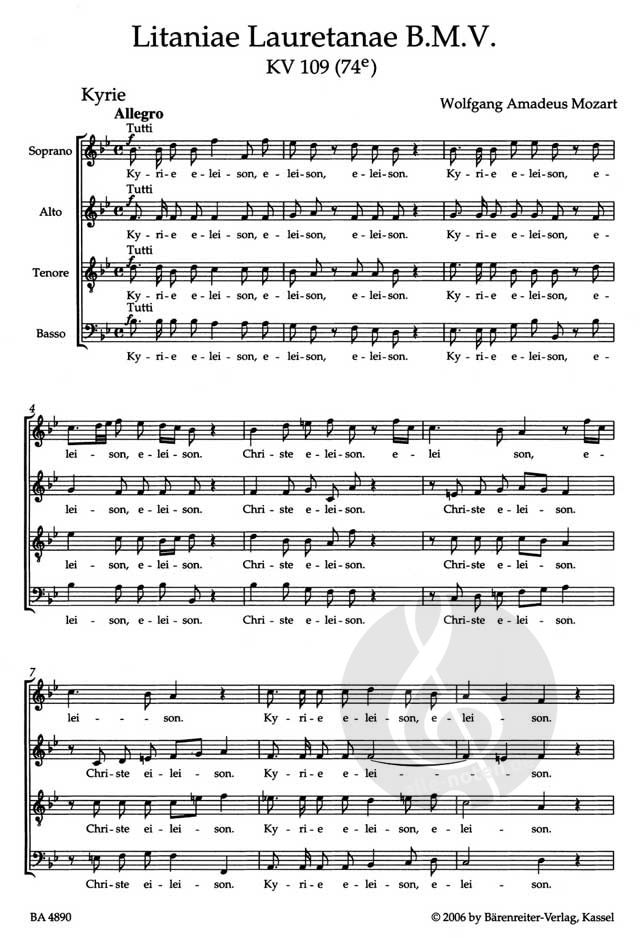
Litaniae Lauretanae in B flat major KV 109 (74e)
Wolfgang Amadeus Mozart
Litaniae Lauretanae in B flat major KV 109 (74e)
- Instrumentation Soloists, Mixed Choir (SATB), 3 Trombones, Strings and Organ
- Composer Wolfgang Amadeus Mozart
- Series Bärenreiter Urtext
- Editor Hellmut Federhofer Renate Federhofer-Königs
-
Difficulty Level
- Edition Score (Urtext) Download
- Publisher Bärenreiter Verlag
- Order no. BA4890-DL
 immediately available
Download immediately after ordering
incl. tax,
excl. shipping costs
Not available in all countries. Learn more

Description:
In addition to masses, requiems and vespers, Mozart's larger works of church music include the four litanies, all of which were composed in Salzburg. After returning from his first trip to Italy (December 13, 1769 to March 28, 1771), Mozart resumed his duties as archbishop's concertmaster and created his first work in this genre, K. 109 (74e), a Lauretanian Litany, dated May 1771, probably still under the spell of what he had experienced.
As the name suggests, this litany, which can already be traced back to early Christian times, is on the one hand a prayer of supplication in the constant repetition of acclamations, and on the other hand a form of alternating prayer. While the Lauretana reflects the worship of the Mother of God as an eloquent expression, the Litany of the Sacraments proclaims the praise, veneration and salvific effect of the Eucharist.
As the name suggests, this litany, which can already be traced back to early Christian times, is on the one hand a prayer of supplication in the constant repetition of acclamations, and on the other hand a form of alternating prayer. While the Lauretana reflects the worship of the Mother of God as an eloquent expression, the Litany of the Sacraments proclaims the praise, veneration and salvific effect of the Eucharist.
Related products:
Here is how the download works:
1 Buy download sheet music
Purchase the download score from our online store
2 Order confirmation with download link
Immediately after completing your order, you will receive an order confirmation by email listing all items. You will find the download link next to each item. You can use this link to start the download right away. Please also check your spam folder if necessary.
Customers rated this product:
Manufacturer Information:
Bärenreiter-Verlag Karl Vötterle GmbH & Co. KG
Heinrich-Schütz-Allee 35-37
34131
Kassel
Deutschland
Other customers also bought:
- Soloists, Mixed Choir (SATB), Organ and Orchestra
- Score (Urtext)
-
ships within 2-4 working days
- Also available for download!