
Georg Friedrich Händel
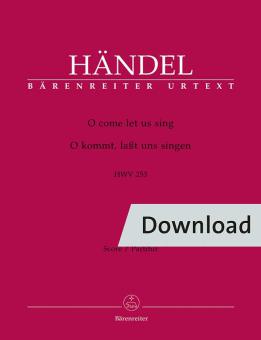
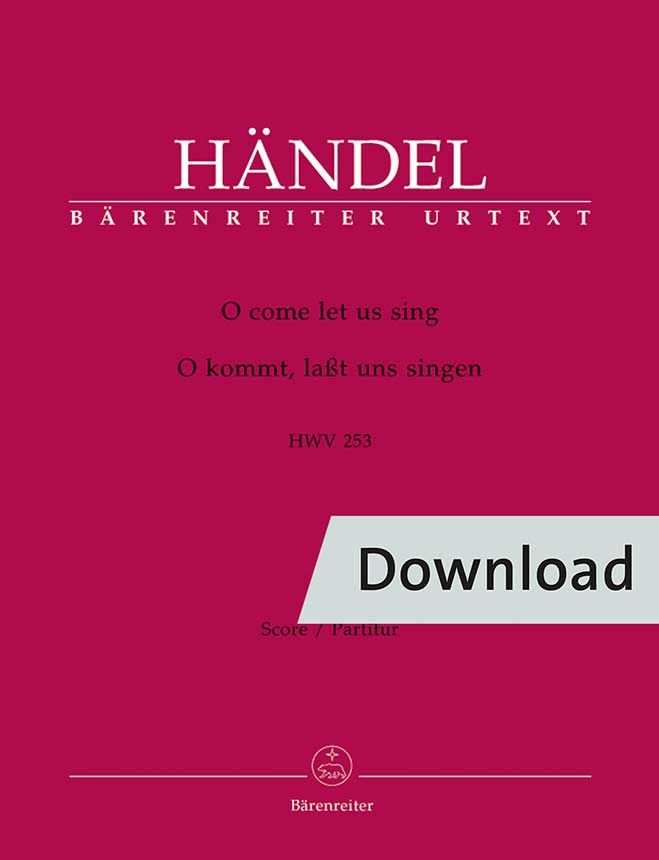
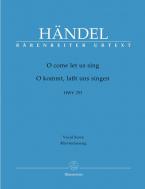
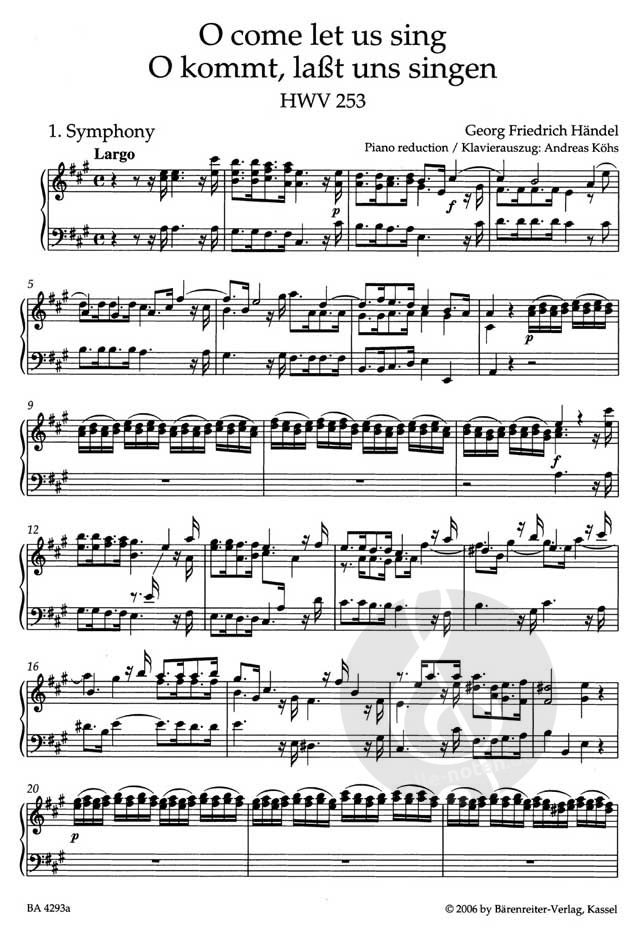
O kommt, lasst uns singen HWV 253
NEW
PDF
view
Georg Friedrich Händel
O kommt, lasst uns singen HWV 253
- Instrumentation Soloists, Mixed Choir (SATB), 2 Recorders, Oboe, Strings and Organ
- Composer Georg Friedrich Händel
- Series Bärenreiter Urtext
- Editor Gerald Hendrie
- Edition Score Download
- Publisher Bärenreiter Verlag
- Order no. BA4293-DL
 immediately available
Download immediately after ordering
incl. tax,
excl. shipping costs
Not available in all countries. Learn more

Description:
The three anthems * HWV 252–254 were composed in 1717 and 1718. George Frideric Handel composed them for Cannons, a princely estate near London. The works are also known as the "Chandos Anthems," named after the first Duke of Chandos, who resided at Cannons.
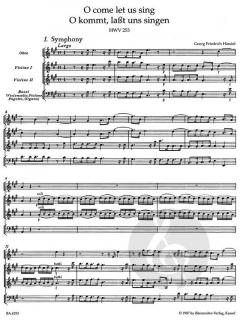
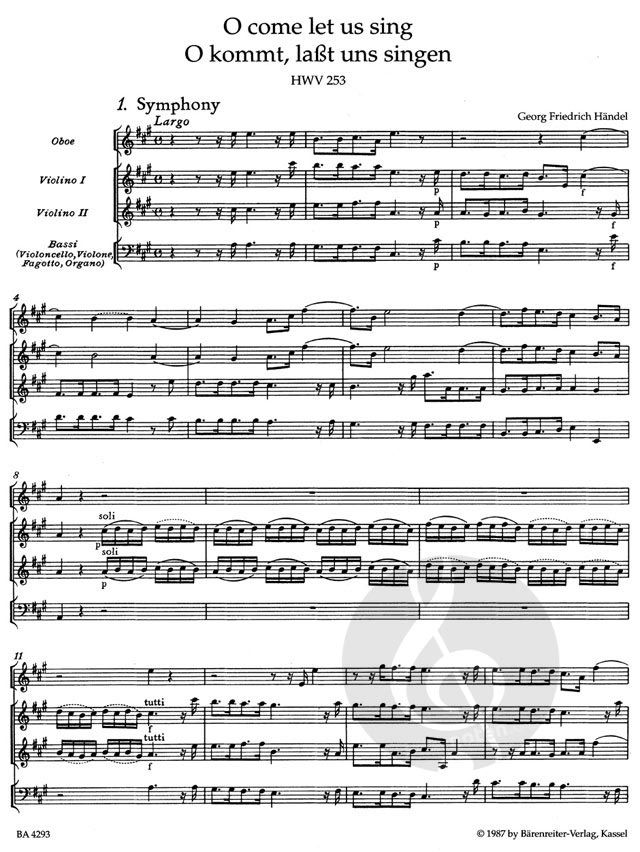
In these three pieces, which captivate with their solemn character and varied orchestral accompaniment, Handel drew on older musical material from his time in Italy and from earlier compositions for the Chapel Royal in London—a common practice in his compositional style. Particularly successful movements, in turn, served as the starting point for later compositions. The instrumentation—featuring soloists, choir, oboe, strings, and continuo—is tailored to the musical conditions of the small residence. For "O come, let us sing unto the Lord"/"O kommt, lasst uns singen," two additional recorders are required.
The anthems are presented according to the original text of the "Hallische Händel-Ausgabe," with clear and easy-to-play piano reductions. In addition to the original English text, the scores and piano reductions also include a singable German translation.
*Anthems:
- My song shall be alway/Mein Lied sing’ auf ewig HWV 252 (BA 4292 )
- O come let us sing/O kommt, lasst uns singen HWV 253 (BA 4293)
- O praise the Lord/O preist den Herrn HWV 254 (BA 4291)
In these three pieces, which captivate with their solemn character and varied orchestral accompaniment, Handel drew on older musical material from his time in Italy and from earlier compositions for the Chapel Royal in London—a common practice in his compositional style. Particularly successful movements, in turn, served as the starting point for later compositions. The instrumentation—featuring soloists, choir, oboe, strings, and continuo—is tailored to the musical conditions of the small residence. For "O come, let us sing unto the Lord"/"O kommt, lasst uns singen," two additional recorders are required.
The anthems are presented according to the original text of the "Hallische Händel-Ausgabe," with clear and easy-to-play piano reductions. In addition to the original English text, the scores and piano reductions also include a singable German translation.
*Anthems:
- My song shall be alway/Mein Lied sing’ auf ewig HWV 252 (BA 4292 )
- O come let us sing/O kommt, lasst uns singen HWV 253 (BA 4293)
- O praise the Lord/O preist den Herrn HWV 254 (BA 4291)
Related products:
Here is how the download works:
1 Buy download sheet music
Purchase the download score from our online store
2 Order confirmation with download link
Immediately after completing your order, you will receive an order confirmation by email listing all items. You will find the download link next to each item. You can use this link to start the download right away. Please also check your spam folder if necessary.
Customers rated this product:
Manufacturer Information:
Bärenreiter-Verlag Karl Vötterle GmbH & Co. KG
Heinrich-Schütz-Allee 35-37
34131
Kassel
Deutschland
Other customers also bought:
Georg Friedrich Händel
- Soloists, Mixed Choir (SATB), 2 Recorders, Oboe, Strings and Organ
- Instrumental Part: Violin 1
-
ships within 2-4 working days
Georg Friedrich Händel
- Soloists, Mixed Choir (SATB), 2 Recorders, Oboe, Strings and Organ
- Instrumental Part: Violin 2
-
ships within 2-4 working days
Georg Friedrich Händel
- Soloists, Mixed Choir (SATB), 2 Recorders, Oboe, Strings and Organ
- Instrumental Parts: Cello and Double Bass
-
ships within 2-4 working days
Georg Friedrich Händel
- Soloists, Mixed Choir (SATB), 2 Recorders, Oboe, Strings and Organ
- Harmony Parts
-
ships within 2-4 working days
- Soloists, Mixed Choir (SATB), 2 Oboes, Bassoon, Violin, Strings and Organ
- Instrumental Parts: Cello and Double Bass
-
ships within 2-5 working days
- Also available for download!
- Mixed Choir (SATB)
- Choral Score
-
ships within 2-5 working days
- Soloists, Mixed Choir (SATB), 2 Oboes, Bassoon, Violin, Strings and Organ
- Instrumental Part: Viola
-
ships within 2-5 working days
- Also available for download!
- Soloists, Mixed Choir (SATB), 2 Oboes, Bassoon, Violin, Strings and Organ
- Harmony Parts
-
ships within 2-5 working days
- Also available for download!
Georg Friedrich Händel
- Soloists, Mixed Choir (SATB) and Piano
- Piano Reduction
- Andreas Köhs
-
ships within 2-4 working days
- Also available for download!
- Soloists, Mixed Choir (SATB), 2 Oboes, Bassoon, Violin, Strings and Organ
- Instrumental Part: Violin 2
-
ships within 2-5 working days
- Also available for download!
- Soloists, Mixed Choir (SATB), 2 Oboes, Bassoon, Violin, Strings and Organ
- Instrumental Parts: Violin Solo & Violin 1
-
ships within 2-5 working days
- Also available for download!