
Anton Reicha
Scène de Néris et Phaon extrait de Sapho, "L'âpreté de ces lieux convient à ma douleur…"
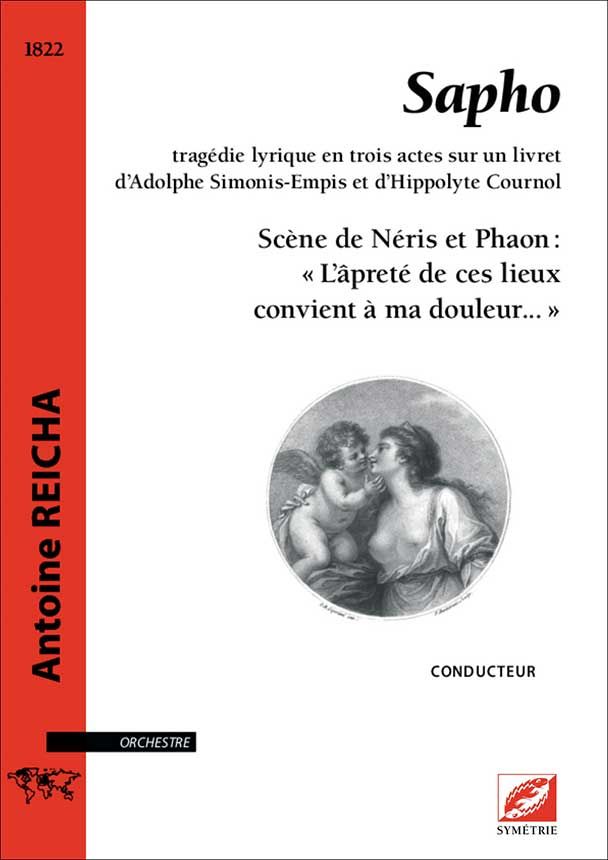
Anton Reicha
Scène de Néris et Phaon extrait de Sapho, "L'âpreté de ces lieux convient à ma douleur…"
- Instrumentation Soloists (ST), 2 Flutes, 2 Oboes, 2 Clarinets, 2 Bassoons, 2 Horns and Strings
- Composer Anton Reicha
- Edition Sheet Music
- Publisher Symétrie
- Order no. 9790231808926
 ships within 1-2 weeks

Description:
The scene published here is taken from the first act. It consists of seven main sections, with an overall structure of three parts: soliloquy - dialogue - duet. We see first of all Phaon, who is singing by himself. The inhospitable landscape seems to him to reflect his torment. Néris arrives. She is eager to be married to Phaon, but wishes to know why he is hesitant. Phaon then admits to his love-affair with Sapho, which developed when she was giving him music lessons. He fears, too, that Sapho may take vengeance on him. Néris forgives him and persuades him to have confidence in her and in Sicily, as protectors. Phaon is won over. The two lovers then sing the same words at the same time: first of all, lento, celebrating their love, and then allegro, predicting a happy life together. It is in the lento that Néris and Phaon finally begin to address each other with the familiar "tu".
This scene is full of changes of emotion, that the music expresses by contrasts of tempo, rhythm and tonality. In general, we find an alternation of allegro and andante, up to the lento. The rhythms range from the clarity and directness of Phaon's first air to the delicate ornamentation of Néris's "C'est trop longtemps…". As for the tonal sequence, going from one piece to the next, there are roughly 12 changes, covering six different keys. We might mention, too, a brief passage of recitative, without key signature, that is resolved to C sharp major - just the tonality to give force to the A major that follows!
This scene is full of changes of emotion, that the music expresses by contrasts of tempo, rhythm and tonality. In general, we find an alternation of allegro and andante, up to the lento. The rhythms range from the clarity and directness of Phaon's first air to the delicate ornamentation of Néris's "C'est trop longtemps…". As for the tonal sequence, going from one piece to the next, there are roughly 12 changes, covering six different keys. We might mention, too, a brief passage of recitative, without key signature, that is resolved to C sharp major - just the tonality to give force to the A major that follows!