
Maurice Ravel
Bolero
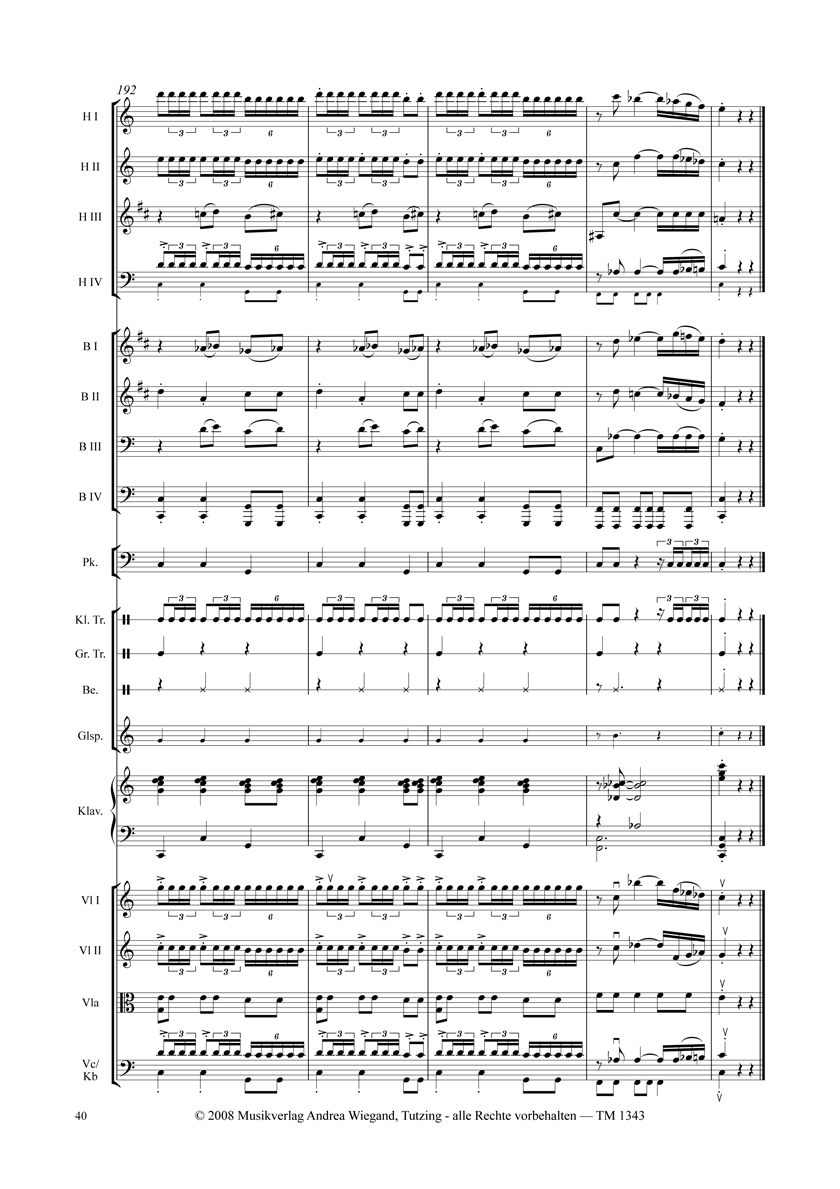
Maurice Ravel
Bolero
- Instrumentation Orchestra
- Composer Maurice Ravel
- Editor Thomas Stapf
- Series Festmusik
-
Difficulty Level
- Edition Score and Parts (Orchestra)
- Publisher Musikverlag Andrea Wiegand
- Order no. ETM1343
 in stock
ships within 1-2 working days
incl. tax,
excl. shipping costs
Not available in all countries. Learn more

Description:
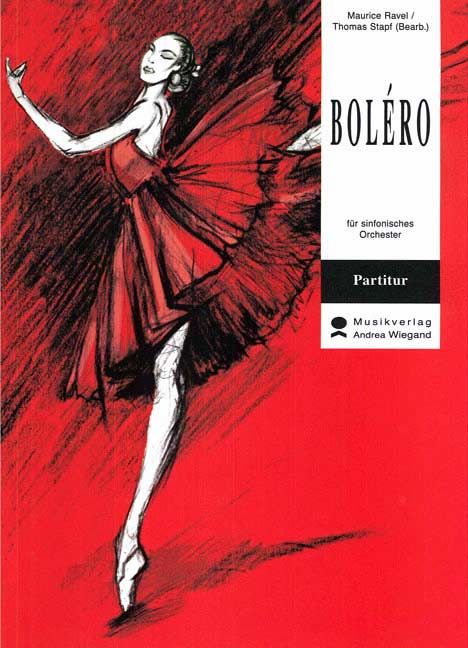
Every major symphony orchestra has it in its repertoire - now school and amateur orchestras can finally immerse themselves in the fascinating sound world of Maurice Ravel's Boléro: With the new, simplified arrangement from the music publisher Andrea Wiegand, it is now almost child's play to make the concise rhythm and catchy melodies of this modern classic sound great yourself!
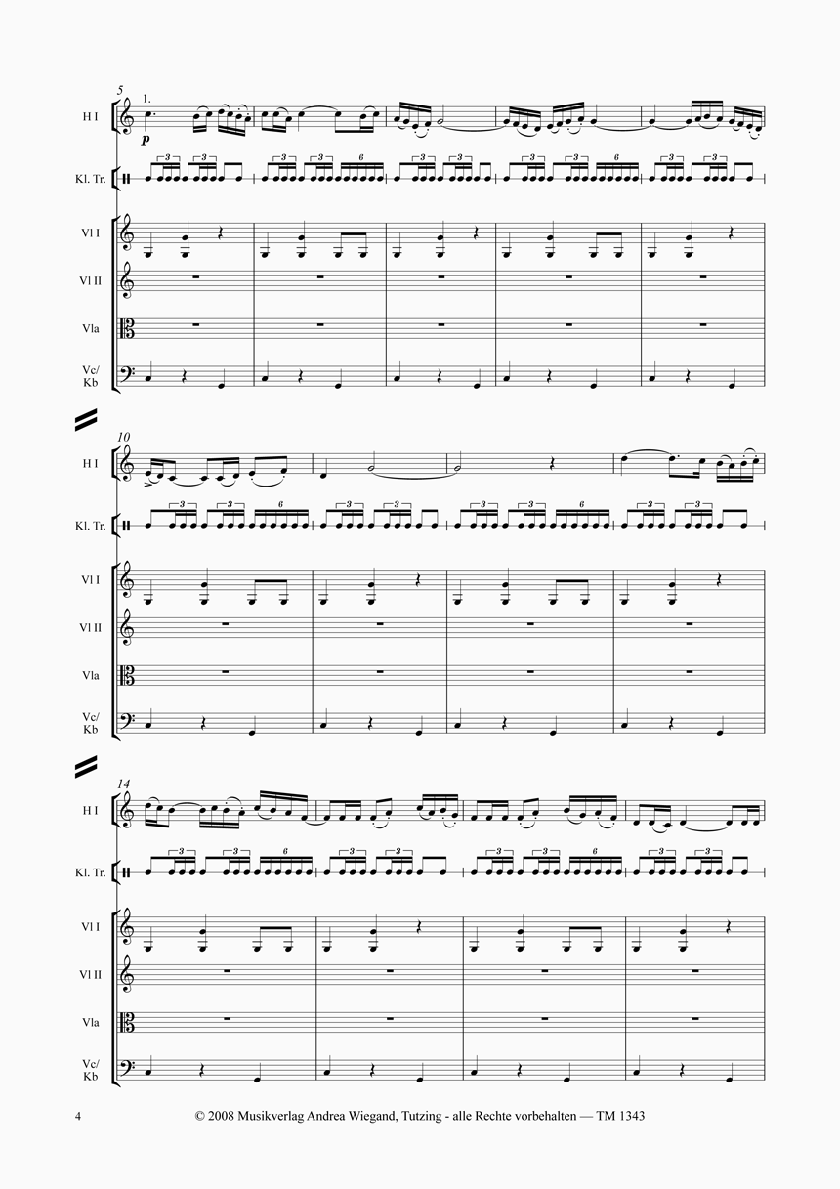
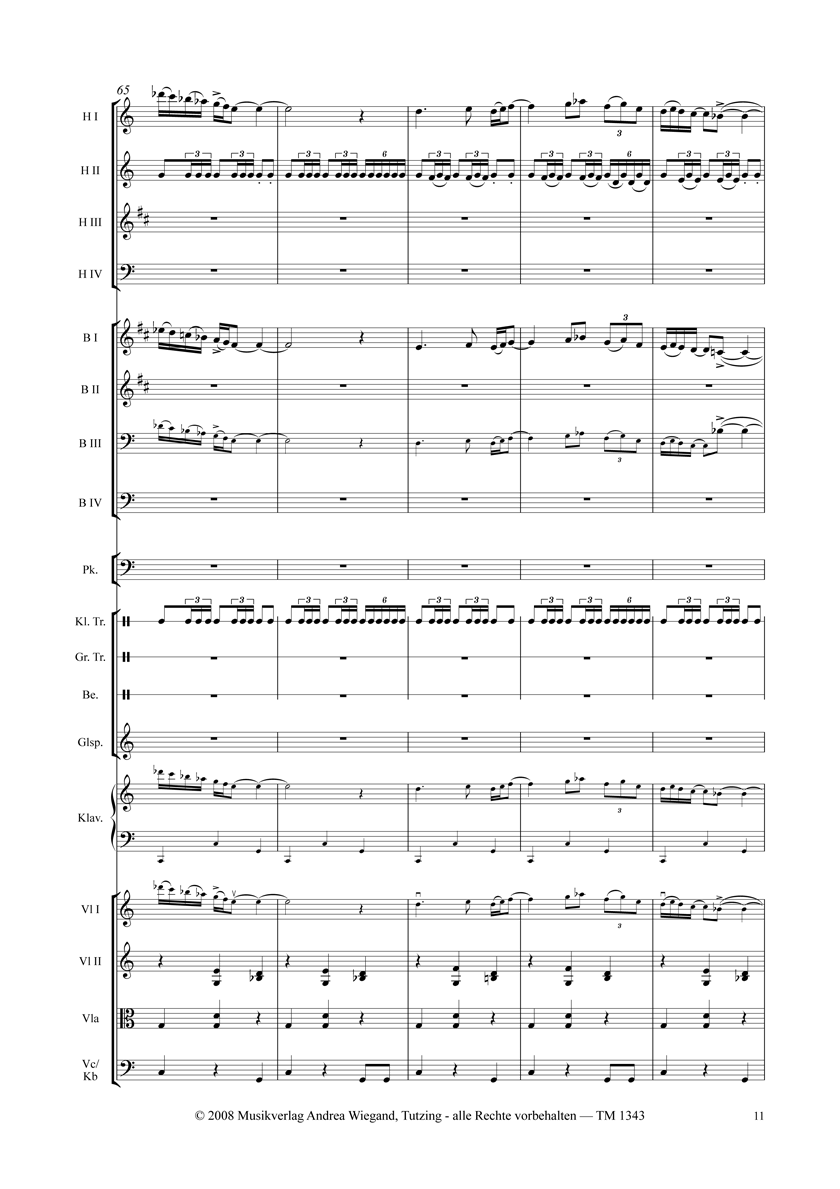
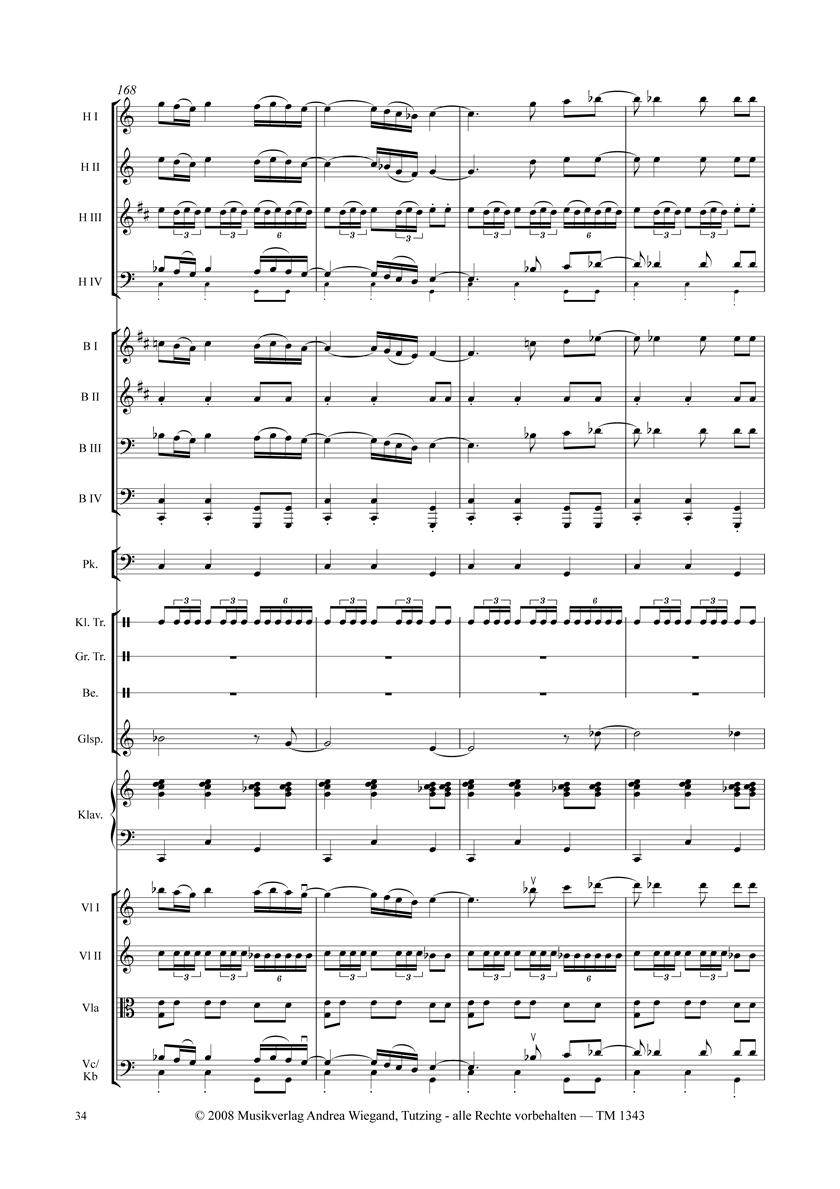
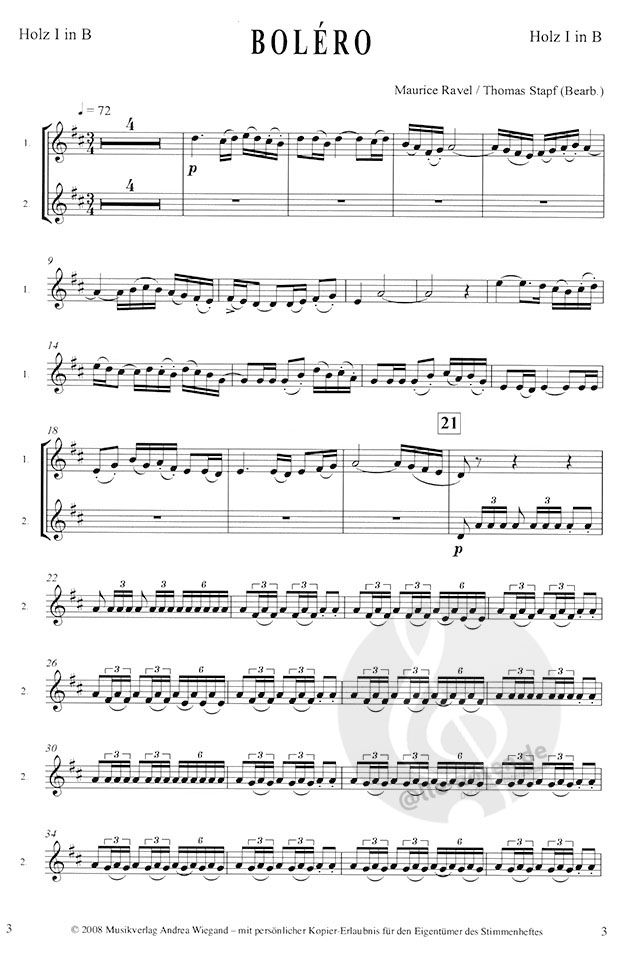
Over the ostinato rhythm of the snare drum, the individual instruments gradually enter in various combinations, whereby the tonal diversity of the orchestral colorfulness of the crescendo composed by Ravel is largely preserved thanks to clever formal condensation.
The strings are joined by four woodwinds and four brass instruments, which can also be divided into two players each if required. The following instrumentation is provided: Flute, oboe, clarinet and bassoon or trumpet, trombone (alternatively horn) and tuba. There is also an obbligato snare drum and a piano ad lib. The work is given additional power and dynamics by timpani, bass drum, cymbals and glockenspiel.
The level of difficulty for the winds is easy to moderate; the string parts are clearly graduated and only require violin I and cello to play in the upper register. The viola can be replaced by a violin III. We have also thought of the younger players: with an easy-to-understand exercise, the characteristic rhythm of the two themes can be successfully rehearsed step by step.
Series: Festive music
Score and a booklet of parts
Over the ostinato rhythm of the snare drum, the individual instruments gradually enter in various combinations, whereby the tonal diversity of the orchestral colorfulness of the crescendo composed by Ravel is largely preserved thanks to clever formal condensation.
The strings are joined by four woodwinds and four brass instruments, which can also be divided into two players each if required. The following instrumentation is provided: Flute, oboe, clarinet and bassoon or trumpet, trombone (alternatively horn) and tuba. There is also an obbligato snare drum and a piano ad lib. The work is given additional power and dynamics by timpani, bass drum, cymbals and glockenspiel.
The level of difficulty for the winds is easy to moderate; the string parts are clearly graduated and only require violin I and cello to play in the upper register. The viola can be replaced by a violin III. We have also thought of the younger players: with an easy-to-understand exercise, the characteristic rhythm of the two themes can be successfully rehearsed step by step.
Series: Festive music
Score and a booklet of parts
Related products:
Customers rated this product:
Manufacturer Information:
Musikverlag Andrea Wiegand
Schreinerstr. 8
85077
Manching
Deutschland
Other customers also bought:

John Williams
- Orchestra
- Score and Parts
- Michael Story
-
in stock
ships within 1-2 working days - Also available for download!
Edward Pola, George Wyle
- Orchestra
- Score and Parts
- Bob Cerulli
-
ships within 3-6 working days
Maurice Ravel
- Orchestra
- Set of Parts - Extra Parts
- Thomas Stapf
-
in stock
ships within 1-2 working days
Rossano Galante
- Orchestra
- Score and Parts
-
in stock
ships within 1-2 working days - Also available for download!
Henry Mancini
- Orchestra
- Score and Parts
- Victor López
-
in stock
ships within 1-2 working days
Georges Bizet
- Orchestra
- Score and Parts
- Richard Meyer
-
in stock
ships within 1-2 working days - Also available for download!
- Orchestra
- Score and Parts
- Thomas Stapf
-
in stock
ships within 1-2 working days
- Orchestra
- Score and Parts
- Thomas Stapf
-
in stock
ships within 1-2 working days
Georges Bizet
- Orchestra
- Score and Parts
- Richard Meyer
-
ships within 3-6 working days
- Also available for download!
Claude-Michel Schönberg
- Orchestra
- Score and Parts
- Bob Lowden
-
in stock
ships within 1-2 working days - Also available for download!
- Concert Band
- Score and Parts
- Robert Longfield
-
in stock
ships within 1-2 working days

John Williams
from 'Star Wars: Episode V - The Empire Strikes Back'
- Concert Band
- Score, Parts and Online Video
- Paul Murtha
-
in stock
ships within 1-2 working days
Johannes Brahms
- Orchestra
- Score, Parts and Piano Reduction
- Stefan Taupe
-
in stock
ships within 1-2 working days
- Orchestra
- Set of Parts
-
in stock
ships within 1-2 working days

- Orchestra
- Score and Parts
- Thomas Stapf
-
ships within 2-4 working days