
Camille Saint-Saëns
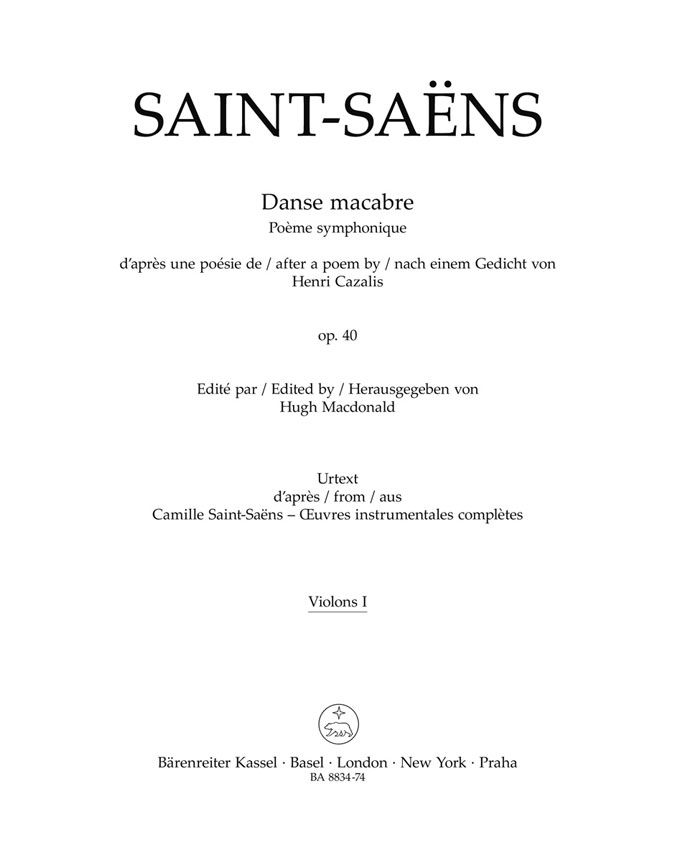
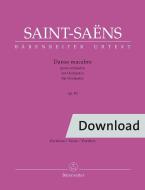
Danse macabre op. 40
Symphonic poem after a poem by Henri Cazalis
Camille Saint-Saëns
Danse macabre op. 40
Symphonic poem after a poem by Henri Cazalis
- Instrumentation Violin and Orchestra
- Composer Camille Saint-Saëns
- Series Bärenreiter Urtext
- Editor Hugh MacDonald
- Edition Instrumental Part: Violin 1 (Urtext)
- Publisher Bärenreiter Verlag
- Order no. BA8834-74
 ships within 2-4 working days
incl. tax,
excl. shipping costs
Not available in all countries. Learn more

Description:
Saint-Saëns was a great admirer of the symphonic poems by Franz Liszt. His own symphonic poem 'Danse macabre' reflects not only his affinity to medieval superstitions but also constitutes a tribute to Liszt’s 'Totentanz'.
'Danse macabre' is based on the eponymous song Saint-Saëns composed in 1872 after Henri Cazalis’ poem. At its premiere, the work was not well-received; in fact it was booed, possibly due to the 'diabolic' solo violin playing on an E-string that was tuned down to E-flat, which the audience might have misinterpreted as being out of tune. However within ten years the work had become so popular that Saint-Saëns quoted some of its musical themes in 'The Carnival of the Animals'. Since the composer’s death, 'Danse macabre' is among the works most often mentioned in connection with the theatrical face of death found in popular mortuary cult.
'Danse macabre' is based on the eponymous song Saint-Saëns composed in 1872 after Henri Cazalis’ poem. At its premiere, the work was not well-received; in fact it was booed, possibly due to the 'diabolic' solo violin playing on an E-string that was tuned down to E-flat, which the audience might have misinterpreted as being out of tune. However within ten years the work had become so popular that Saint-Saëns quoted some of its musical themes in 'The Carnival of the Animals'. Since the composer’s death, 'Danse macabre' is among the works most often mentioned in connection with the theatrical face of death found in popular mortuary cult.
Related products:
Customers rated this product:
Manufacturer Information:
Bärenreiter-Verlag Karl Vötterle GmbH & Co. KG
Heinrich-Schütz-Allee 35-37
34131
Kassel
Deutschland
Other customers also bought:
- Violin and Orchestra
- Instrumental Part: Violin 1 (Urtext)
-
in stock
ships within 1-2 working days
- Violin and Orchestra
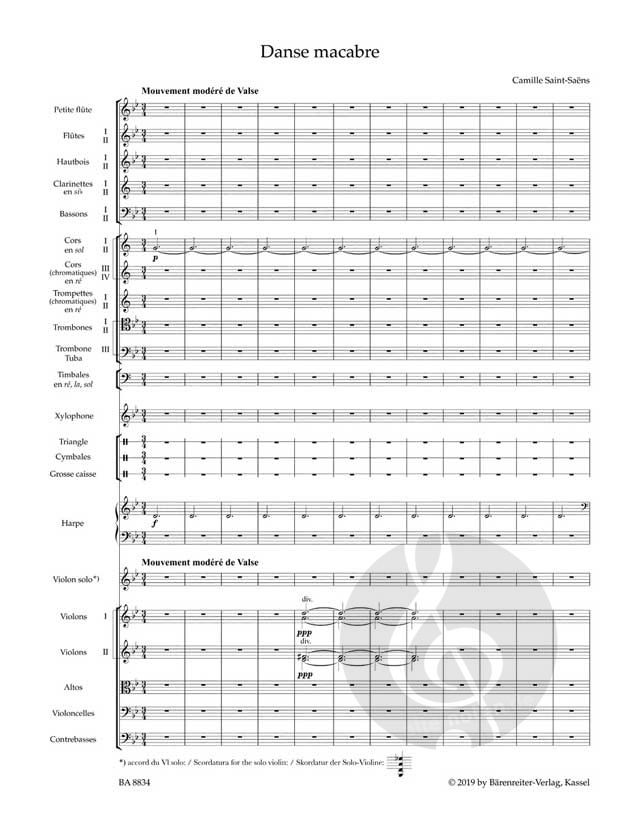
- Score (Urtext)
-
in stock
ships within 1-2 working days - Also available for download!

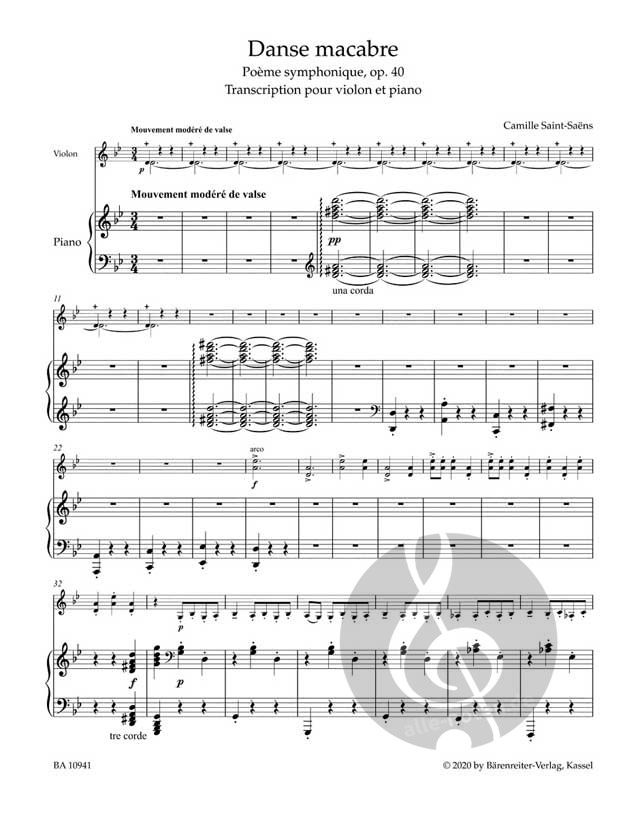
- Violin and Piano
- Instrumental Score & Parts (Download)
-
immediately available
Download immediately after ordering
- Violin and Orchestra
- Score (Urtext) Download
-
immediately available
Download immediately after ordering
- Violin and Orchestra
- Instrumental Part: Violin Solo (Urtext)
-
ships within 2-4 working days
- Violin and Orchestra
- Instrumental Part: Cello (Urtext)
-
ships within 2-4 working days
- Violin and Orchestra
- Instrumental Part: Violin 2 (Urtext)
-
ships within 2-4 working days
- Violin and Orchestra
- Instrumental Part: Viola (Urtext)
-
ships within 2-4 working days
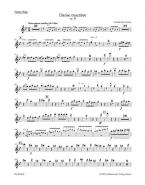
- Violin and Orchestra
- Harmony Parts (Urtext)
-
ships within 2-4 working days
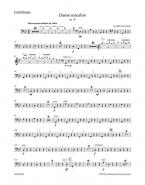
- Violin and Orchestra
- Instrumental Part: Double Bass (Urtext)
-
ships within 2-4 working days