
Wolfgang Amadeus Mozart
Litaniae Lauretanae B. M. V. KV 195 (186d)
Wolfgang Amadeus Mozart
Litaniae Lauretanae B. M. V. KV 195 (186d)
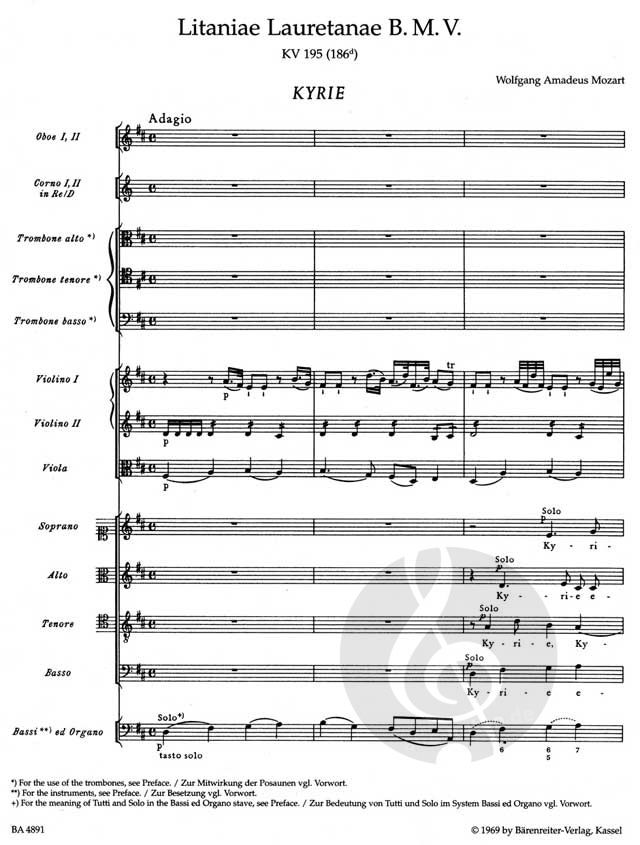
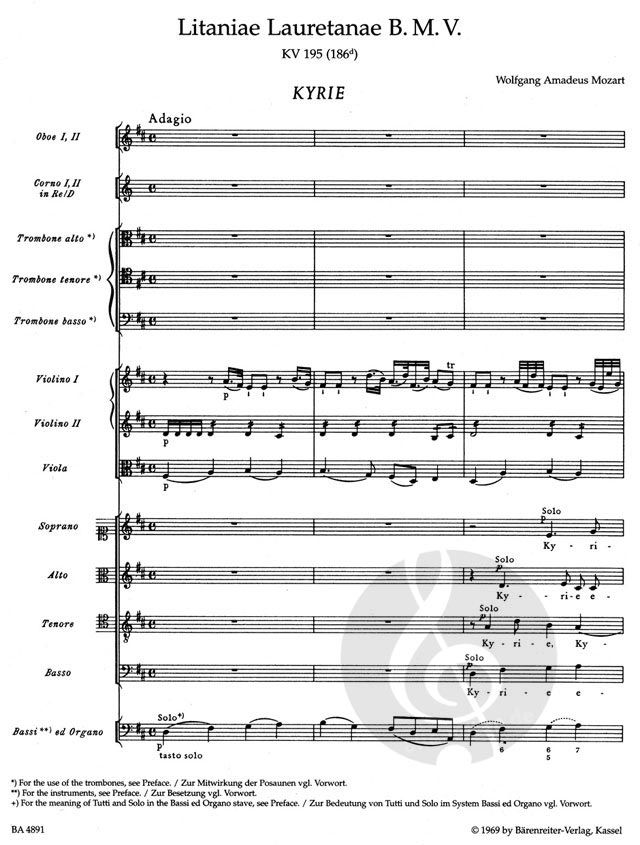
- Instrumentation Soloists, Mixed Choir (SATB), Orchestra and Continuo
- Composer Wolfgang Amadeus Mozart
- Series Bärenreiter Urtext
- Editor Hellmut Federhofer
-
Difficulty Level
- Edition Score (Urtext) Download
- Publisher Bärenreiter Verlag
- Order no. BA4891-DL
 immediately available
Download immediately after ordering
incl. tax,
excl. shipping costs
Not available in all countries. Learn more

Description:
In addition to masses, requiems and vespers, Mozart's larger works of church music include the four litanies, all of which were composed in Salzburg. After returning from his first trip to Italy (December 13, 1769 to March 28, 1771), Mozart resumed his duties as archbishop's concertmaster and - probably still under the spell of his experiences - created his first work in this genre, K. 109 (74e), a Lauretanian Litany, dated May 1771. This was followed between his second stay in Italy (August 13 to December 15, 1771) and the third (October 24, 1772 to March 13, 1773) by the Litany of the Sacraments K. 125, completed in March 1772. Between trips to Vienna and Munich, the second Lauretana K. 195 (186d) was composed during a longer stay in Salzburg in 1774, while the second Litany de venerabili altaris Sacramento K. 243 was completed in March 1776. With this work, Mozart made his last and most extensive contribution to litanic composition.
As the name suggests, the litany, which can already be traced back to early Christian times, is a prayer of supplication in the constant repetition of acclamations on the one hand, and the form of an alternating prayer on the other. While the Lauretana reflects the worship of the Mother of God as an eloquent expression, the Litany of the Sacraments proclaims the praise, veneration and salvific effect of the Eucharist.
As the name suggests, the litany, which can already be traced back to early Christian times, is a prayer of supplication in the constant repetition of acclamations on the one hand, and the form of an alternating prayer on the other. While the Lauretana reflects the worship of the Mother of God as an eloquent expression, the Litany of the Sacraments proclaims the praise, veneration and salvific effect of the Eucharist.