
Wolfgang Amadeus Mozart
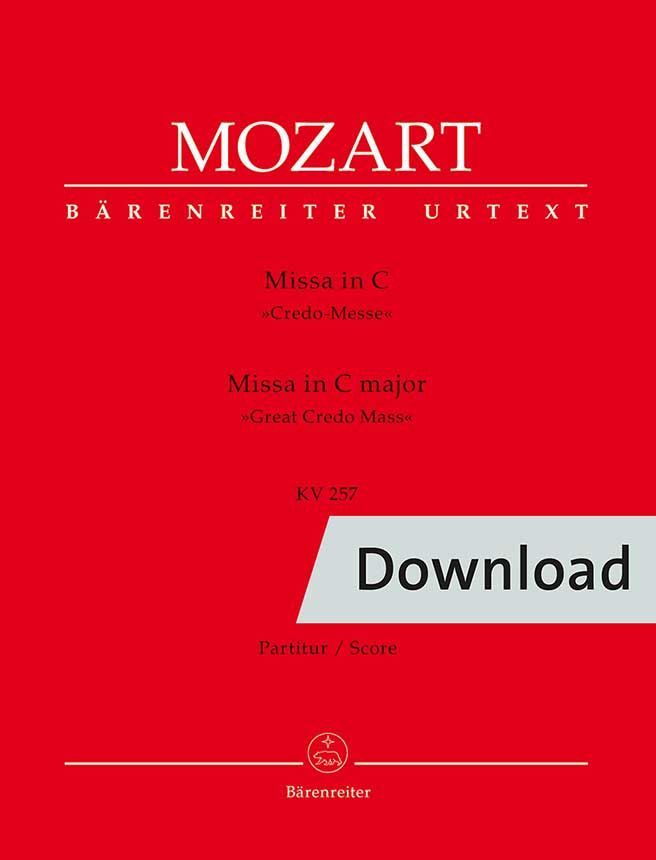
Missa in C major KV 257
Credo Mass
PDF
view
Wolfgang Amadeus Mozart
Missa in C major KV 257
Credo Mass
- Instrumentation Soloists, Mixed Choir (SATB), Organ and Orchestra
- Composer Wolfgang Amadeus Mozart
- Series Bärenreiter Urtext
- Editor Walter Senn
-
Difficulty Level
- Edition Score (Urtext) Download
- Publisher Bärenreiter Verlag
- Order no. BA4859-DL
 immediately available
Download immediately after ordering
incl. tax,
excl. shipping costs
Not available in all countries. Learn more

Description:
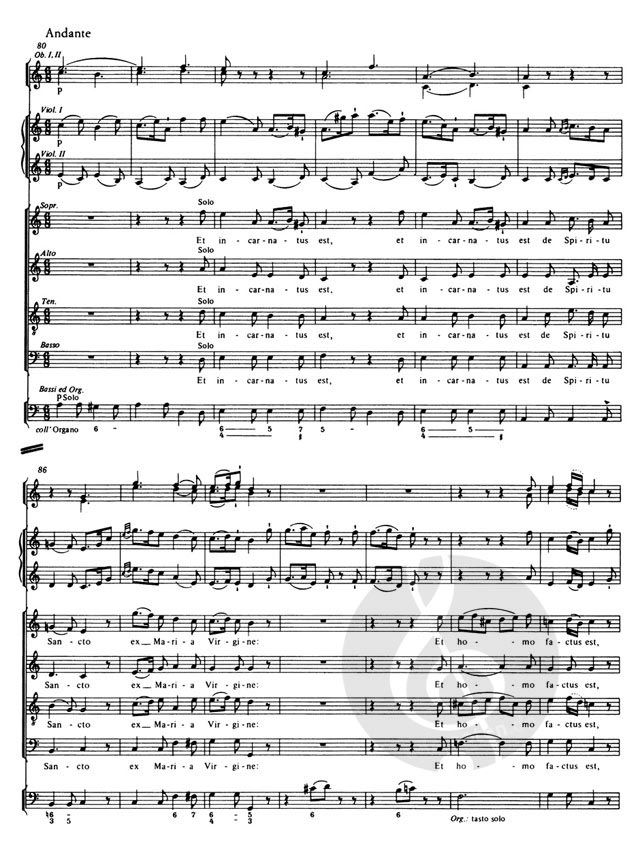
Wolfgang Amadeus Mozart's "Missa in C" K. 257 has been given many nicknames throughout its history. Known as the "Great Credo Mass", Leopold Mozart referred to it as the "Missa longa" due to its length. Mozart usually liked to use the nomenclature "Missa solemnis" for his masses, although he had unknown reasons for not using this title for his "Great Credo Mass". As it was composed on the occasion of the consecration of the Salzburg canon Ignaz Joseph Graf von Spaur, Leopold also called it the "Spaur Mass".
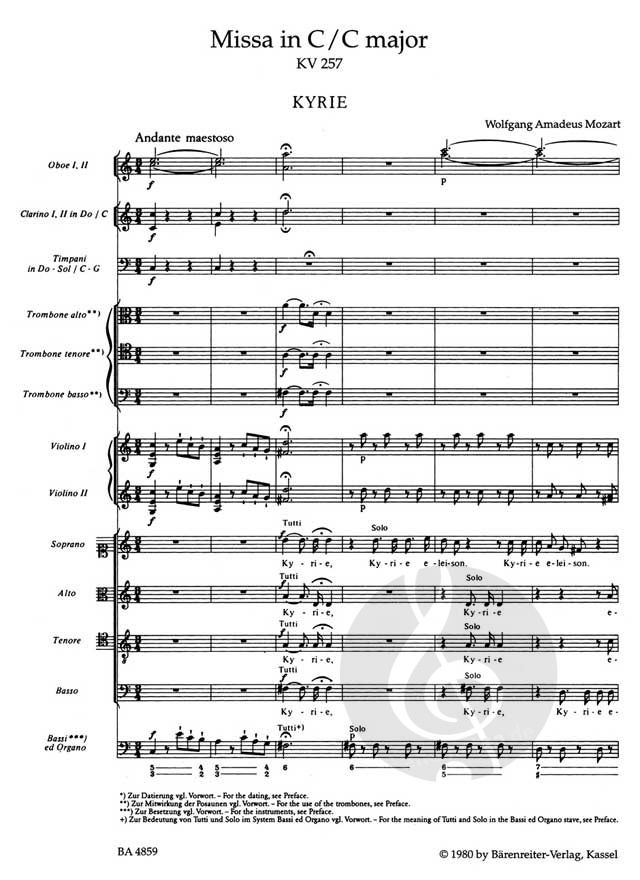
The work was composed at the end of 1776 or at the latest in the first half of 1777 in the usual Baroque tradition, in which three trombones are led in tutti colla parte with alto, tenor and basso.
The separate arrangement of the musicians in Salzburg Cathedral is reminiscent of the polychoral style, in which solo and choral ensembles played separately with one organ each. The soloists and the first organ formed the "concerto", while the choristers and the second organ formed the "ripieno".
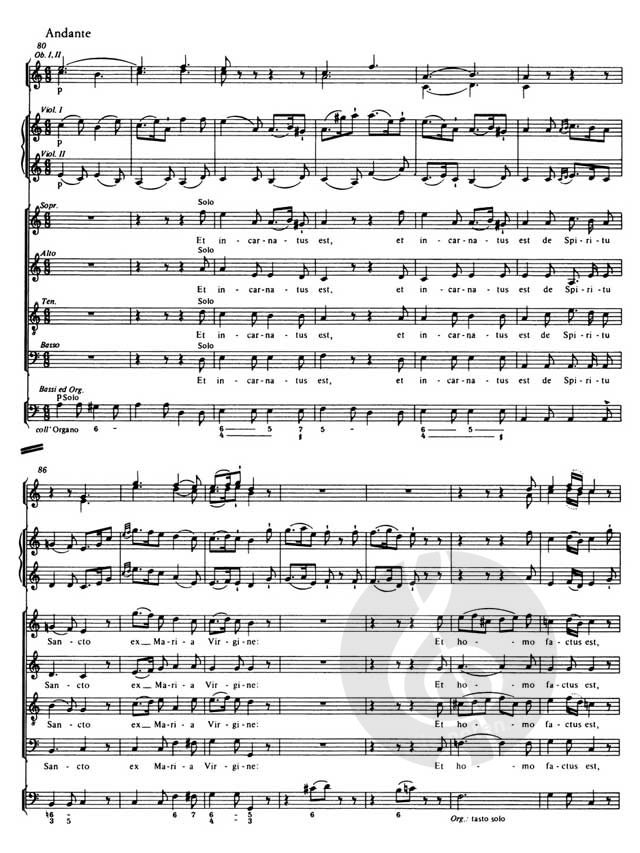
Walter Senn's edition is essentially based on the autograph score and an autograph set of parts - which were subsequently added to and corrected by Wolfgang Amadeus and Leopold Mozart.
The work was composed at the end of 1776 or at the latest in the first half of 1777 in the usual Baroque tradition, in which three trombones are led in tutti colla parte with alto, tenor and basso.
The separate arrangement of the musicians in Salzburg Cathedral is reminiscent of the polychoral style, in which solo and choral ensembles played separately with one organ each. The soloists and the first organ formed the "concerto", while the choristers and the second organ formed the "ripieno".
Walter Senn's edition is essentially based on the autograph score and an autograph set of parts - which were subsequently added to and corrected by Wolfgang Amadeus and Leopold Mozart.
Related products:
Here is how the download works:
1 Buy download sheet music
Purchase the download score from our online store
2 Order confirmation with download link
Immediately after completing your order, you will receive an order confirmation by email listing all items. You will find the download link next to each item. You can use this link to start the download right away. Please also check your spam folder if necessary.
Customers rated this product:
Manufacturer Information:
Bärenreiter-Verlag Karl Vötterle GmbH & Co. KG
Heinrich-Schütz-Allee 35-37
34131
Kassel
Deutschland
Other customers also bought:
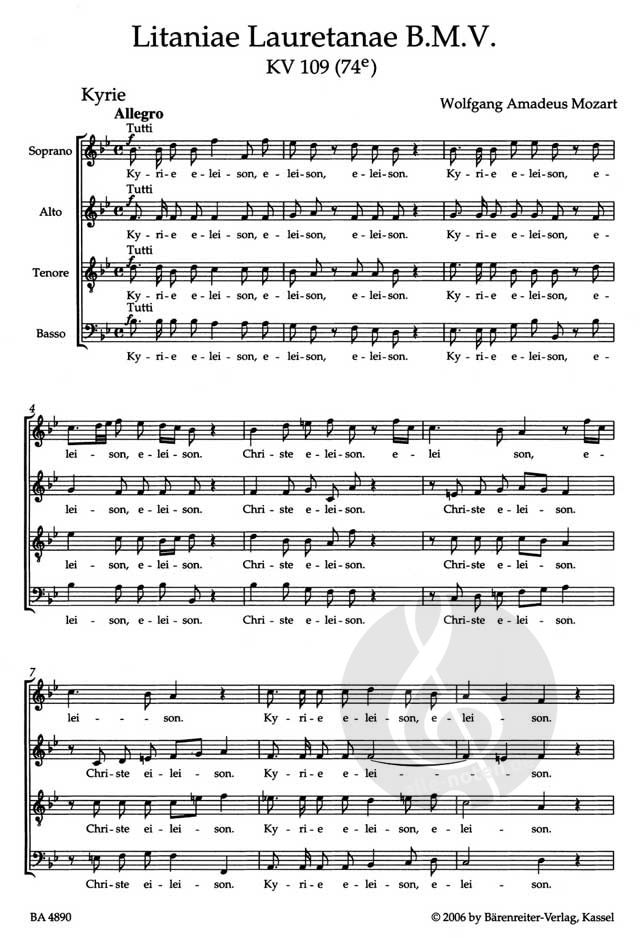
Wolfgang Amadeus Mozart
- Soloists, Mixed Choir (SATB), 3 Trombones, Strings and Organ
- Score (Urtext)
-
ships within 2-4 working days
- Also available for download!