
Carl Maria von Weber
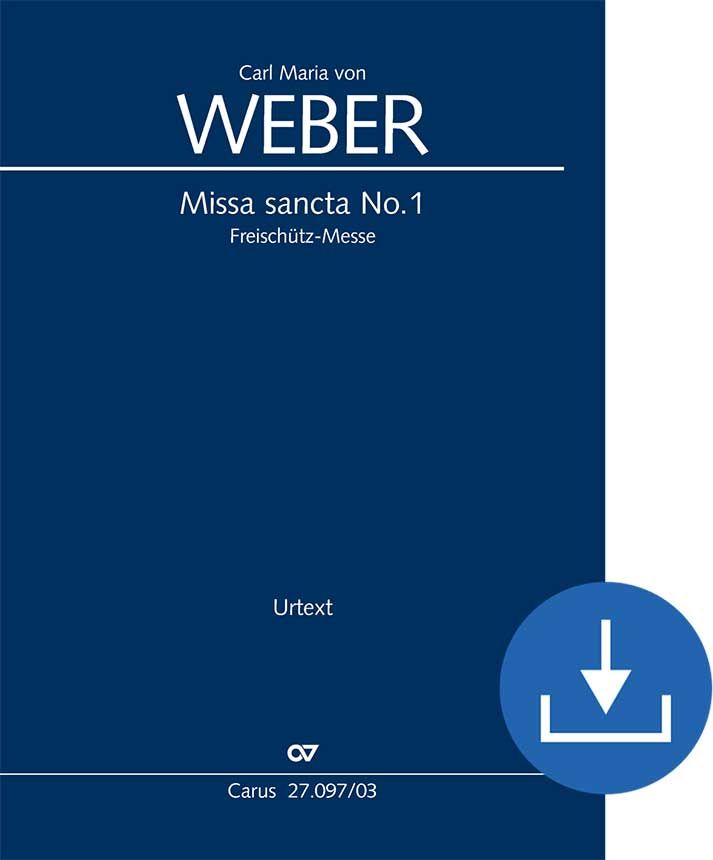
Missa sancta No. 1 E-flat major WeV A.2
Freischütz Mass
PDF
1
view
PDF
2
view
Carl Maria von Weber
Missa sancta No. 1 E-flat major WeV A.2
Freischütz Mass
- Instrumentation Soloists (SATB), Mixed Choir (SATB) and Orchestra
- Composer Carl Maria von Weber
- Editor Karin Wollschläger
-
Difficulty Level
- Edition Piano Reduction Download
- Publisher Carus-Verlag
- Order no. CV27097-03-DL
 immediately available
Download immediately after ordering
incl. tax,
excl. shipping costs
Not available in all countries. Learn more

Description:
Weber's "Missa sancta No. 1" in E flat major is also known as the "Freischütz Mass", as he composed it in 1818 while working on the opera of the same name. The mass already enjoyed great popularity among his contemporaries and is still an attractive work today. Composed at an easy to medium level of difficulty, the mass is a great addition to the repertoire for any mixed choir with orchestra.
In the mass, Weber took special account of local circumstances: he took the liturgical practice of the Dresden court into consideration by adding an offertorium to the mass's ordinarium movements and designed this as a bravura aria, which was tailor-made for the Dresden star soprano Filippo Sassaroli. Due to the strong reverberation of the Hofkirche, he also refrained from rapid changes of harmony. Although the mass was considered too "operatic" by critics, both the public and the king liked it. - First practical edition, first commercially available performance material - Easy to medium level of difficulty - Mass text extended by an offertorium in accordance with the liturgical practice of the Dresden court at the time
In the mass, Weber took special account of local circumstances: he took the liturgical practice of the Dresden court into consideration by adding an offertorium to the mass's ordinarium movements and designed this as a bravura aria, which was tailor-made for the Dresden star soprano Filippo Sassaroli. Due to the strong reverberation of the Hofkirche, he also refrained from rapid changes of harmony. Although the mass was considered too "operatic" by critics, both the public and the king liked it. - First practical edition, first commercially available performance material - Easy to medium level of difficulty - Mass text extended by an offertorium in accordance with the liturgical practice of the Dresden court at the time
Related products:
Here is how the download works:
1 Buy download sheet music
Purchase the download score from our online store
2 Order confirmation with download link
Immediately after completing your order, you will receive an order confirmation by email listing all items. You will find the download link next to each item. You can use this link to start the download right away. Please also check your spam folder if necessary.
Customers rated this product:
Manufacturer Information:
Carus-Verlag GmbH & Co. KG
Sielminger Str. 51
70771
Leinfelden-Echterdingen
Deutschland
Other customers also bought:
Johann Sebastian Bach
Kantate BWV 27 zum 16. Sonntag nach Trinitatis
- Soloists, Mixed Choir (SATB) and Chamber Orchestra
- Piano Reduction
-
in stock
ships within 1-2 working days - Also available for download!
Johann Kuhnau
with insertion movements for performances over Christmas - Urtext
- Mixed Choir (SSATB) and Orchestra
- Piano Reduction (Urtext)
-
in stock
ships within 1-2 working days
Johann Ernst Eberlin
- Mixed Choir (SATB) and Continuo
- Score
-
ships within 4-8 working days

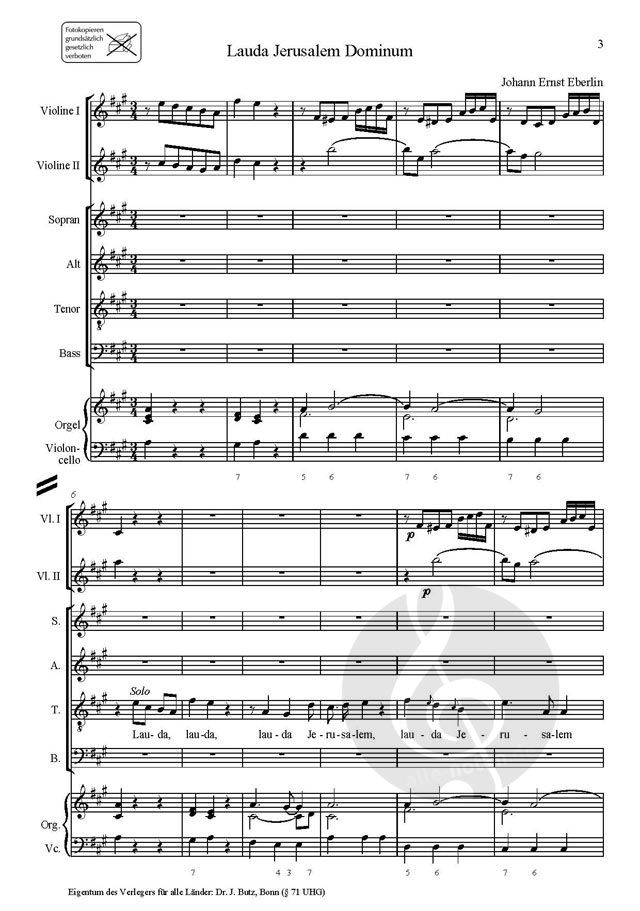
Johann Ernst Eberlin
für Soli, SATB, 2 Vl, Vc und Orgel Text nach Psalm 147 'Lobe den Herrn, Jerusalem'
- Soloists, Mixed Choir (SATB), 2 Violins, Cello and Organ
- Score
-
ships within 3-6 working days

- Mixed Choir and Orchestra
- Piano Reduction
-
ships within 4-8 working days
- Soloists (SATB), Mixed Choir (SATB), Organ and Orchestra
- Score
-
in stock
ships within 1-2 working days
Johann Ernst Eberlin
- Soloists, Mixed Choir (SATB), 2 Trumpets, Timpani, 2 Violins, Viola and Continuo
- Score
-
ships within 2-5 working days
Johann Ernst Eberlin
Soli SATB, Chor SATB, 2 Violinen und Gb
- Soloists (SATB), Mixed Choir (SATB), 2 Violins and Continuo
- Score
-
ships within 3-6 working days
Christoph Rheineck
- Mixed Choir (SATB) and Orchestra
- Score
-
in stock
ships within 1-2 working days
- Soloists, Mixed Choir, Childrens' Choir, Orchestra and Organ
- Piano Reduction
-
ships within 4-8 working days
Johann Sebastian Bach
Cantata BWV 212 For soli SB, mixed choir SB and orchestra
- 2 Soloists, Mixed Choir (SATB) and Orchestra
- Score
-
ships within 2-5 working days

- Soloists, Mixed Choir (SATB) and Chamber Orchestra
- Piano Reduction
-
in stock
ships within 1-2 working days
- Soloists (SATB), Mixed Choir (SATB) and Orchestra
- Score
-
ships within 2-5 working days
- Also available for download!
- Soloists and Piano
- Sheet Music
-
in stock
ships within 1-2 working days