
Daniel Friedrich Eduard Wilsing
Symphony in D Major
for orchestra
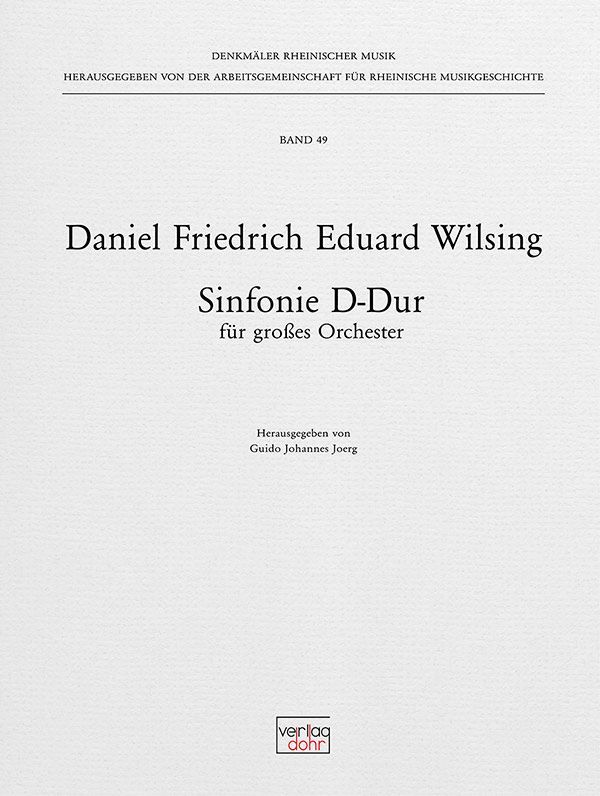
Daniel Friedrich Eduard Wilsing
Symphony in D Major
for orchestra
- Instrumentation Orchestra
- Composer Daniel Friedrich Eduard Wilsing
- Editor Guido Johannes Joerg
- Edition Score
- Publisher Musikverlag Christoph Dohr
- Order no. DOHR30816
 ships within 2-5 working days
incl. tax,
excl. shipping costs
Not available in all countries. Learn more

Description:
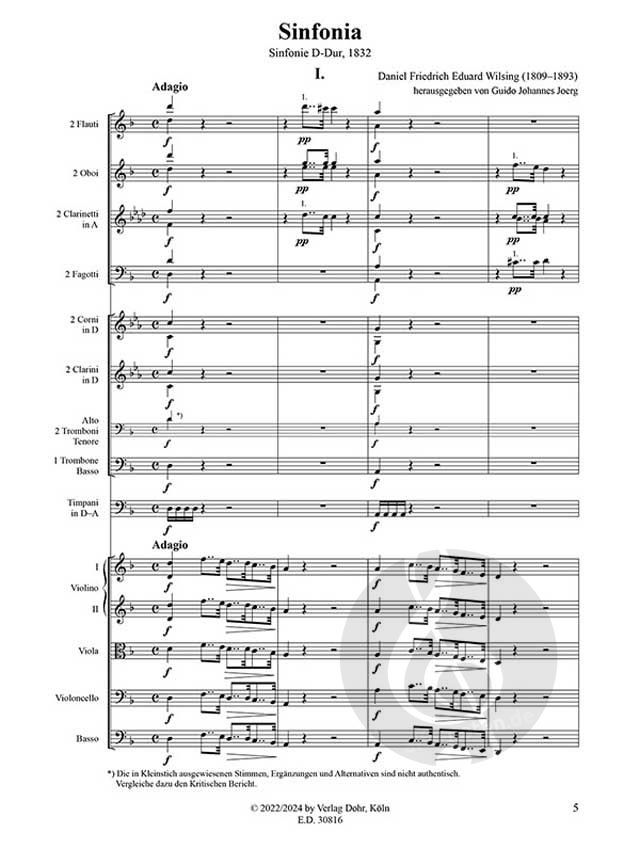
The (only) symphony by Daniel Friedrich Eduard Wilsing was written in Wesel, where the composer worked as a church musician. In November 1832, Wilsing made a fair copy. The work was almost certainly intended for a performance in Dortmund, where Wilsing maintained the best relations with a symphonic orchestra with the "Liebhaber-Concert-Gesellschaft". In fact, there was also a performance in Dortmund, but only almost a decade after the completion and writing of the work.
Wilsing's Sinfonia is a beautiful, well-crafted work, grateful for performers and audience alike. As a work of art, it is quite comparable to the two symphonies of Carl Maria von Weber from 1806/1807, to the early symphonies of Franz Schubert (from 1813) and, above all, to the string symphonies of the young Felix Mendelssohn Bartholdy - namely his Sinfonia No. 8 of 1822/1823, which is also in D major. The present first edition is a modern music-critical first edition, carefully edited according to the only available source, which comes up with a historical classification (afterword) and a critical report. (Guido Johannes Joerg)
Wilsing's Sinfonia is a beautiful, well-crafted work, grateful for performers and audience alike. As a work of art, it is quite comparable to the two symphonies of Carl Maria von Weber from 1806/1807, to the early symphonies of Franz Schubert (from 1813) and, above all, to the string symphonies of the young Felix Mendelssohn Bartholdy - namely his Sinfonia No. 8 of 1822/1823, which is also in D major. The present first edition is a modern music-critical first edition, carefully edited according to the only available source, which comes up with a historical classification (afterword) and a critical report. (Guido Johannes Joerg)