
Camille Saint-Saëns
La Muse et le Poète op. 132
for violin, violoncello string orchestra with timpani ad lib.
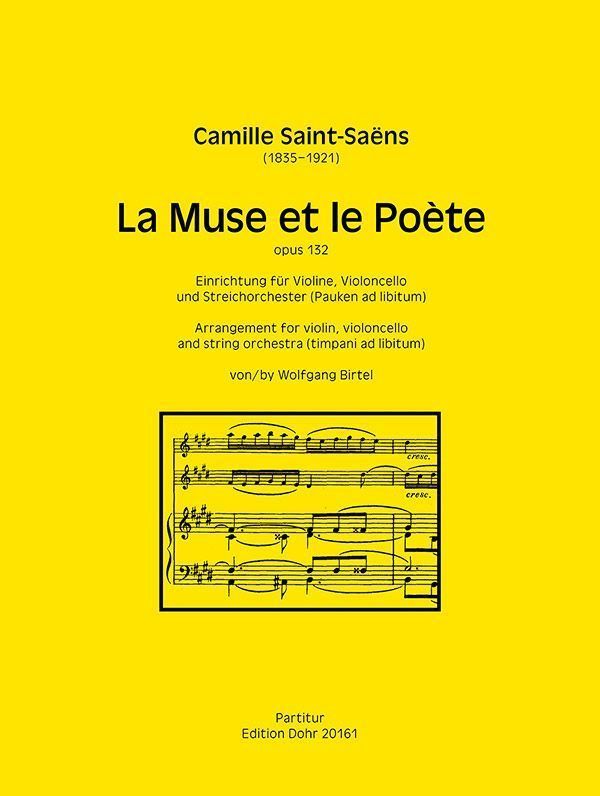
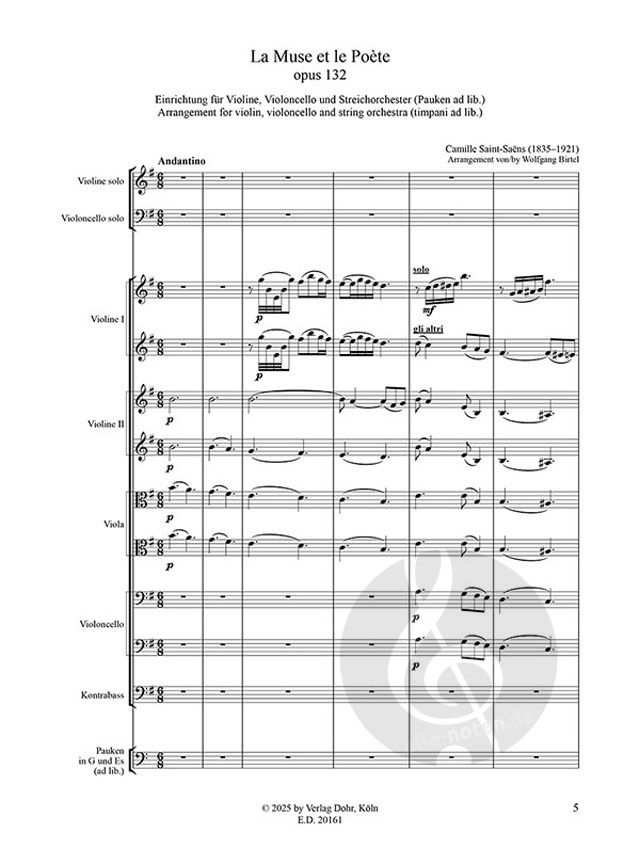
Camille Saint-Saëns
La Muse et le Poète op. 132
for violin, violoncello string orchestra with timpani ad lib.
- Instrumentation String Duet (Violin and Cello) and String Orchestra
- Optional Instrumentation Viola, Cello, Timpani and String Orchestra
- Composer Camille Saint-Saëns
- Editor Wolfgang Birtel
- Edition Score
- Publisher Musikverlag Christoph Dohr
- Order no. DOHR20161
 ships within 2-5 working days
incl. tax,
excl. shipping costs
Not available in all countries. Learn more

Description:
La Muse et le poète op. 132 occupies a special place in Camille Saint-Saëns' oeuvre. In the fall of 1909, the composer reported to the cellist Joseph Hollmann on initial sketches for a duo (for violin and cello), which he completed in December - in the version with piano. The dialog between the muse (violin) and the poet (cello) is dedicated "à la mémoire de Madame Julie-Henry Carruette" (1844-1908). She had commissioned a statue of the musician, which was unveiled at the Théâtre Dieppe on October 27, 1907. When she died the following year, Saint-Saëns was very upset.
The Duo, a work from the composer's late period, was premiered in the version for violin, cello and piano on June 7, 1910 in London's Queen's Hall with Eugène Ysaÿe (violin) and Joseph Hollmann (cello) and with the composer at the piano. The concertante work was performed with great success by the public, but was also criticized by some critics for its virtuosity, although Saint-Saëns had expressly intended "a conversation between the two instruments, and not a contest between virtuosos". (Wolfgang Birtel)
This arrangement was commissioned for the "Kronberg Academy Festival 2013" and was premiered on October 3, 2013 by Hyeyoon Park (violin), Gary Hoffman (cello) and the Kremerata Baltica (cond. Christian Kluxen).
The orchestral part set is 6/5/4/3/2-Pk. The solo parts are included in the new edition of the piano version published by Edition Dohr (E.D. 20161), which also serves as a piano reduction of the arrangement.
The Duo, a work from the composer's late period, was premiered in the version for violin, cello and piano on June 7, 1910 in London's Queen's Hall with Eugène Ysaÿe (violin) and Joseph Hollmann (cello) and with the composer at the piano. The concertante work was performed with great success by the public, but was also criticized by some critics for its virtuosity, although Saint-Saëns had expressly intended "a conversation between the two instruments, and not a contest between virtuosos". (Wolfgang Birtel)
This arrangement was commissioned for the "Kronberg Academy Festival 2013" and was premiered on October 3, 2013 by Hyeyoon Park (violin), Gary Hoffman (cello) and the Kremerata Baltica (cond. Christian Kluxen).
The orchestral part set is 6/5/4/3/2-Pk. The solo parts are included in the new edition of the piano version published by Edition Dohr (E.D. 20161), which also serves as a piano reduction of the arrangement.
Related products:
Customers rated this product:
Manufacturer Information:
MV Christoph Dohr
Kasselberger Weg 120
50769
Köln
Deutschland
Other customers also bought:
Camille Saint-Saëns
for violin, violoncello string orchestra with timpani ad lib.
- String Duet (Violin and Cello) and String Orchestra
- Set of Parts
- Wolfgang Birtel
-
ships within 2-5 working days