
Antonio de Cabezón
Selected Works for Keyboard Instruments 3
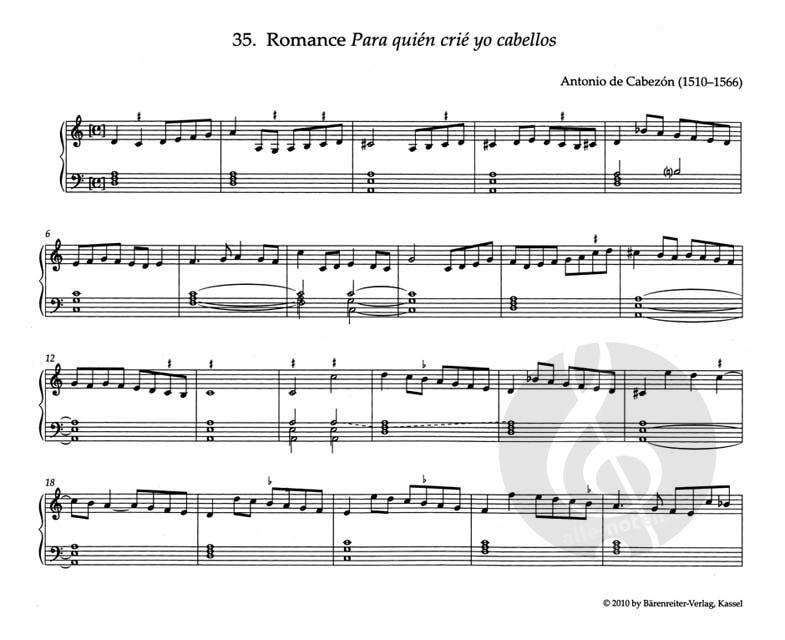
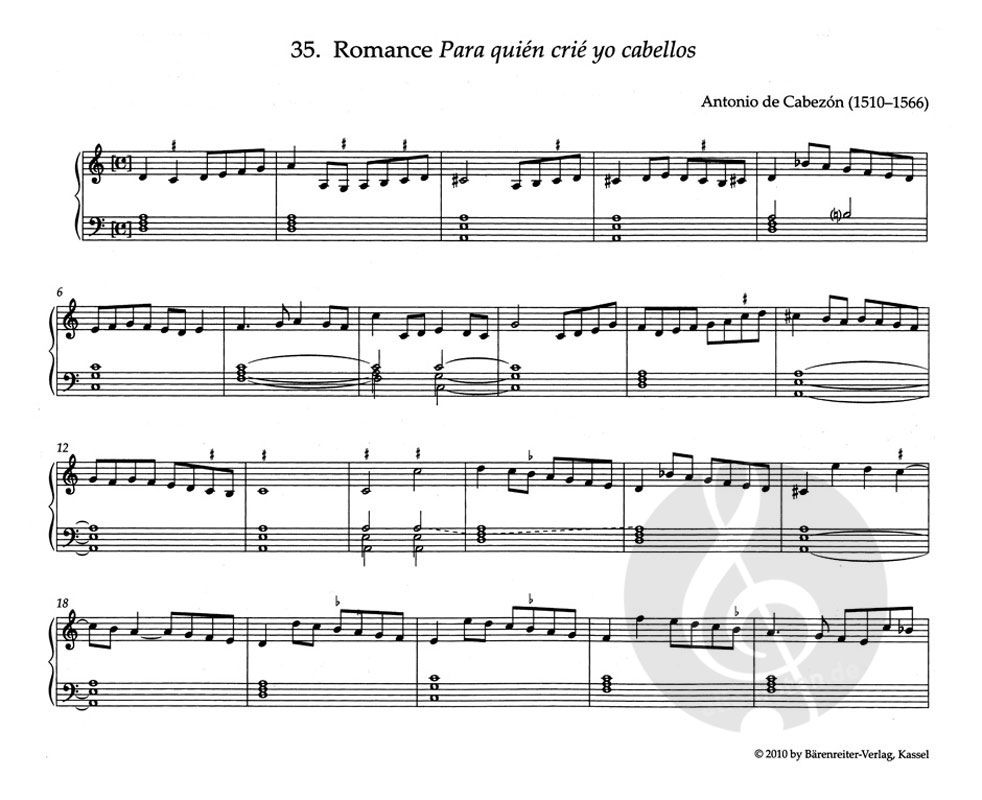
Antonio de Cabezón
Selected Works for Keyboard Instruments 3
- Instrumentation Organ
- Optional Instrumentation Piano
- Composer Antonio de Cabezón
- Series Bärenreiter Urtext
- Editor Gerhard Doderer Miguel Bernal Ripoll
- Edition Sheet Music Download
- Publisher Bärenreiter Verlag
- Order no. BA9263-DL
 immediately available
Download immediately after ordering
incl. tax,
excl. shipping costs
Not available in all countries. Learn more

Description:
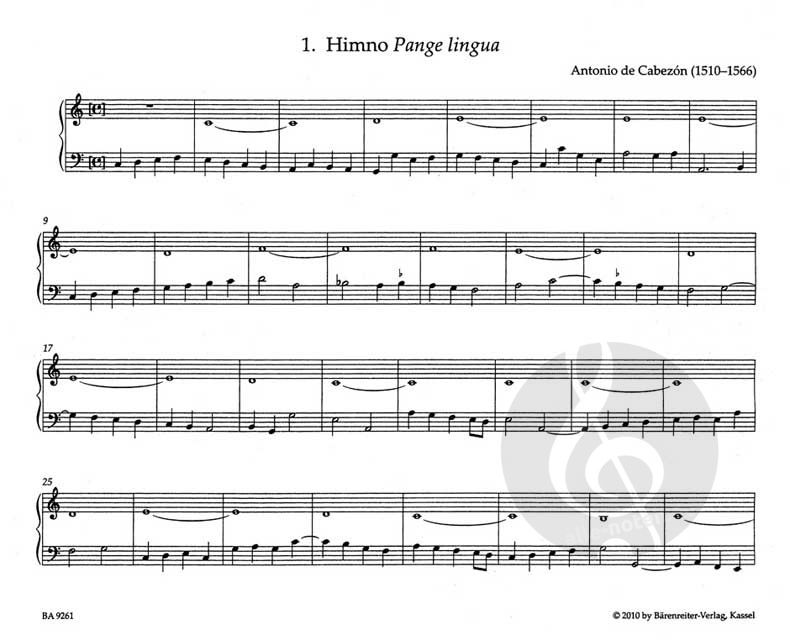
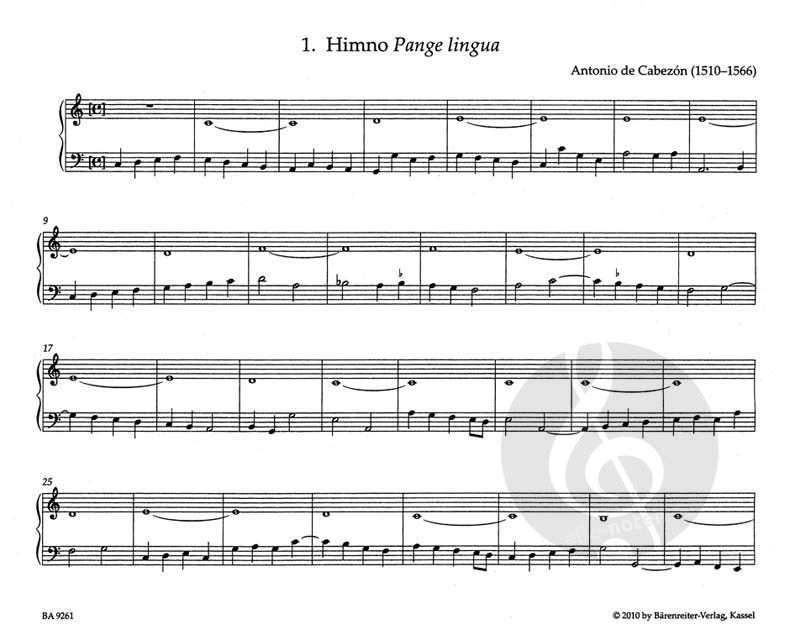
The court organist Antonio de Cabezón, who was appointed to Queen Isabella's court chapel in Toledo at the age of 16, is rightly regarded by his contemporaries as the most important Spanish organist and harpsichordist of the 16th century.
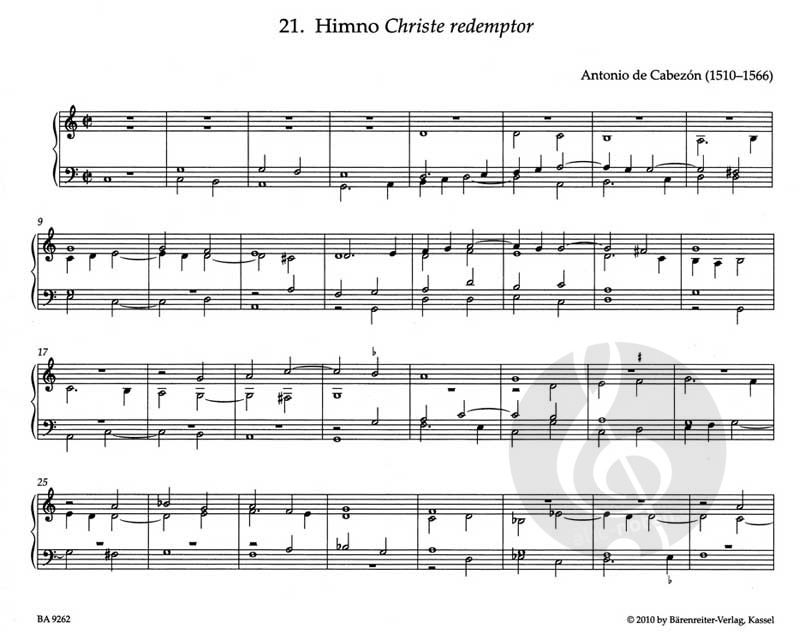
His hymns and verses are based on short, ornate harmonizations of psalm tones. In the tientos, the transition from the vocal motet style to a setting adapted to the keyboard instrument is perfectly accomplished.
Existing editions of Cabezón's works are difficult to access and only available in a graphically unappealing presentation.
This four-volume critical and practical edition of selected works by editors who teach at Portuguese and Spanish universities and are eminent experts on Cabezón's works contains the composer's best-known works; it reflects the latest state of scholarly knowledge. Each volume contains a preface with notes on editing techniques and performance practice as well as a critical report with a list of sources.
His hymns and verses are based on short, ornate harmonizations of psalm tones. In the tientos, the transition from the vocal motet style to a setting adapted to the keyboard instrument is perfectly accomplished.
Existing editions of Cabezón's works are difficult to access and only available in a graphically unappealing presentation.
This four-volume critical and practical edition of selected works by editors who teach at Portuguese and Spanish universities and are eminent experts on Cabezón's works contains the composer's best-known works; it reflects the latest state of scholarly knowledge. Each volume contains a preface with notes on editing techniques and performance practice as well as a critical report with a list of sources.
Here is how the download works:
1 Buy download sheet music
Purchase the download score from our online store
2 Order confirmation with download link
Immediately after completing your order, you will receive an order confirmation by email listing all items. You will find the download link next to each item. You can use this link to start the download right away. Please also check your spam folder if necessary.
Customers rated this product:
Manufacturer Information:
Bärenreiter-Verlag Karl Vötterle GmbH & Co. KG
Heinrich-Schütz-Allee 35-37
34131
Kassel
Deutschland
Related products:

- Organ
- Sheet Music Download
- Bärenreiter Verlag
-
immediately available
Download immediately after ordering - Instant download
- Organ
- Sheet Music Download
- Bärenreiter Verlag
-
immediately available
Download immediately after ordering - Instant download
- Organ
- Sheet Music
- Bärenreiter Verlag
-
ships within 2-4 working days
- Also available for download!
- Organ
- Sheet Music
- Bärenreiter Verlag
-
ships within 2-4 working days
- Also available for download!
Other customers also bought:
Johann Sebastian Bach
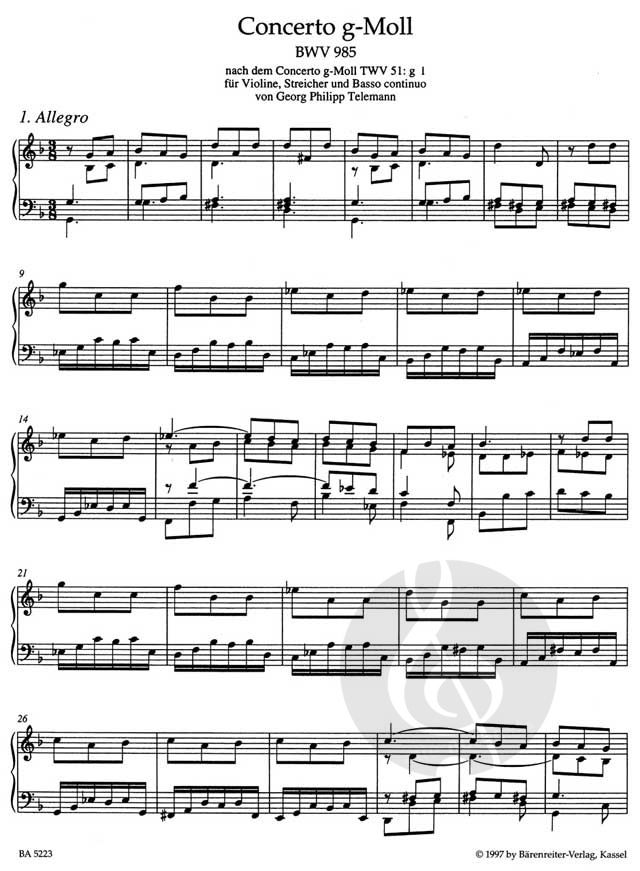
Five Concerti after Vivaldi and others/Two Sonatas, Fugue after Reinken
- Piano
- Sheet Music (Urtext)
-
in stock
ships within 1-2 working days - Also available for download!
Antonio de Cabezón
- Organ
- Sheet Music
-
ships within 2-4 working days
- Also available for download!
- Piano
- Sheet Music (Urtext)
-
in stock
ships within 1-2 working days - Also available for download!
Jean-Philippe Rameau
- Piano
- Sheet Music
-
in stock
ships within 1-2 working days - Also available for download!