
Ludwig van Beethoven
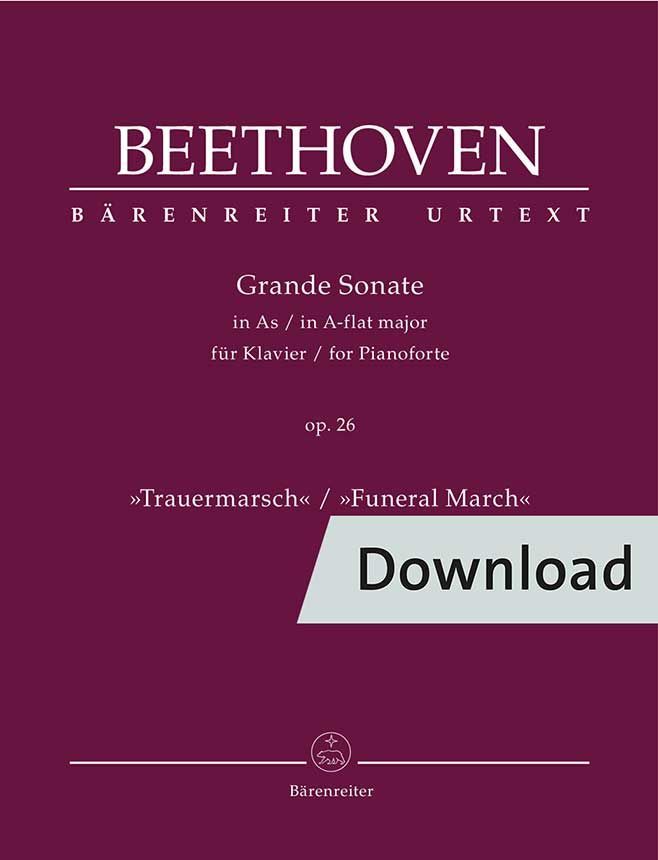
Grande Sonata in A flat op. 26
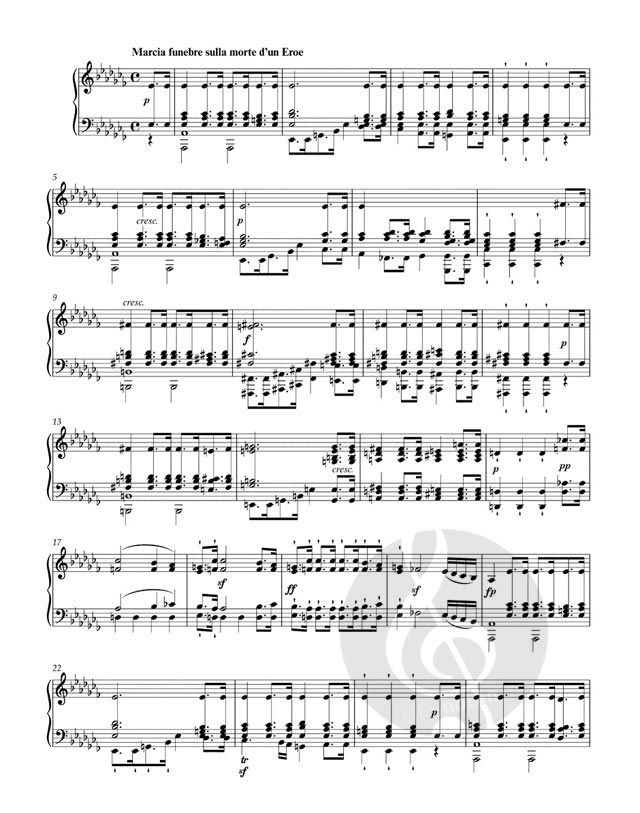
'Funeral March' for piano
PDF
view
Ludwig van Beethoven
Grande Sonata in A flat op. 26
'Funeral March' for piano
- Instrumentation Piano
- Composer Ludwig van Beethoven
- Series Bärenreiter Urtext
- Editor Jonathan Del Mar
-
Difficulty Level
- Edition Sheet Music Download (Urtext)
- Publisher Bärenreiter Verlag
- Order no. BA11804-DL
 immediately available
Download immediately after ordering
incl. tax,
excl. shipping costs
Not available in all countries. Learn more

Description:
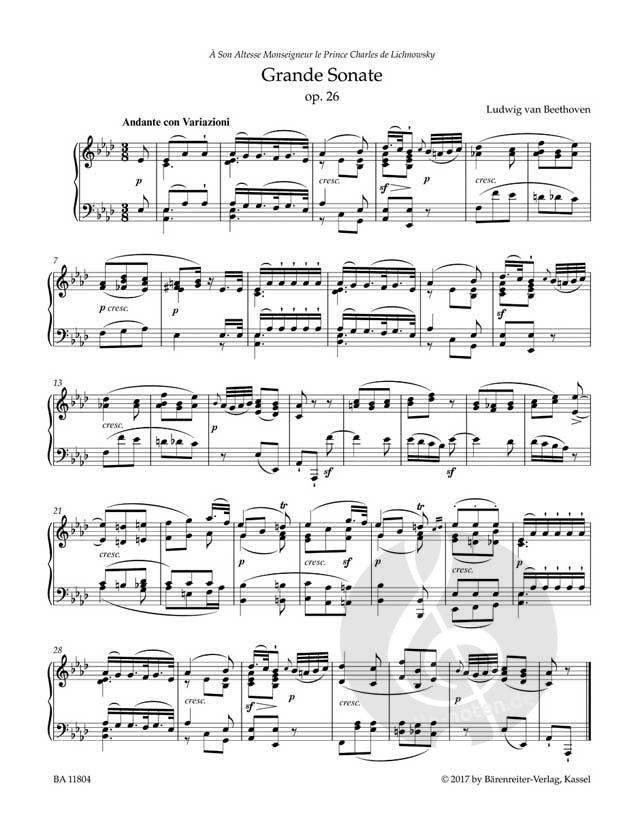
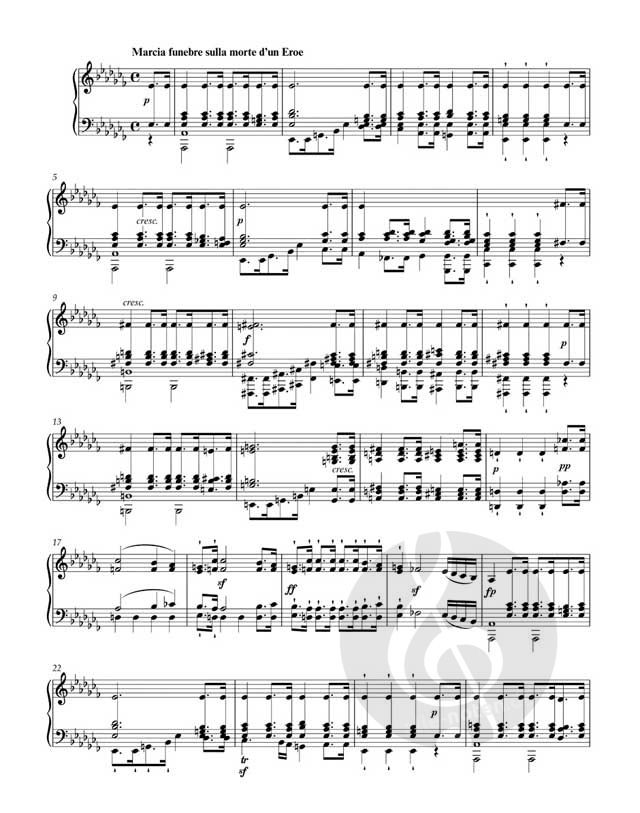
Beethoven's four-movement Sonata in A flat major op. 26 is one of his most popular works. It is dedicated to Prince Karl von Lichnowsky, one of his most important patrons, to whom Beethoven also dedicated the "Grande Sonate pathétique" op. 13 (BA 10851) and the Second Symphony op. 35. The demanding sonata, whose first drafts date from 1800/01 and which appeared in March 1802, is formally very varied: it begins with a variation movement and contains the famous Marcia funebre sulla morte d'un Eroe in third place, to which it also owes its nickname "Sonata with the funeral march". Who this hero was, however, is still unknown today. Arranged for orchestra, the funeral march was played at Beethoven's funeral on 29 March 1827.
In order to identify all the subtleties of Beethoven's notation, in particular many questionable bowings, Jonathan Del Mar was probably one of the first editors of modern editions to consult the original autograph of the sonata for the Bärenreiter edition. The result is a highly reliable and conscientiously edited musical text, in whose critical commentary all readings and editorial decisions are precisely documented. An elegant musical notation with practical turnarounds and informative notes on central questions of historical performance practice (pedalization, ornamentation, tempo, dynamics, articulation) are also a matter of course for this new edition.
In order to identify all the subtleties of Beethoven's notation, in particular many questionable bowings, Jonathan Del Mar was probably one of the first editors of modern editions to consult the original autograph of the sonata for the Bärenreiter edition. The result is a highly reliable and conscientiously edited musical text, in whose critical commentary all readings and editorial decisions are precisely documented. An elegant musical notation with practical turnarounds and informative notes on central questions of historical performance practice (pedalization, ornamentation, tempo, dynamics, articulation) are also a matter of course for this new edition.
Here is how the download works:
1 Buy download sheet music
Purchase the download score from our online store
2 Order confirmation with download link
Immediately after completing your order, you will receive an order confirmation by email listing all items. You will find the download link next to each item. You can use this link to start the download right away. Please also check your spam folder if necessary.
Customers rated this product:
Manufacturer Information:
Bärenreiter-Verlag Karl Vötterle GmbH & Co. KG
Heinrich-Schütz-Allee 35-37
34131
Kassel
Deutschland
Related products:

- Piano
- Sheet Music (Urtext)
- Bärenreiter Verlag
-
-
ships within 2-4 working days
- Also available for download!
Other customers also bought:

- Piano and Orchestra
- Piano Reduction (Urtext)
- András Schiff
-
in stock
ships within 1-2 working days

- Piano
- Sheet Music (Urtext)
-
ships within 2-4 working days
- Also available for download!
- Piano
- Sheet Music (Urtext)
-
in stock
ships within 1-2 working days - Also available for download!

- Piano
- Sheet Music (Urtext)
-
ships within 2-4 working days
- Also available for download!

- Piano
- Sheet Music (Urtext)
- Joachim Draheim Günter Ludwig
-
in stock
ships within 1-2 working days
- Piano
- Sheet Music (Urtext)
- Ernst Herttrich
-
in stock
ships within 1-2 working days

- Piano
- Sheet Music (Urtext)
-
in stock
ships within 1-2 working days

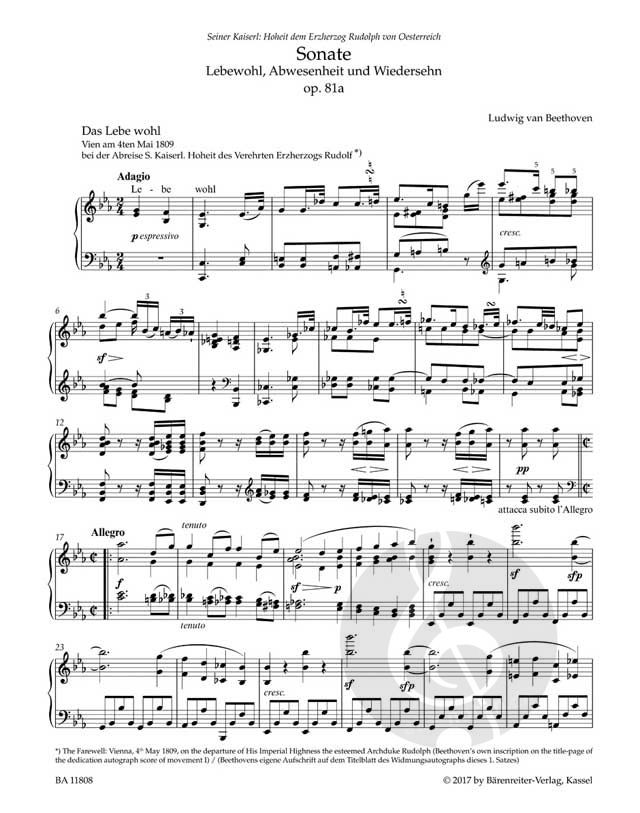
Ludwig van Beethoven
Lebewohl, Abwesenheit und Wiedersehn
- Piano
- Sheet Music (Urtext)
-
ships within 2-4 working days
- Also available for download!

- Piano
- Sheet Music (Urtext)
-
in stock
ships within 1-2 working days
Ludwig van Beethoven
- Piano
- Sheet Music (Urtext)
- Murray Perahia
-
in stock
ships within 1-2 working days

- Piano
- Sheet Music (Urtext)
-
in stock
ships within 1-2 working days - Also available for download!

- 2 Pianos 4 Hands
- Piano Reduction (Urtext)
-
in stock
ships within 1-2 working days

- 2 Pianos 4 Hands
- Piano Reduction (Urtext)
-
in stock
ships within 1-2 working days

Benjamin Britten
- 2 Pianos 4 Hands
- Piano Reduction
-
in stock
ships within 1-2 working days


- Piano
- Sheet Music (Urtext)
-
in stock
ships within 1-2 working days - Also available for download!