
pian é forte
Women Composers through the Centuries - Music for Piano
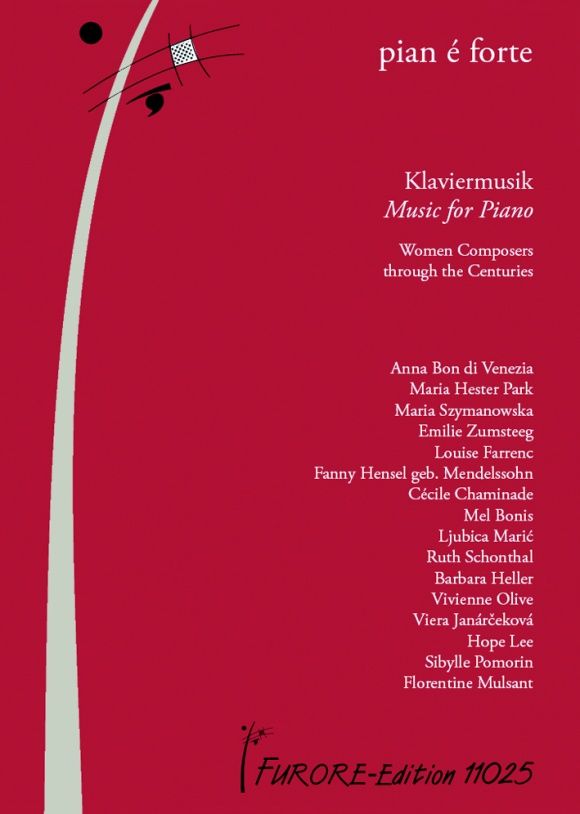
pian é forte
Women Composers through the Centuries - Music for Piano
- Instrumentation Piano
-
Difficulty Level
- Edition Sheet Music
- Publisher Furore Verlag
- Order no. FUR11025
 in stock
ships within 1-2 working days
incl. tax,
excl. shipping costs
Not available in all countries. Learn more

Description:
It was the editor’s intent to place before the performer pieces enjoyable to play, pieces easy to enjoy, and pieces not terribly difficult to execute. Ordered chronologically, like its anniversary companion above, the works are suitable for the intermediate pianist, with a bit of wiggle-room on either side: some are a little easier than intermediate level, some are a little harder. All of the compositions are thoughtfully edited. …
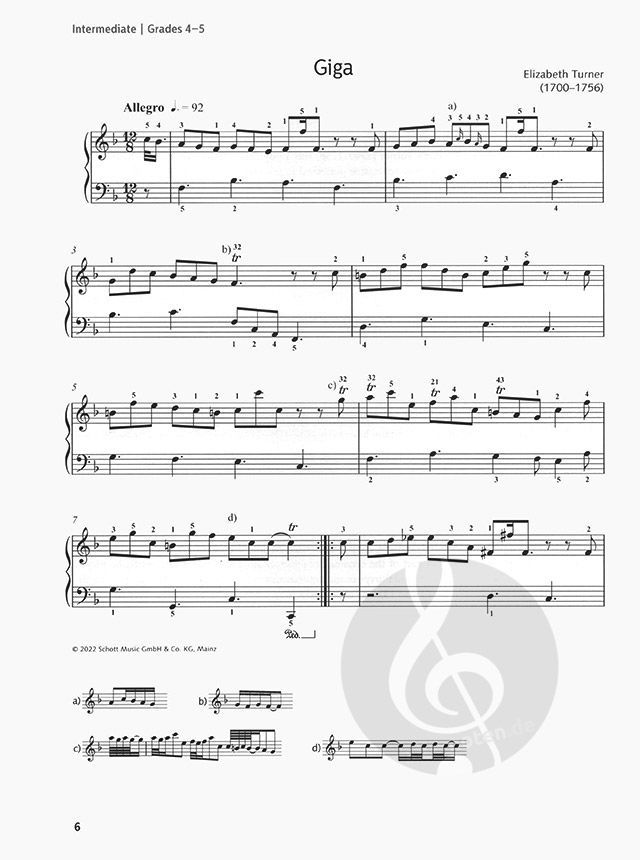
The compositions shows a wide range of atmosphere and required touch. There are dances (Contre-danse by Szymanowska, Polonaise by Zumsteeg, Marche Russe by Chaminade, and Bush Gin Rag by Olive); mood pieces (Nocturne by Farren and Klavierstück by Hensel); and even one that includes improvisatory passages and a Turkish air. The piano and vocal volumes are equally compelling purchases. Ellen Grolman, Journal of the IAWM, Vol. 17, Nr. 2, 2011
The pianoforte, the keyboard instrument which can be played both softly and loudly, was so called because it was such a ground-breaking invention. It has outstripped every other instrument, in that there is no other for which so much music has been written. Although English and French use the familiar short form "piano", this is not to suggest that it is only played softly. The German "Klavier" likewise lacks any allusion to the crucial contrast of forte and piano. It is simply taken for granted and requires no further mention. However, the more we thought about this universal instrument, the more we were inspired to select some pieces which owe their genesis to this polarity of piano and forte.
In anniversary mood – 25 years of Furore Verlag – we cast our collective eye back, celebrating 250 years of the pianoforte with piano pieces which place particular emphasis on the sense of tone. The fact that the tone can only be influenced by touch, and not by any mechanical device, means that music can be performed on different levels at the same time. Previously, it had not been possible simultaneously to elaborate in dynamic shadings foreground and background, line and harmony, melody and accompaniment – in other words, music in its entirety – on one keyboard. The pianoforte opened up an immeasurably wide scope for interpretative variation and individual touch.
To play a piano score in all its complexity and its abundance of information is an intellectual tour de force – to say nothing of virtuosity. And we all know how readily we put a piece to one side with a sigh because the effort seems too daunting.
We have chosen compositions that are congenial to the hand and have left out those that might constitute too hard a nut to crack. The collection is intended to be performer-friendly, andante rather than presto. Our focus is on tone rather than technique, on suppleness rather than velocity. What was important to us was the initial appeal. We selected pieces whose charm lies in their dance-like quality, whose appeal is to the heart or whose sound arouses one’s curiosity.
We hope you enjoy them.
The compositions shows a wide range of atmosphere and required touch. There are dances (Contre-danse by Szymanowska, Polonaise by Zumsteeg, Marche Russe by Chaminade, and Bush Gin Rag by Olive); mood pieces (Nocturne by Farren and Klavierstück by Hensel); and even one that includes improvisatory passages and a Turkish air. The piano and vocal volumes are equally compelling purchases. Ellen Grolman, Journal of the IAWM, Vol. 17, Nr. 2, 2011
The pianoforte, the keyboard instrument which can be played both softly and loudly, was so called because it was such a ground-breaking invention. It has outstripped every other instrument, in that there is no other for which so much music has been written. Although English and French use the familiar short form "piano", this is not to suggest that it is only played softly. The German "Klavier" likewise lacks any allusion to the crucial contrast of forte and piano. It is simply taken for granted and requires no further mention. However, the more we thought about this universal instrument, the more we were inspired to select some pieces which owe their genesis to this polarity of piano and forte.
In anniversary mood – 25 years of Furore Verlag – we cast our collective eye back, celebrating 250 years of the pianoforte with piano pieces which place particular emphasis on the sense of tone. The fact that the tone can only be influenced by touch, and not by any mechanical device, means that music can be performed on different levels at the same time. Previously, it had not been possible simultaneously to elaborate in dynamic shadings foreground and background, line and harmony, melody and accompaniment – in other words, music in its entirety – on one keyboard. The pianoforte opened up an immeasurably wide scope for interpretative variation and individual touch.
To play a piano score in all its complexity and its abundance of information is an intellectual tour de force – to say nothing of virtuosity. And we all know how readily we put a piece to one side with a sigh because the effort seems too daunting.
We have chosen compositions that are congenial to the hand and have left out those that might constitute too hard a nut to crack. The collection is intended to be performer-friendly, andante rather than presto. Our focus is on tone rather than technique, on suppleness rather than velocity. What was important to us was the initial appeal. We selected pieces whose charm lies in their dance-like quality, whose appeal is to the heart or whose sound arouses one’s curiosity.
We hope you enjoy them.
-
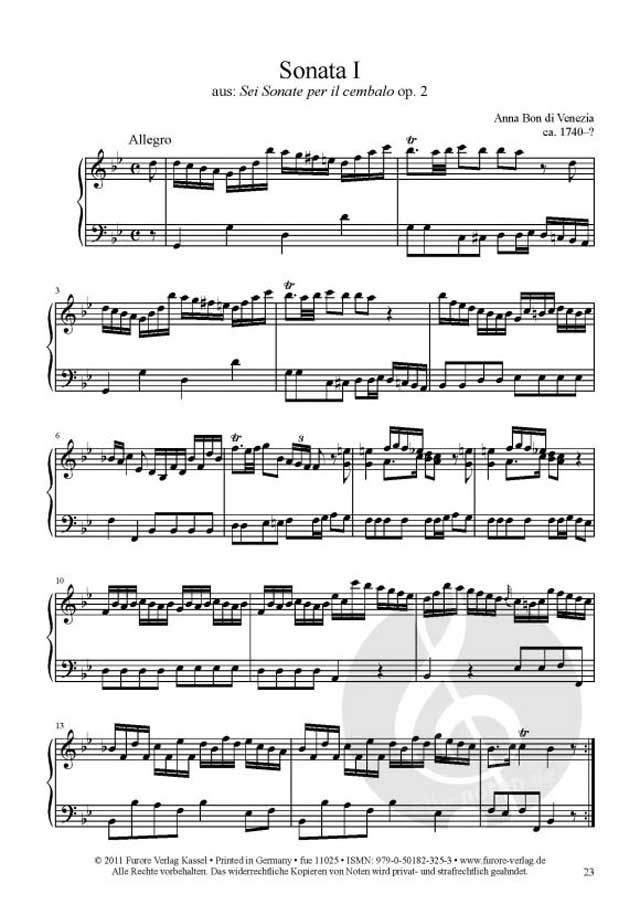
Anna Bon Sonata I, 1. Satz Allegro, aus Sei Sonate per il cembalo op. 2
-
Maria Hester Park Sonata I, 1. Satz Allegro, aus Two Sonatas for the Pianoforte or Harpsichord op. 4
-
Maria Agata Szymanowska Contre-danse, aus Dix-huit Danses de différent genre pour le Pianoforte
-
Emilie Zumsteeg Polonaise Nr. 3, aus Trois Polonaises pour le Pianoforte
-
Louise Farrenc Nocturne op. 49/1
-
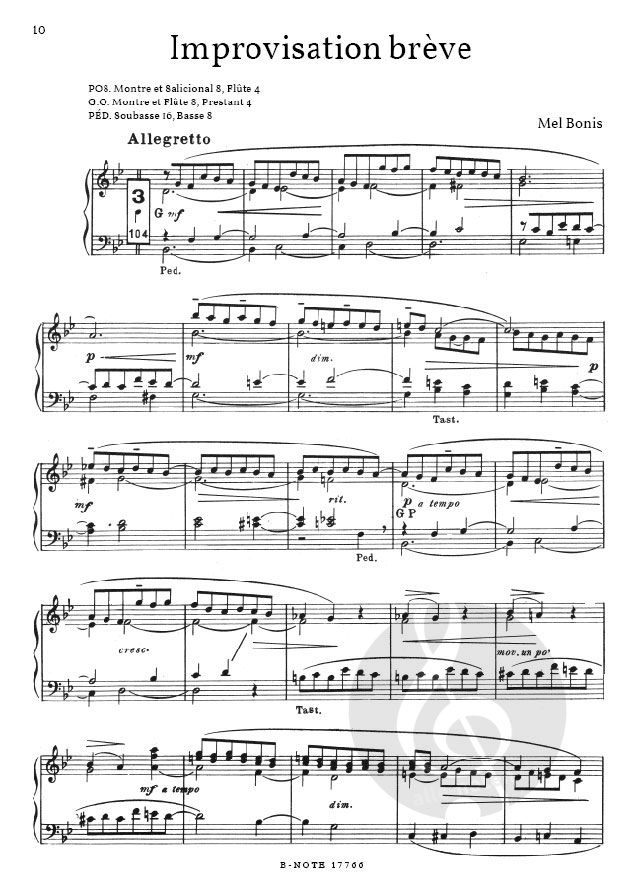
Mel Bonis Prélude op. 10, aus Cinq pièces musicales
-
Fanny Hensel Klavierstück, E-Dur und Andante, d-Moll
-
Cécile Chaminade Marche Russe, aus Album des Enfants op. 123/12
-
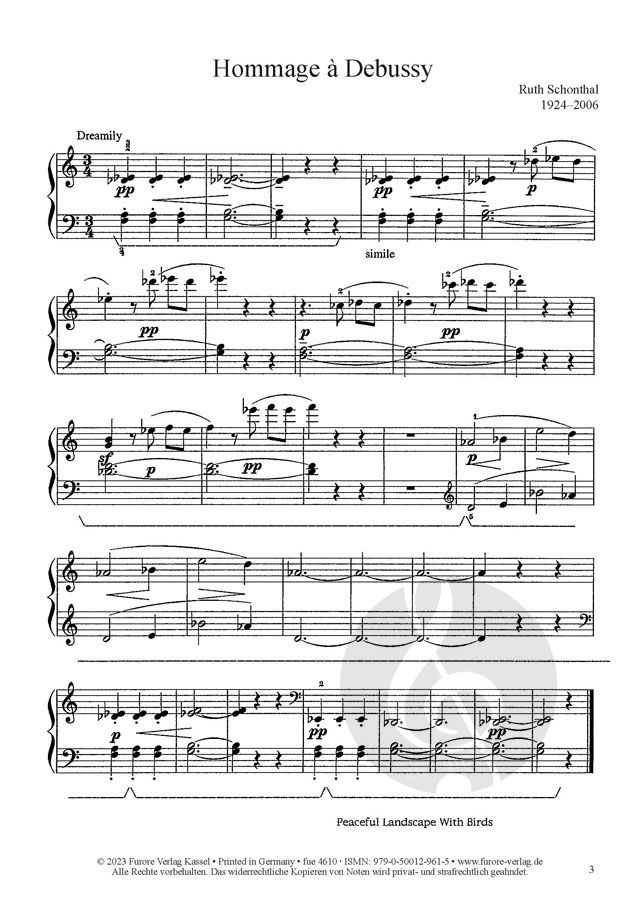
Ruth Schönthal The Seagull’s slow Ascent and Descent, aus Five Oceanic Preludes
-
Ljubica Marić Song and Dance
-
Barbara Heller Nelkenblume, aus Klaviermusik
-
Viera Janárčeková Tröpfelnde Elegie, aus Abgestaubte Saiten
-
Hope Lee Flower Drum Dance
-
Sibylle Pomorin Nr. III aus Istanbuler Kompositionen
-
Florentine Mulsant Nr. II und III aus Cinq Pièces pour les enfants pour piano op. 12
-
Vivienne Olive Bush Gin Rag
Customers rated this product:
Manufacturer Information:
Furore Verlag
Naumburger Str. 40
34127
Kassel
Deutschland
Other customers also bought:
- Organ
- Sheet Music
-
ships within 1-2 weeks
- Piano
- Sheet Music
-
ships within 4-8 working days
A Graded Anthology for Piano
- Piano
- Sheet Music
-
in stock
ships within 1-2 working days - Also available for download!
- Piano
- Sheet Music
- Maurice Hinson
-
in stock
ships within 1-2 working days
Mel Bonis
- Organ
- Sheet Music
-
in stock
ships within 1-2 working days