
Sophie Lavoie
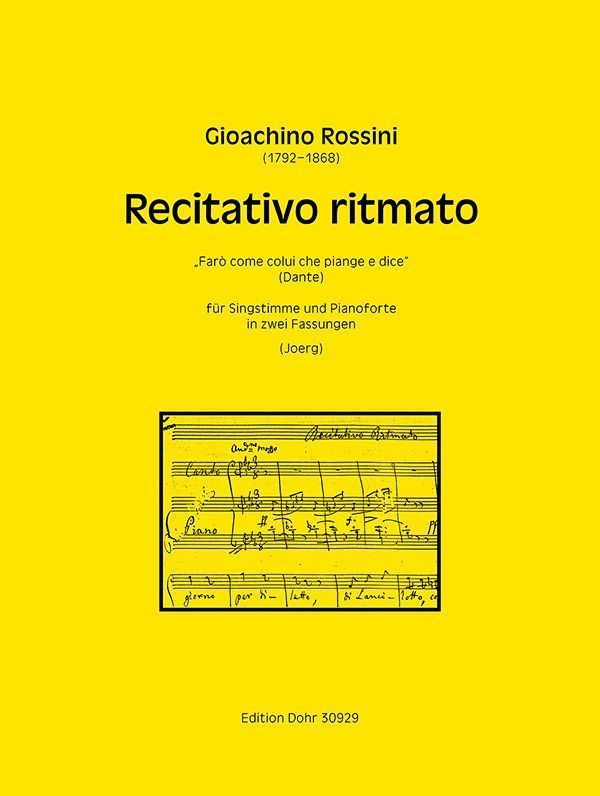
Recitativo ritmato - "Farò come colui che piange e dice" (Dante)
for voice and piano - 2 versions
Sophie Lavoie
Recitativo ritmato - "Farò come colui che piange e dice" (Dante)
for voice and piano - 2 versions
- Instrumentation Piano and Voice
- Composer Sophie Lavoie
- Editor Guido Johannes Joerg
- Edition Score
- Publisher Musikverlag Christoph Dohr
- Order no. DOHR30929
 ships within 2-5 working days
incl. tax,
excl. shipping costs
Not available in all countries. Learn more

Description:
The title, a terminus technicus that is unique in this combination in the history of music, combines the concept of the recitative, i.e. a rather free style of singing that follows the spoken language, with that of a decided rhythm laid down in notes. Basically, the piece is to be understood as an early example of a so-called "speech melody", as Rossini was keen to translate Dante's verses as faithfully as possible - following the spoken language - into a singable version. He succeeded in creating a musically elaborate miniature in the smallest of spaces, which does almost perfect justice to the verses of the great poet. It is noteworthy that Rossini uses the verse "Farò come colui che piange e dice", which immediately precedes the twelve verses he set to music or the four tercets in Dante's Commedia (it is the third and last verse of the preceding tercet) as part of the title. Dante switches here from the dialog with Francesca da Rimini to her "confession of tears"; and Rossini uses that verse both as an introduction to the theme ("Thus I will tell you in tears: ...") - and as a kind of performance instruction, which is intended to convey the mood on which the singer is to base her performance. (Guido Johannes Joerg).
The edition:
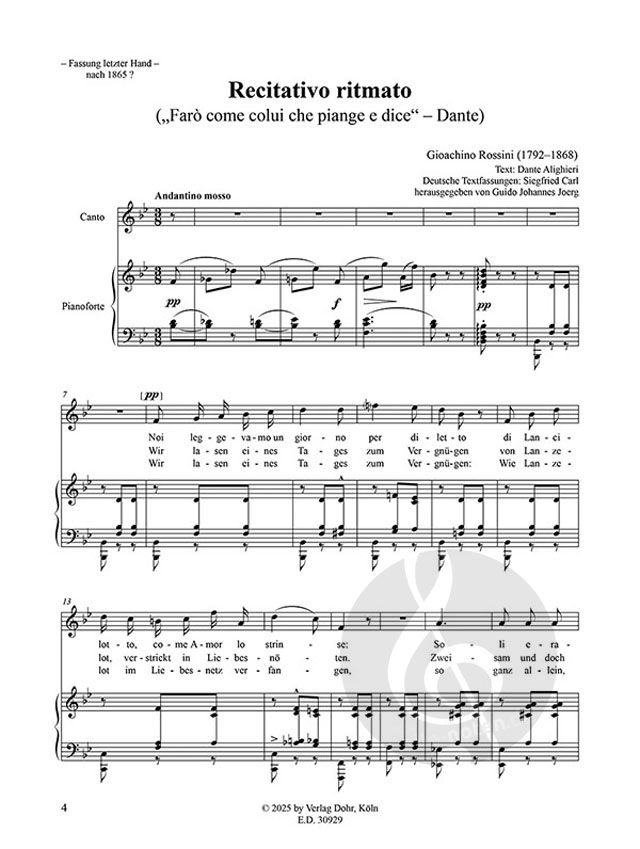
The new edition contains two versions of the composition:
Last-hand version (after 1865?)
Original version (La Francesca da Rimini; around 1856)
Both versions are accompanied by the original Italian text as well as two German-language adaptations by Siegfried Carl.
In addition to the afterword and critical report by the editor Guido Johannes Joerg, an essay by Rüdiger Krüger ("Thoughts on the aesthetics of lust") is also included.
The edition:
The new edition contains two versions of the composition:
Last-hand version (after 1865?)
Original version (La Francesca da Rimini; around 1856)
Both versions are accompanied by the original Italian text as well as two German-language adaptations by Siegfried Carl.
In addition to the afterword and critical report by the editor Guido Johannes Joerg, an essay by Rüdiger Krüger ("Thoughts on the aesthetics of lust") is also included.