
Jean-François Didier d' Attel de Luttange
Romances
PDF
view
Jean-François Didier d' Attel de Luttange
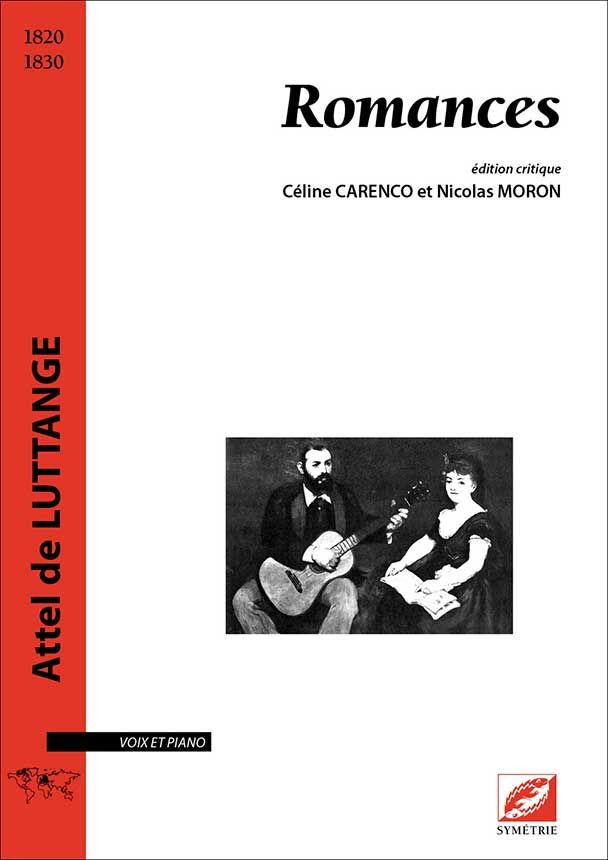
Romances
- Instrumentation Piano and Voice
- Composer Jean-François Didier d' Attel de Luttange
- Editor Céline Carenco Nicolas Moron
- Edition Score
- Publisher Symétrie
- Order no. 9782364852310
 ships within 1-2 weeks

Description:
Already practised in the salons of the second half of the 18th century, the genre of the romance experienced an unprecedented vogue under the Empire and then the Restoration. Defined in Jean-Jacques Rousseau's Dictionnaire de musique in 1768 as an "Air on which one sings a little poem of the same name, divided into couplets, the subject of which is usually some amorous and often tragic story", the romance is a simple song usually accompanied by the piano. Accessible to many amateur musicians, the romance was also the success of famous singers such as Pierre Garat (1762-1823) and well-known composers such as Alexis de Garaudé (1779-1852). In a booming music publishing market, sales of romances, in separate sheets, as supplements to newspapers such as Le Ménestrel, in specialised periodicals such as the Journal d'Euterpe or in anthologies such as the Chansonnier des grâces, grew considerably.
Jean-François Didier Attel de Luttange devotes himself to the writing of about twenty romances, probably during the years 1820 and 1830. Today preserved in the library of Verdun, the pieces are all present in the manuscript state in the ms. 372, tome 6. This bound volume also includes a large number of manuscript copies of romances for which Attel wrote only the literary text or the musical accompaniment, and a few romances of which he was not the author at all.
Among the romances for which Attel wrote the words and music, three are related to his work as a writer and his published novels. These are the only three to be published during his lifetime: Le Chant du Damoisel (of which a complete printed version is preserved in Attel's papers in Verdun), La Dame de Rosange (of which the text and melody were published in the Chansonnier des Grâces in 1821), and Le Diable au manoir (of which, however, the version published in 1824 in the Journal d'Euterpe features a setting by Alexis de Garaudé, not Attel's version). The other romances presented here only existed in manuscript form to our knowledge.
Reflecting a fairly well-developed amateur practice, the composition of these romances, both musically and poetically, has met with rather varied fortunes. In the ten or so pieces selected for this collection, the performer will sometimes be confronted with prosodic difficulties, particularly in the verses following the first one, as Attel did not always ensure that the entire text was consistent with the melody. Some stylistic features in the writing of the accompaniment may also be surprising.
Jean-François Didier Attel de Luttange devotes himself to the writing of about twenty romances, probably during the years 1820 and 1830. Today preserved in the library of Verdun, the pieces are all present in the manuscript state in the ms. 372, tome 6. This bound volume also includes a large number of manuscript copies of romances for which Attel wrote only the literary text or the musical accompaniment, and a few romances of which he was not the author at all.
Among the romances for which Attel wrote the words and music, three are related to his work as a writer and his published novels. These are the only three to be published during his lifetime: Le Chant du Damoisel (of which a complete printed version is preserved in Attel's papers in Verdun), La Dame de Rosange (of which the text and melody were published in the Chansonnier des Grâces in 1821), and Le Diable au manoir (of which, however, the version published in 1824 in the Journal d'Euterpe features a setting by Alexis de Garaudé, not Attel's version). The other romances presented here only existed in manuscript form to our knowledge.
Reflecting a fairly well-developed amateur practice, the composition of these romances, both musically and poetically, has met with rather varied fortunes. In the ten or so pieces selected for this collection, the performer will sometimes be confronted with prosodic difficulties, particularly in the verses following the first one, as Attel did not always ensure that the entire text was consistent with the melody. Some stylistic features in the writing of the accompaniment may also be surprising.