
Reynaldo Hahn
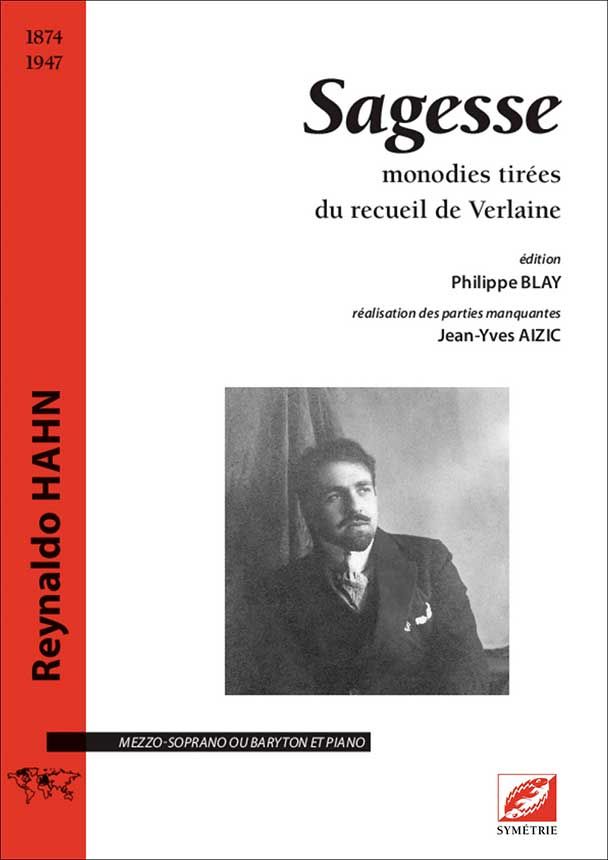
Sagesse
monodies tirées du recueil de Verlaine
PDF
view
Reynaldo Hahn
Sagesse
monodies tirées du recueil de Verlaine
- Instrumentation Medium Voice and Piano
- Composer Reynaldo Hahn
- Editor Philippe Blay Jean-Yves Aizic
- Edition Choral Score
- Publisher Symétrie
- Order no. 9782364852952

Description:
Recently discovered, Reynaldo Hahn's Sagesse cycle, inspired by Verlaine's collection, is among the works composed during his romantic relationship with Marcel Proust, between 1894 and 1896. He first conceived the idea in the spring of 1895, when he was sinking into a melancholic episode, the cause of which we do not know. Proust apparently had nothing to do with it, since Hahn - who was staying in Saint-Germain-en-Laye in July, where he came to "drown his great moral troubles in the invigorating and pure air" - writes to his friend the pianist Édouard Risler: "The only distractions here are the frequent visits of this dear boy, whose gentleness and intelligence are truly restorative."
The composer nevertheless tried to advance the scores in progress, working both on musical images for orchestra, inspired by Maurice Barrès's novel Le Jardin de Bérénice, as well as "Monodies taken from Verlaine's collection".
These latter are then considered as "a very long series of melodies on Sagesse", a set of vast proportions in which "the whole book […] would have been contained". From this work - in which the poet affirms his repentance and return to the Catholic faith following his dramatic altercation with Rimbaud - only four poems will eventually be set to music. The resulting melodies, which have remained unpublished, were first written during the summer and autumn of 1895, in Saint-Germain and in Brittany, when Hahn and Proust stayed at Beg-Meil, from September 8 to October 27; then the following summer, when the composer was staying with his sister in Hamburg. A second version of the first melody, written later, and several corrections suggest that the composer revised these pieces later.
Why were these vocal poems, which he carefully preserved and even reworked, left as they were? Probably because they were too closely associated with Marcel Proust, too evocative of an old love and a bygone time that he wished to keep at a distance. The same was true of all the scores in progress at the time of his separation from the writer in August 1896: Le Jardin de Bérénice and the Trio for violin, cello and piano. These were forgotten pages, which in Sagesse showed a somber Verlaine, far removed from the enveloping style of Chansons grises or many of the melodies in Premier recueil. Here, the tone is more serious, more discordant, in keeping with the texts chosen.
The first "monody" of the cycle, "… Sagesse humaine…", uses the last four stanzas of "Qu'en dis-tu, voyageur, des pays et des gares" (What do you say, traveler, about countries and stations), in which the poet acknowledges the "evil" he has done, and hopes for "God's grace". This is a "measured recit" in F major, religious in character, embracing the recto tono or a joint vocal line and a peaceful harmony; this meditation is pierced by the large vocal interval through which the verse "Bien de n'être pas dupe en ce monde d'une heure" begins, followed by a tonal darkening. The second, "Les chers mains qui étaient miennes…", in short octosyllables, follows the morphology of a three-beat dance, with rapid vocal diction accompanied by brief chords in mobile harmony. The hands, as much instruments of sin as mediators of the figure of the cross in the blessing, appear there in their versatility. On the contrary, it is a completely marble-like immobility (expressed by a first chord in appoggiatura then a second one delaying above the low notes of the keyboard) which spreads in "Un grand sommeil noir…". Pronounced "as in a dream - with half-closed eyes", Verlaine's text brings together beyond human temporality the "cradle" and the "vault". The last piece, "La tristesse, la langueur du corps humain", which remains unfinished, is both the most painful and the most lyrical. Its chromatic harmonies, modulations and diminished seventh chords give it a pathetic character, like the "sad body" depicted by the poet.
(translation Hjördis Romain)
Details: mezzo-soprano or baritone and piano
The composer nevertheless tried to advance the scores in progress, working both on musical images for orchestra, inspired by Maurice Barrès's novel Le Jardin de Bérénice, as well as "Monodies taken from Verlaine's collection".
These latter are then considered as "a very long series of melodies on Sagesse", a set of vast proportions in which "the whole book […] would have been contained". From this work - in which the poet affirms his repentance and return to the Catholic faith following his dramatic altercation with Rimbaud - only four poems will eventually be set to music. The resulting melodies, which have remained unpublished, were first written during the summer and autumn of 1895, in Saint-Germain and in Brittany, when Hahn and Proust stayed at Beg-Meil, from September 8 to October 27; then the following summer, when the composer was staying with his sister in Hamburg. A second version of the first melody, written later, and several corrections suggest that the composer revised these pieces later.
Why were these vocal poems, which he carefully preserved and even reworked, left as they were? Probably because they were too closely associated with Marcel Proust, too evocative of an old love and a bygone time that he wished to keep at a distance. The same was true of all the scores in progress at the time of his separation from the writer in August 1896: Le Jardin de Bérénice and the Trio for violin, cello and piano. These were forgotten pages, which in Sagesse showed a somber Verlaine, far removed from the enveloping style of Chansons grises or many of the melodies in Premier recueil. Here, the tone is more serious, more discordant, in keeping with the texts chosen.
The first "monody" of the cycle, "… Sagesse humaine…", uses the last four stanzas of "Qu'en dis-tu, voyageur, des pays et des gares" (What do you say, traveler, about countries and stations), in which the poet acknowledges the "evil" he has done, and hopes for "God's grace". This is a "measured recit" in F major, religious in character, embracing the recto tono or a joint vocal line and a peaceful harmony; this meditation is pierced by the large vocal interval through which the verse "Bien de n'être pas dupe en ce monde d'une heure" begins, followed by a tonal darkening. The second, "Les chers mains qui étaient miennes…", in short octosyllables, follows the morphology of a three-beat dance, with rapid vocal diction accompanied by brief chords in mobile harmony. The hands, as much instruments of sin as mediators of the figure of the cross in the blessing, appear there in their versatility. On the contrary, it is a completely marble-like immobility (expressed by a first chord in appoggiatura then a second one delaying above the low notes of the keyboard) which spreads in "Un grand sommeil noir…". Pronounced "as in a dream - with half-closed eyes", Verlaine's text brings together beyond human temporality the "cradle" and the "vault". The last piece, "La tristesse, la langueur du corps humain", which remains unfinished, is both the most painful and the most lyrical. Its chromatic harmonies, modulations and diminished seventh chords give it a pathetic character, like the "sad body" depicted by the poet.
(translation Hjördis Romain)
Details: mezzo-soprano or baritone and piano
-
Préfacei
-
Sagesse humaine
-
Les chères mains qui furent miennes
-
Un grand sommeil noir
-
La tristesse, la langueur du corps humain
-
Notes critiques
-
Variantes, corrections et remarques
Customers rated this product:
Manufacturer Information:
Symétrie
30 rue Jean-Baptiste Say
69001
Lyon
Deutschland
Other customers also bought:
- Mixed Choir (3-4 Parts)
- Sheet Music
-
 ships within 3-6 working days
Reynaldo Hahn
- Piano and Voice
- Sheet Music
-
ships within 3-6 working days

Reynaldo Hahn
- Piano and Voice
- Sheet Music
-
ships within 3-6 working days

- Mixed Choir (SATB) and Piano
- Sheet Music
-
ships within 3-6 working days