
Dorothea Hofmann
Begegnungen auf dem Möbiusband
für zwei Flöten (2009) -Hommage à M.C. Escher-

Dorothea Hofmann
Begegnungen auf dem Möbiusband
für zwei Flöten (2009) -Hommage à M.C. Escher-
- Instrumentation Flute Duet
- Composer Dorothea Hofmann
- Edition Score and Parts
- Publisher Musikverlag Christoph Dohr
- Order no. DOHR31061
 ships within 2-5 working days
incl. tax,
excl. shipping costs
Not available in all countries. Learn more

Description:
A Möbius strip is a figure that leads back into itself, so that the whole strip has only one side and one edge: there is no top and no bottom, no inside and outside. Since its discovery, the Möbius strip has been a figure of infinity. The Dutch artist Mauritz Cornelis Escher was probably the first to find convincing pictorial, artistic forms for this figure in his search for ways to represent infinity.
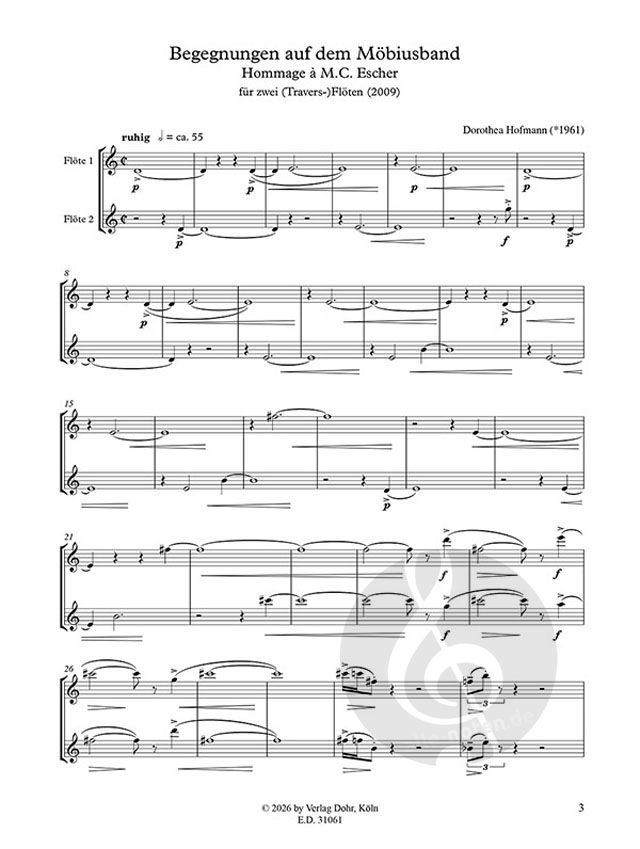
The mathematical figure of the Möbius strip would correspond cosmically to the idea of rebirth, an infinity in which nothing is lost, but everything - albeit transformed - returns. My "Encounters" translate this idea into music: there is no upper and lower voice, no melody and accompaniment, but both instruments always act as equals, imitating each other. The motifs develop imperceptibly from the previous one and the result is a flowing change with constant self-similarity, so much so that the listener hardly notices when the music has long since left the linear progression and instead the former "top" has now become "bottom": the two instruments have swapped roles and the whole thing could start all over again. (Dorothea Hofmann)
The mathematical figure of the Möbius strip would correspond cosmically to the idea of rebirth, an infinity in which nothing is lost, but everything - albeit transformed - returns. My "Encounters" translate this idea into music: there is no upper and lower voice, no melody and accompaniment, but both instruments always act as equals, imitating each other. The motifs develop imperceptibly from the previous one and the result is a flowing change with constant self-similarity, so much so that the listener hardly notices when the music has long since left the linear progression and instead the former "top" has now become "bottom": the two instruments have swapped roles and the whole thing could start all over again. (Dorothea Hofmann)