
Carl Reinecke
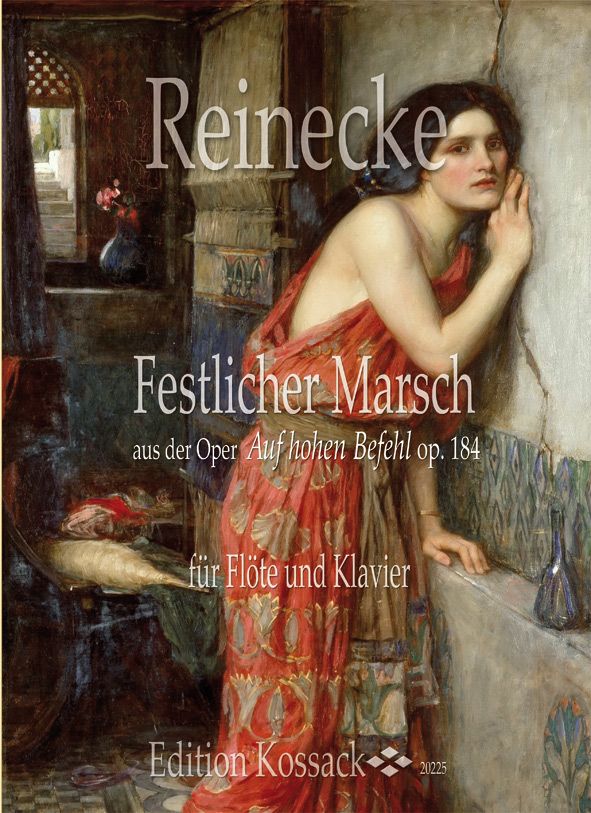
Festlicher Marsch
aus der Oper Auf hohen Befehl op. 184
Demo
listen
Carl Reinecke
Festlicher Marsch
aus der Oper Auf hohen Befehl op. 184
- Instrumentation Flute and Piano
- Composer Carl Reinecke
- Editor Henrik Wiese
- Edition Sheet Music
- Publisher Edition Kossack
- Order no. KOSSACK20225
 ships within 4-8 working days
incl. tax,
excl. shipping costs
Not available in all countries. Learn more

Description:
1. The genesis of the opera Auf hohen Befehl
Reinecke probably wrote the comic opera Auf hohen Befehl op. 184 in view of his 25th anniversary as Leipzig Gewandhauskapellmeister in the fall of 1885. He not only wrote the music but also the libretto for this stage work. While the librettist Reinecke hides behind pseudonyms such as W. te Grove (e.g. Ein Abenteuer Händels op. 104) or Heinrich Carsten (e.g. Dornröschen op. 139) in other works, he appears in the opera Auf hohen Befehl as a poet-composer under his real name.The plot is based on the novella Ovid am Hofe by Wilhelm Heinrich Riehl (1823-1897). On July 12, 1884, he reported to his pupil Gustav Tyson-Wolff (1840-1907): "In the meantime, I have written a harp concerto with orchestra, which has become very brilliant and - (but entre nous) a text for a three-act comic opera." He wrote to his good friend Ferdinand Hiller (1811-1885) on October 21, 1884: "You will be amused to learn that I have now written, i.e. sketched, but completely sketched, a three-act comic opera. I wrote the text myself after a Riehl novella, but before I set about composing it, I read it to some theater experts, including Heinrich Behr, and only after they advised me did I set about it. And if I finally emerge from the battle with the theater audience with a tattered helmet, I don't consider the misfortune to be too great. Similar things have happened to better musicians than me. There is no telling how strange and unpredictable the audience is towards stage works." On December 9, 1884, Reinecke offered Georg Alexander Duke of Mecklenburg-Strelitz (1859-1909) the opportunity to perform the opera or parts of it (probably still under the original title Ovid at Court), and a letter dated September 5, 1885 to an unknown publisher reveals that Reinecke had "just" finished composing his opera. Looking back, he wrote that the orchestration had taken some time and the piano reduction was published in October 1885 by Max Hesse's Verlag, Leipzig. However, it was not premiered in Leipzig on the occasion of Reinecke's service anniversary in the fall of 1885. Instead, the work was performed for the first time on October 1, 1886 in Hamburg under Reinecke's direction. Performances followed in Lübeck, Schwerin, Sondershausen, Aachen, Kiel, Regensburg, Halle and Dresden. The Leipzig premiere under the direction of Arthur Nikisch (1855-1922) did not take place until February 17, 1888, but there is no evidence of a performance with the tenor Emil Goetze (1856-1901), to whom the opera is dedicated.2. about the content of this comedy of mistaken identity
At home, Franz and Cornelia confess their fiery love. However, a wedding is out of the question because their fathers are enemies. Under the false name of Howora, Franz manages to be accepted as a singing pupil by Cornelia's father, singing master Dal Segno. Meanwhile, Franz's father, the bandmaster and court poet Ignaz Lämml, has been commissioned by the royal family to compose an opera based on Ovid's Pyramus and Thisbe, but at the princess's request, the outcome is good. When a chamber singer was needed at the princely court, Kapellmeister Ignaz Lämml claimed the position for his son Franz. At the same time, singing master Dal Segno claims it for his new eleven Howora. A singing contest between Franz and his alter ego Howora is arranged at court. To make the impossible possible, Cornelia disguises herself as Franz and the guests arrive to the sound of the Festive March, including Kapellmeister Ignaz Lämml, Singmeister Dal Segno, Franz (disguised as Howora), Cornelia (disguised as Franz), Julia dal Segno (the Singmeister's sister, disguised as Cornelia) and the princely couple. "[W]ithin the pianissimo passage in the march" (bars 54-70), Julia reveals to the astonished Franz in a dialog that she has also disguised herself, namely as Cornelia, so that the ruse is not discovered. After the disguised Franz and Cornelia sing a contest, the confusion is cleared up, the fathers make peace in the presence of the princely couple, and Franz and Cornelia are allowed to marry.For the audience of Reinecke's opera, the princess's wish for the commissioned opera is fulfilled at the same time. Although the plot is set in a small residence at the beginning of the 18th century and not in antiquity, it takes up essential elements of Ovid's story with the secret love and the quarrelling parents and ends on a good note.3. The musical sources
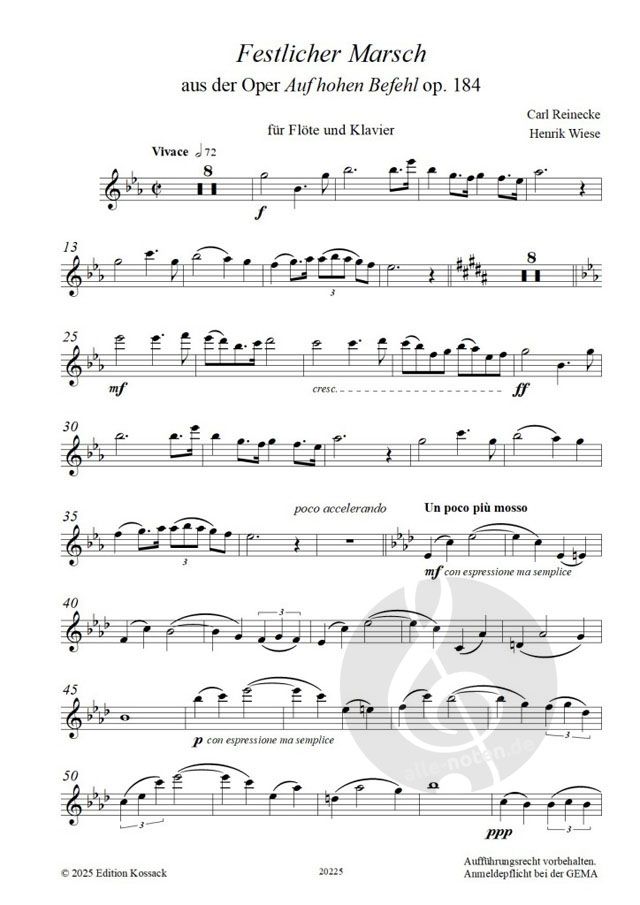
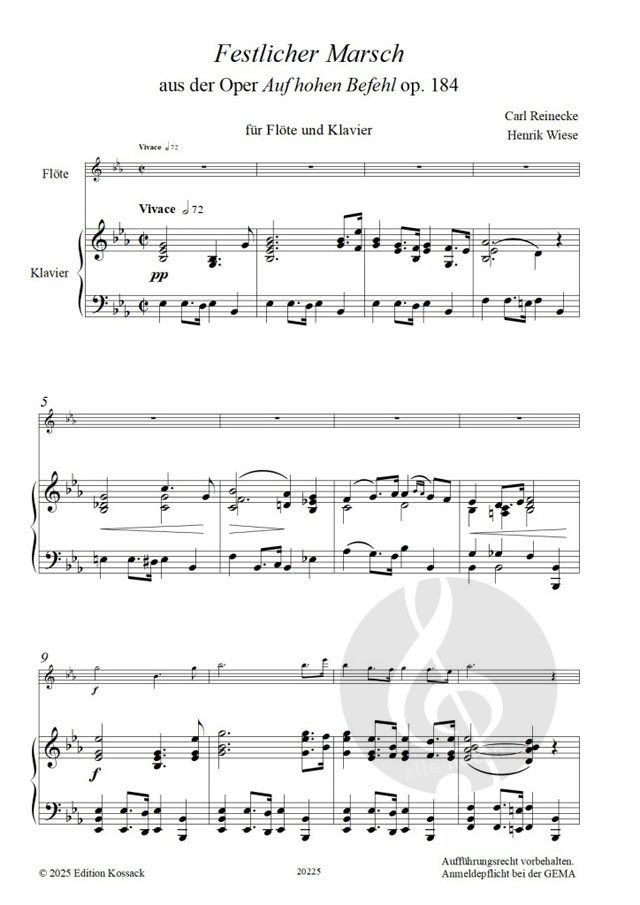
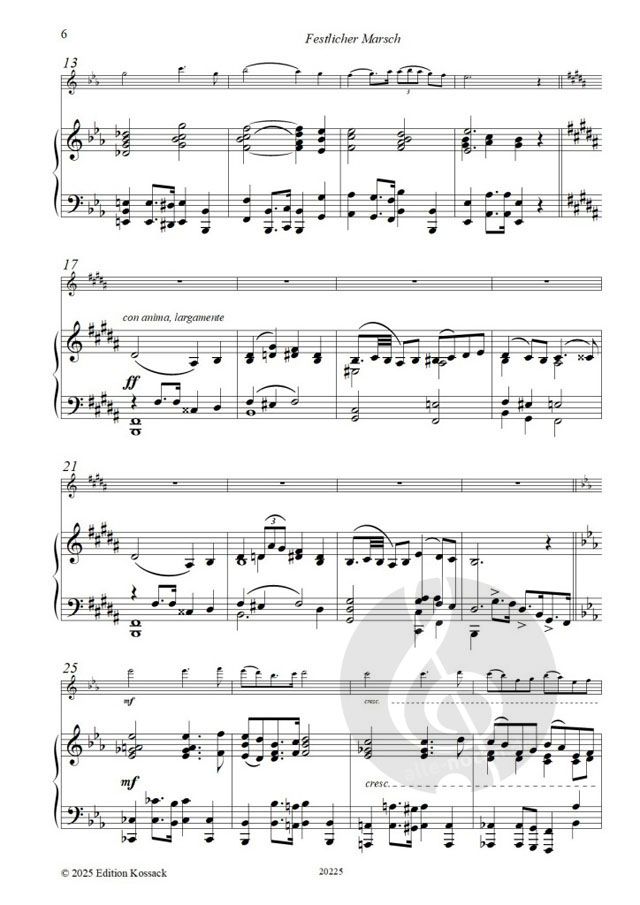
Some individual pieces from the opera were distributed in arrangements for piano two or four hands, including the transformation music March and ballet music from Act 3. The march was also published separately in a single edition under the more specific title Festive March, and the original version of the opera (score and orchestral parts) and piano arrangements of this music differ considerably. In the orchestral version, for example, a bar is inserted after m. 70, while in the individual edition for piano the march is preceded by two introductory bars with a trumpet signal, whereas the version for piano four hands dispenses with this. The performance markings also diverge between the versions. This applies in particular to bars 38-70, in which Reinecke takes up the well-known theme from the Undine Sonata op. 167. In the present arrangement, an attempt has been made to find a plausible, practical solution for the performance markings. Anyone wishing to delve deeper into the comparison of the readings should consult the musical sources directly. It should also be noted that the unexpected (from the perspective of the Undine sonata) notes (e.g. e-flat2 in m. 51) are consistently transmitted in the sources. The only exception is the 4th note c2 in m. 54, which can be found in the orchestral version and in the arrangement for piano four hands, but the piano reduction contains the more familiar as1.4. Connection to the Undine Sonata
The fact that the well-known theme from Reinecke's Undine Sonata op. 167 reappears in the context of his opera Auf hohen Befehl allows a more differentiated view: the theme appears in the opera when Franz unexpectedly thinks he sees his Cornelia again shortly before the competition. In reality, however, it is the disguised Julia dal Segno who is hiding behind it and explains the reasons for this. Reinecke knows how to skillfully encode appearance and reality in his music. The supposed Cornelia is linked to the theme in m. 38. However, Reinecke symbolizes the fact that she is only played or "copied" by Julia dal Segno by imitating the melody part from m. 63 onwards. Transferred to the Undine Sonata, the theme could therefore very specifically represent the protagonist Undine. Reinecke also dispenses with the imitation here, and the theme is also associated with mystery in both works. In the Undine Sonata, the intermezzo in m. 97 and the finale in m. 289 both contain the performance designation misterioso. Perhaps it refers to the mysterious, strange nature of the water spirit Undine. In the Festive March, Julia dal Segno, disguised as Cornelia, is the bearer of the secret.
Customers rated this product:
Manufacturer Information:
Edition Kossack
Bergstraße 13
48431
Rheine
Deutschland
Other customers also bought:
Johann Sebastian Bach
The Flute Collection (Henrik Wiese presents)
- Flute and Piano
- Sheet Music
- Henrik Wiese
-
in stock
ships within 1-2 working days