
Dorothea Hofmann
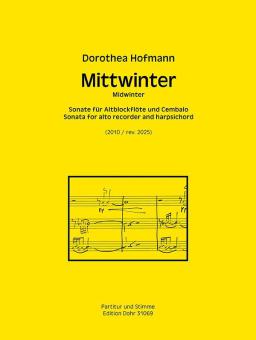
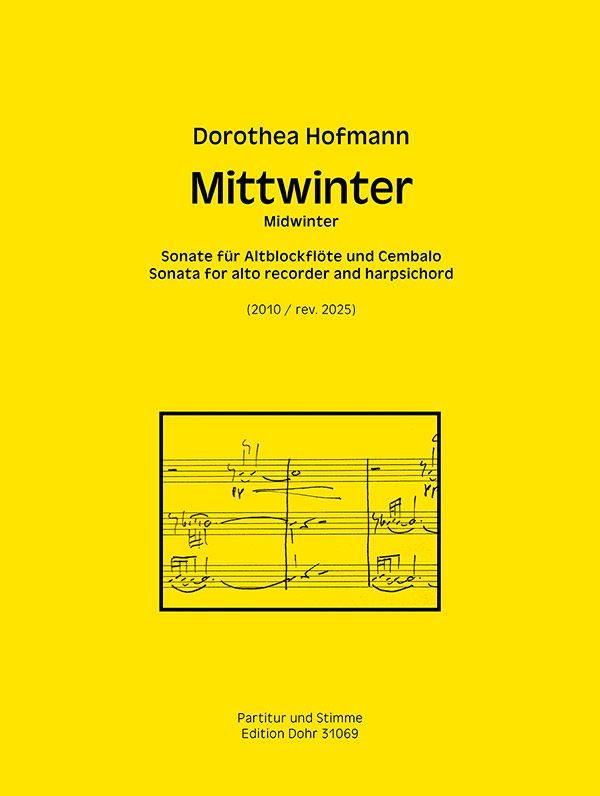
Mittwinter
Sonata for Alto Recorder and Harpsichord (2010/2025)
NEW
Dorothea Hofmann
Mittwinter
Sonata for Alto Recorder and Harpsichord (2010/2025)
- Instrumentation Alto Flute and Harpsichord
- Composer Dorothea Hofmann
- Edition Score and Parts
- Publisher Musikverlag Christoph Dohr
- Order no. DOHR31069
 ships within 2-5 working days
incl. tax,
excl. shipping costs
Not available in all countries. Learn more

Description:
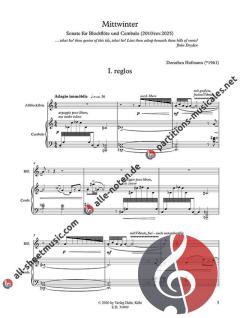
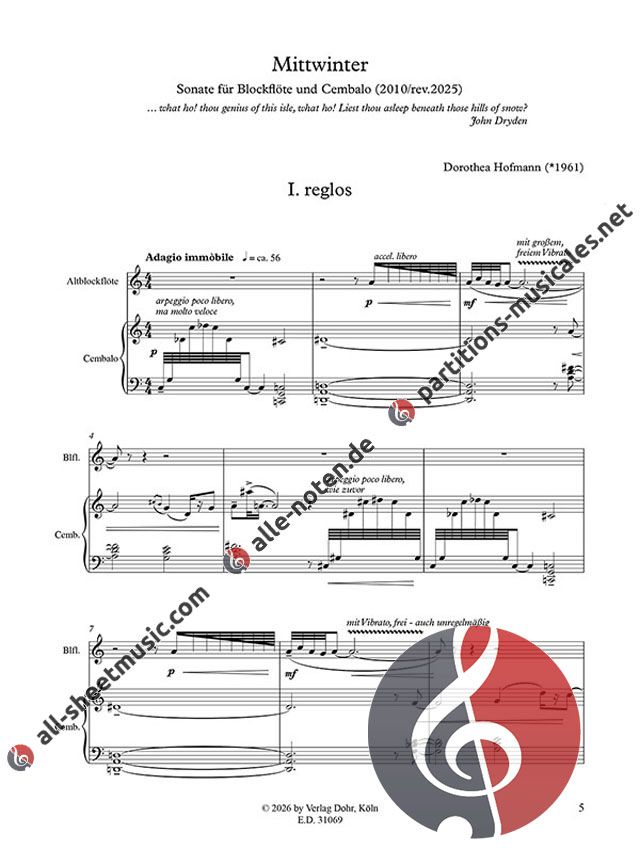
... What ho! Thou genius of this isle, what ho!
Thou asleep beneath those hills of snow?
(John Dryden, King Arthur, Act 3, Cupid)
A motto from a "semi-opera" by Henry Purcell, referring to perhaps its most famous scene: the dialogue between Cupid and the "Cold Genius." Cupid awakens the Cold Genius, who, coming to his senses "unwillingly and slow," initially insists on remaining in his icy cold—"let me freeze again to death." But Cupid insists: "At Love’s appearing, All the sky clearing" and convinces him: "Great Love, I know thee now: Eldest of the gods art thou"—and the scene ends in a very spring-like manner: "Love was made for a blessing and not for a pain." The sonata maintains a theatrical tone throughout, as does all Baroque instrumental music; it makes use of various Baroque performance techniques such as trills, etc., without ever directly quoting Baroque styles, thus creating an intense instrumental reinterpretation of an ancient theme. (Dorothea Hofmann)
Thou asleep beneath those hills of snow?
(John Dryden, King Arthur, Act 3, Cupid)
A motto from a "semi-opera" by Henry Purcell, referring to perhaps its most famous scene: the dialogue between Cupid and the "Cold Genius." Cupid awakens the Cold Genius, who, coming to his senses "unwillingly and slow," initially insists on remaining in his icy cold—"let me freeze again to death." But Cupid insists: "At Love’s appearing, All the sky clearing" and convinces him: "Great Love, I know thee now: Eldest of the gods art thou"—and the scene ends in a very spring-like manner: "Love was made for a blessing and not for a pain." The sonata maintains a theatrical tone throughout, as does all Baroque instrumental music; it makes use of various Baroque performance techniques such as trills, etc., without ever directly quoting Baroque styles, thus creating an intense instrumental reinterpretation of an ancient theme. (Dorothea Hofmann)