
Albert Loritz
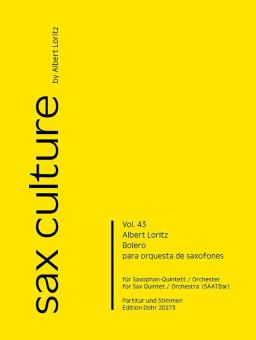
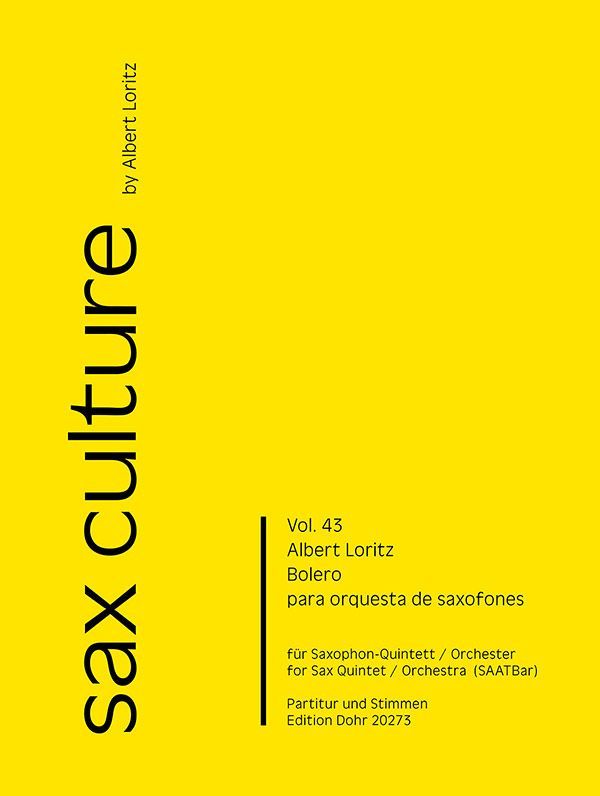
sax culture 43: Bolero
for saxophone quintet/saxophone orchestra (2016)
NEW
Albert Loritz
sax culture 43: Bolero
for saxophone quintet/saxophone orchestra (2016)
- Instrumentation Saxophone Quintet (SAATB)
- Composer Albert Loritz
- Editor Albert Loritz
- Edition Score and Parts
- Publisher Musikverlag Christoph Dohr
- Order no. DOHR20273
 ships within 2-5 working days
incl. tax,
excl. shipping costs
Not available in all countries. Learn more

Description:
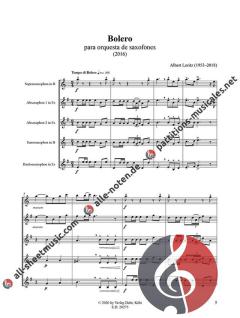
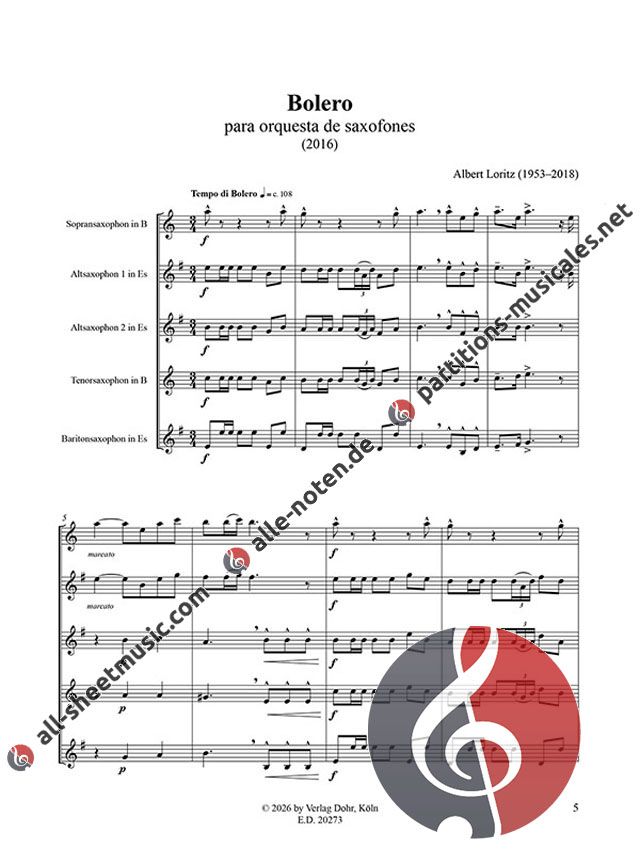
The title "Bolero" immediately brings to mind Maurice Ravel’s orchestral work of the same name. This composition for a five-part saxophone ensemble, with its characteristic rhythms and the harmonies of the so-called Spanish cadence, initially recalls the origins of the bolero as a Spanish folk dance.
In addition, Albert Loritz drew inspiration from the compositional principles of Ravel’s "Bolero." First, there is the idea of presenting several repetitions of a two-part (here 16-measure) theme with an oriental flavor and gradually developing it into a polyphonic texture through parallel-moving individual parts. Furthermore, similar to Ravel, a harmonic build-up is incorporated toward the final repetition of the theme. Toward the end, the piece does not collapse abruptly as in Ravel’s work, but rather systematically reduces itself from five-part to one-part harmony using the motif from the introduction. An effective composition that expresses both the emotional aspects of this dance and its elegant and proud spirit. (Annette Kutzer)
In addition, Albert Loritz drew inspiration from the compositional principles of Ravel’s "Bolero." First, there is the idea of presenting several repetitions of a two-part (here 16-measure) theme with an oriental flavor and gradually developing it into a polyphonic texture through parallel-moving individual parts. Furthermore, similar to Ravel, a harmonic build-up is incorporated toward the final repetition of the theme. Toward the end, the piece does not collapse abruptly as in Ravel’s work, but rather systematically reduces itself from five-part to one-part harmony using the motif from the introduction. An effective composition that expresses both the emotional aspects of this dance and its elegant and proud spirit. (Annette Kutzer)