
Johann Kuhnau
Welt adieu, ich bin dein müde
Kantate zum 24. Sonntag nach Trinitatis - Urtext
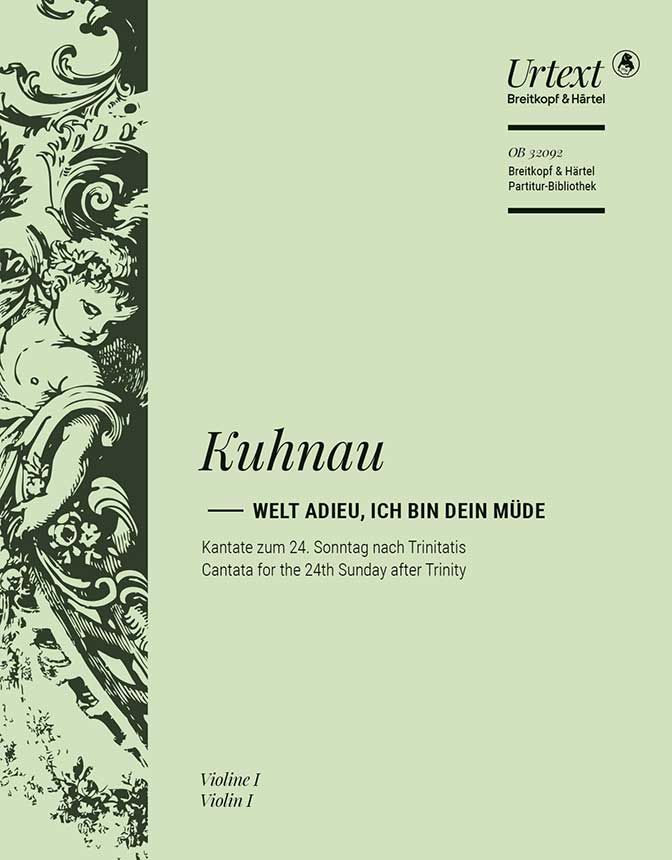
Johann Kuhnau
Welt adieu, ich bin dein müde
Kantate zum 24. Sonntag nach Trinitatis - Urtext
- Instrumentation Soloists, Mixed Choir and Orchestra
- Composer Johann Kuhnau
- Editor David Erler
- Edition Instrumental Part: Violin 1 (Urtext)
- Publisher Breitkopf & Härtel
- Order no. OB32092-15
 ships within 2-5 working days
incl. tax,
excl. shipping costs
Not available in all countries. Learn more

Description:
The cantata Welt adieu, ich bin dein müde is intended for the 24th Sunday after Trinitatis and thus already the end of the church year. Based on the scribes of the handwritten set of parts, the editor assumes a performance around 1720. The cantata therefore falls into the last years of Kuhnau's life and can also be considered a kind of "swan song" for Kuhnau due to its fitting theme of death and eternity. It is also one of only two surviving purely choral cantatas, even if others are also partly based on chorales.
The text of the chorale used was written by Johann Georg Albinus (1624-1679), a pastor and rector of the cathedral school in Naumburg. He wrote it for the funeral of a daughter of the Thomasschule rector Abraham Teller in 1649. For the current edition, three of the five vocal parts that were missing from the set of parts were added by the editor. The alternation between "tutti" and "solo" passages in the opening and closing movements suggest the scoring of a choir. Due to its length and manageable orchestration, this cantata is also ideally suited for a performance in a church service.
Audio examples: Opella Musica, camerata lipsiensis, cond. Gregor Meyer (cpo, 2013)
Binding: stapled
The text of the chorale used was written by Johann Georg Albinus (1624-1679), a pastor and rector of the cathedral school in Naumburg. He wrote it for the funeral of a daughter of the Thomasschule rector Abraham Teller in 1649. For the current edition, three of the five vocal parts that were missing from the set of parts were added by the editor. The alternation between "tutti" and "solo" passages in the opening and closing movements suggest the scoring of a choir. Due to its length and manageable orchestration, this cantata is also ideally suited for a performance in a church service.
Audio examples: Opella Musica, camerata lipsiensis, cond. Gregor Meyer (cpo, 2013)
Binding: stapled
Customers rated this product:
Manufacturer Information:
Breitkopf & Härtel KG
Walkmühlstraße 52
65195
Wiesbaden
Deutschland
Related products:
- Soloists, Mixed Choir and Orchestra
- Instrumental Part: Viola 2 (Urtext)
- Breitkopf & Härtel
-
ships within 2-5 working days
- Soloists, Mixed Choir and Orchestra
- Instrumental Part: Violin 2 (Urtext)
- Breitkopf & Härtel
-
ships within 2-5 working days
- Soloists, Mixed Choir and Orchestra
- Instrumental Part: Double Bass (Urtext)
- Breitkopf & Härtel
-
ships within 2-5 working days
- Soloists, Mixed Choir and Orchestra
- Instrumental Part: Viola 1 (Urtext)
- Breitkopf & Härtel
-
ships within 2-5 working days
- Soloists, Mixed Choir and Orchestra
- Instrumental Part: Organ (Urtext)
- Breitkopf & Härtel
-
ships within 2-5 working days
- Soloists, Mixed Choir and Orchestra
- Harmony Parts (Urtext)
- Breitkopf & Härtel
-
ships within 2-5 working days