
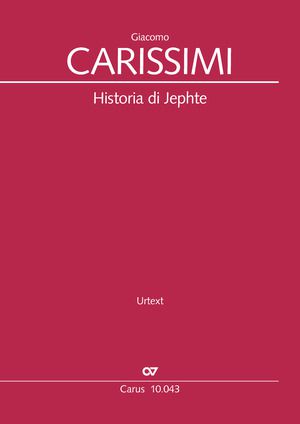
Giacomo Carissimi
Historia di Jephte
Oratorio
PDF
view
Giacomo Carissimi
Historia di Jephte
Oratorio
- Instrumentation Soloists (SSATB) and Basso Continuo
- Optional Instrumentation Soloists (SSATB), Mixed Choir (SSATB) and Basso Continuo
- Composer Giacomo Carissimi
- Editor Wolfgang Hochstein
-
Difficulty Level
- Edition Score (Urtext)
- Publisher Carus-Verlag
- Order no. CV10043-00
 in stock
ships within 1-2 working days
incl. tax,
excl. shipping costs
- Volume scale:
- from 6 pcs 25,00 €
Not available in all countries. Learn more

Description:
The harrowing Old Testament story of the army commander Jephthah, bound by a sacred vow to kill his daughter, inspired the Roman composer Giacomo Carissimi to create this intense and moving setting. Written in the 1640s, Historia di Jephte is not only one of the earliest oratorios, but also one of its greatest.
Scored for just six solo voices in diverse combinations accompanied by basso continuo, Carissimi presents the Latin biblical text in the recitative style of the early Baroque. He nonetheless repeatedly abandons this style to highlight the plot's tragic events, employing all expressive Affekts he had available to him. The chromatic voice-leading and thrilling harmonization of the lamentations and Jephthah’s dialogue with his doomed daughter create an intense and anguished atmosphere.
While scholars believe that the choir originally consisted of six solo parts, the work does not suffer when performed by a larger ensemble. To commemorate the 350th anniversary of the composer’s death, Carus is publishing this new critical edition based on the copy made by Carissimi’s pupil, Marc-Antoine Charpentier. A continuo realization is included in the score.
Scored for just six solo voices in diverse combinations accompanied by basso continuo, Carissimi presents the Latin biblical text in the recitative style of the early Baroque. He nonetheless repeatedly abandons this style to highlight the plot's tragic events, employing all expressive Affekts he had available to him. The chromatic voice-leading and thrilling harmonization of the lamentations and Jephthah’s dialogue with his doomed daughter create an intense and anguished atmosphere.
While scholars believe that the choir originally consisted of six solo parts, the work does not suffer when performed by a larger ensemble. To commemorate the 350th anniversary of the composer’s death, Carus is publishing this new critical edition based on the copy made by Carissimi’s pupil, Marc-Antoine Charpentier. A continuo realization is included in the score.
Related products:
Customers rated this product:
Manufacturer Information:
Carus-Verlag GmbH & Co. KG
Sielminger Str. 51
70771
Leinfelden-Echterdingen
Deutschland
Other customers also bought:
Johannes Brahms
- Mixed Choir (SATB) and Piano
- Piano Reduction
-
in stock
ships within 1-2 working days