
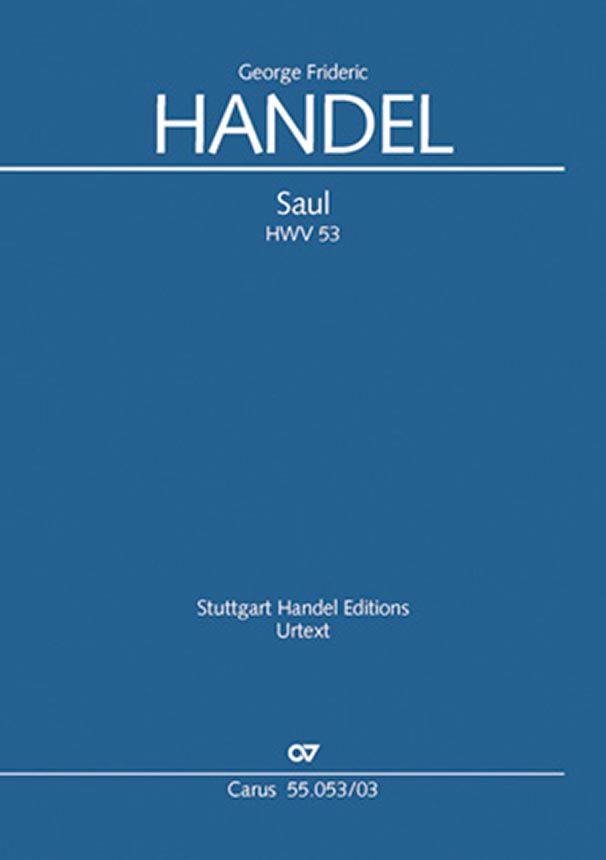
Georg Friedrich Händel
Saul HWV 53
Oratorio
Demo
listen
PDF
view
Georg Friedrich Händel
Saul HWV 53
Oratorio
- Instrumentation Soloists, Mixed Choir (SSATB) and Orchestra
- Composer Georg Friedrich Händel
- Editor Felix Loy
-
Difficulty Level
- Edition Piano Reduction Download
- Publisher Carus-Verlag
- Order no. CV55053-03-DL
 immediately available
Download immediately after ordering
incl. tax,
excl. shipping costs
Not available in all countries. Learn more
Description:
Saul for the first time in the version conducted by Handel himself. Saul is one of Handel's most dramatic oratorios. More than in almost any other oratorio, its stirring drama demonstrates its proximity to the opera of the time. The score calls for Handel's most colorful orchestra to date: in addition to the normal opera orchestra, trombones, harp, solo organ, carillon (glockenspiel) and large kettledrums are also used. The chorus functions for the first time as a central component of a dramatic action, but also takes on a commentary function as in Greek tragedy.
This new edition is the first time that sheet music is available which, according to recent Handel scholarship, takes into account the conductor's score from which Handel himself conducted his performances as the most important source. Only from it can we learn which arias, choruses, recitatives and instrumental pieces Handel ultimately chose for his performances, after the numerous corrections in the autograph, and in what order they were performed. This results in many innovations in detail (e.g. autograph instructions for the use of the organ) as well as unusual sequences of individual pieces and passages with significantly altered musical text.
This new edition is the first time that sheet music is available which, according to recent Handel scholarship, takes into account the conductor's score from which Handel himself conducted his performances as the most important source. Only from it can we learn which arias, choruses, recitatives and instrumental pieces Handel ultimately chose for his performances, after the numerous corrections in the autograph, and in what order they were performed. This results in many innovations in detail (e.g. autograph instructions for the use of the organ) as well as unusual sequences of individual pieces and passages with significantly altered musical text.
Related products:
Here is how the download works:
1 Buy download sheet music
Purchase the download score from our online store
2 Order confirmation with download link
Immediately after completing your order, you will receive an order confirmation by email listing all items. You will find the download link next to each item. You can use this link to start the download right away. Please also check your spam folder if necessary.
Customers rated this product:
Manufacturer Information:
Carus-Verlag GmbH & Co. KG
Sielminger Str. 51
70771
Leinfelden-Echterdingen
Deutschland
Other customers also bought:

- Mixed Choir (SATB), 2 Horns and Strings
- Set of Parts
-
ships within 2-5 working days
- Also available for download!