
Ludwig van Beethoven
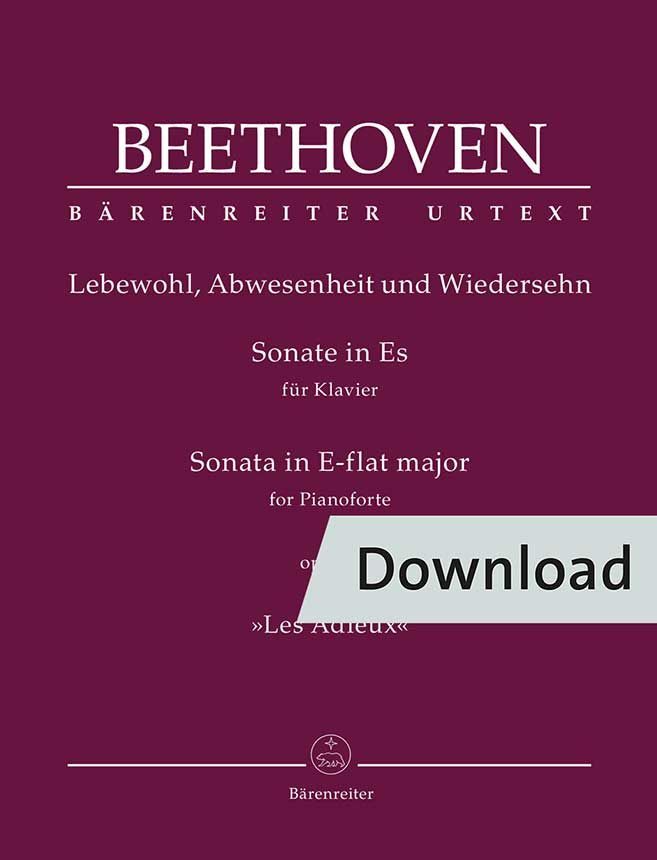
Sonata for Piano in E flat major op. 81a 'Les Adieux'
Farewell, absence and reunion
PDF
view
Ludwig van Beethoven
Sonata for Piano in E flat major op. 81a 'Les Adieux'
Farewell, absence and reunion
- Instrumentation Piano
- Composer Ludwig van Beethoven
- Series Bärenreiter Urtext
- Editor Jonathan Del Mar
-
Difficulty Level
- Edition Sheet Music Download (Urtext)
- Publisher Bärenreiter Verlag
- Order no. BA11808-DL
 immediately available
Download immediately after ordering
incl. tax,
excl. shipping costs
Not available in all countries. Learn more

Description:
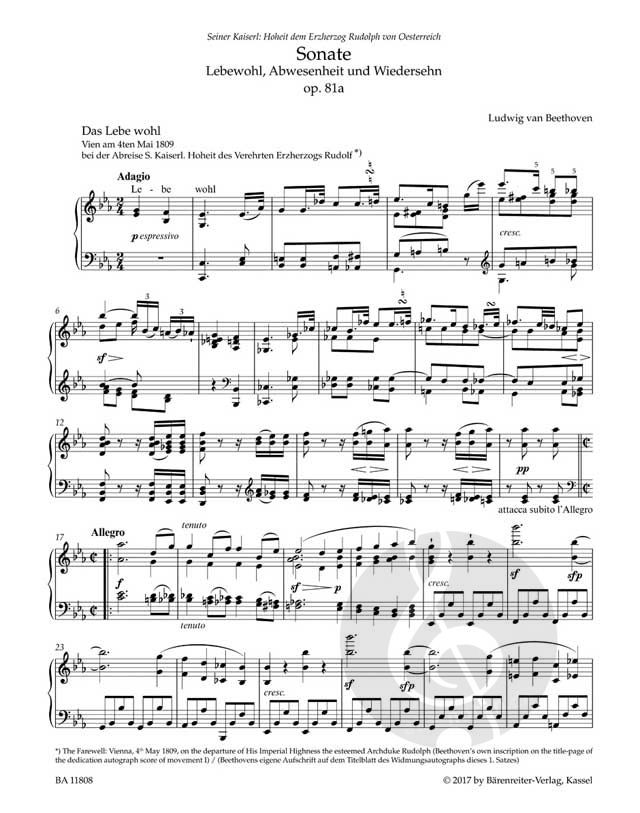
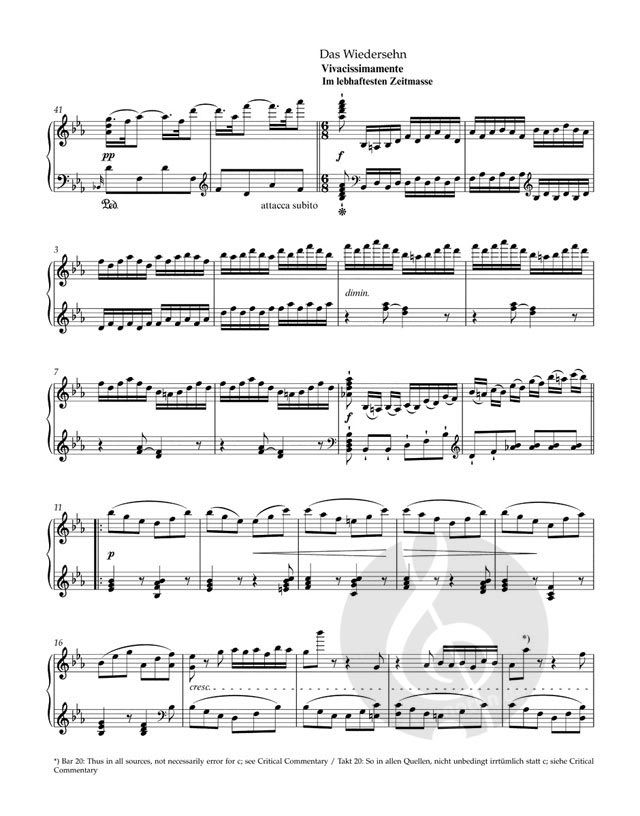
Beethoven incorporated very personal impressions into his Sonata op. 81a, composed in 1809/10, with the movement titles "Das Lebewohl", "Die Abwesenheit" and "Das Wiedersehn". The compositional trigger was the hasty departure of Beethoven's close friend and patron Archduke Rudolph of Austria, who fled Vienna together with the imperial family on May 4, 1809 for fear of the approaching Napoleonic troops. Beethoven described op. 81a as a "characteristic sonata", but this was not meant in the sense of programmatic music, but as a musical expression of his feelings. The composer reacted angrily to the publisher's French translations of the title and movement designations, which could not prevent op. 81a from becoming widely known under the name "Les Adieux".
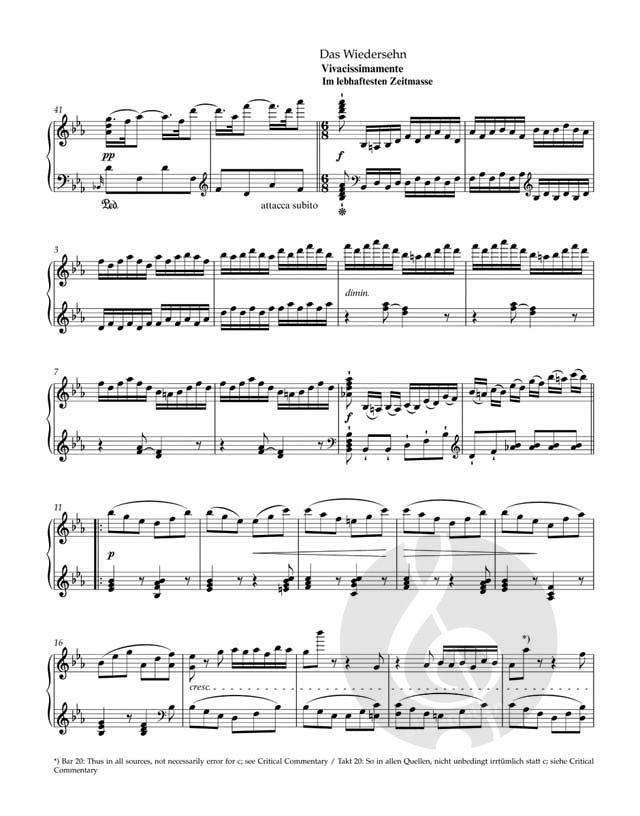
Jonathan Del Mar, a world-renowned authority on the edition of Beethoven's instrumental music, offers a reliably edited musical text based on the latest research findings, the principles of which are revealed in a precisely formulated Critical Commentary. The elegant notation meets the highest practical demands, and in particular the new Bärenreiter edition eliminates the need to turn pages between the slow second movement and the Vivacissimamente which follows "attacca subito". Knowledgeable notes on essential questions of historical performance practice and an informative introduction round off the new edition of the sonata.
Jonathan Del Mar, a world-renowned authority on the edition of Beethoven's instrumental music, offers a reliably edited musical text based on the latest research findings, the principles of which are revealed in a precisely formulated Critical Commentary. The elegant notation meets the highest practical demands, and in particular the new Bärenreiter edition eliminates the need to turn pages between the slow second movement and the Vivacissimamente which follows "attacca subito". Knowledgeable notes on essential questions of historical performance practice and an informative introduction round off the new edition of the sonata.
Here is how the download works:
1 Buy download sheet music
Purchase the download score from our online store
2 Order confirmation with download link
Immediately after completing your order, you will receive an order confirmation by email listing all items. You will find the download link next to each item. You can use this link to start the download right away. Please also check your spam folder if necessary.
Customers rated this product:
Manufacturer Information:
Bärenreiter-Verlag Karl Vötterle GmbH & Co. KG
Heinrich-Schütz-Allee 35-37
34131
Kassel
Deutschland
Related products:

Ludwig van Beethoven
Lebewohl, Abwesenheit und Wiedersehn
- Piano
- Sheet Music (Urtext)
- Bärenreiter Verlag
-
-
ships within 2-4 working days
- Also available for download!
Other customers also bought:

- Piano and Orchestra
- Piano Reduction (Urtext)
- András Schiff
-
in stock
ships within 1-2 working days

- Piano
- Sheet Music (Urtext)
-
ships within 2-4 working days
- Also available for download!
- Piano
- Sheet Music (Urtext)
-
in stock
ships within 1-2 working days - Also available for download!
- Piano
- Sheet Music (Urtext)
-
ships within 2-4 working days
- Also available for download!

- Piano
- Sheet Music (Urtext)
- Joachim Draheim Günter Ludwig
-
in stock
ships within 1-2 working days

- Piano
- Sheet Music (Urtext)
-
ships within 2-4 working days
- Also available for download!
- Piano
- Sheet Music (Urtext)
- Ernst Herttrich
-
in stock
ships within 1-2 working days

- Piano
- Sheet Music (Urtext)
-
in stock
ships within 1-2 working days
- Piano
- Sheet Music (Urtext)
-
in stock
ships within 1-2 working days
Ludwig van Beethoven
- Piano
- Sheet Music (Urtext)
- Murray Perahia
-
in stock
ships within 1-2 working days

- Piano
- Sheet Music (Urtext)
-
in stock
ships within 1-2 working days - Also available for download!

- 2 Pianos 4 Hands
- Piano Reduction (Urtext)
-
in stock
ships within 1-2 working days

- 2 Pianos 4 Hands
- Piano Reduction (Urtext)
-
in stock
ships within 1-2 working days

Benjamin Britten
- 2 Pianos 4 Hands
- Piano Reduction
-
in stock
ships within 1-2 working days

- Piano
- Sheet Music (Urtext)
-
in stock
ships within 1-2 working days - Also available for download!