
Johann Sebastian Bach
Goldberg-Variationen
bearbeitet für Streichquartett
NEW
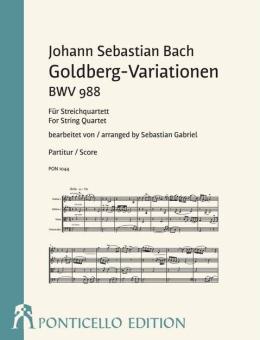
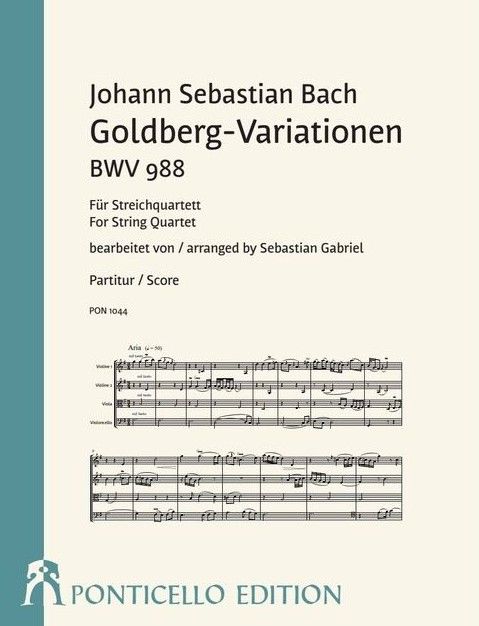
Johann Sebastian Bach
Goldberg-Variationen
bearbeitet für Streichquartett
- Instrumentation String Quartet (2 Violins, Viola and Cello)
- Composer Johann Sebastian Bach
- Editor Sebastian Gabriel
- Edition Score and Parts
- Publisher Ponticello Edition
- Order no. PON1044
 ships within 2-4 working days
incl. tax,
excl. shipping costs
Not available in all countries. Learn more

Description:
The arranger writes about his arrangement of this famous masterpiece:
As a composer and arranger, I was very involved with music for string orchestras and ensembles around the turn of the year 2018/2019. In November 2018, I happened to come across an older Urtext edition of the >Goldberg Variations<—as a pianist, I had already been grappling for quite some time with the challenges of interpreting the work on a modern single-manual concert grand piano— and so, driven by the idea of bringing a new arrangement of this landmark work for string quartet to the market, I began working on this edition.
And one is immersed in the incomprehensible perfection of this music. The more intensely I focused on creating a chamber-music-like interplay—in the best sense of the term—the clearer it became to me that I could not simply assign the upper voice to the first violin’s right hand and the left hand to the cello. Within his composition, Bach allows the voices to sing together—sometimes obviously, sometimes less clearly—but this interplay is always present, and it is what matters most to me in this work. That is why the score was not simply and rigidly divided among four strings; but I always tried to let the baton of the voice leading pass from one instrument to the next, which resulted in a highly interwoven yet crystal-clear musical structure—a musical conversation, a shared singing that I value so highly when making music.
This required careful interventions in the musical text, which have been indicated in this edition using notation marks; in most cases, this involves adding individual notes that either make the piece easier to play or bring a sequence that passes through several instruments to a meaningful conclusion.
I now wish the performers of the >Goldberg Variations< one thing above all: the same reverent joy in the perfection and radiance of this music.
Augsburg, July 2026
Sebastian Gabriel
As a composer and arranger, I was very involved with music for string orchestras and ensembles around the turn of the year 2018/2019. In November 2018, I happened to come across an older Urtext edition of the >Goldberg Variations<—as a pianist, I had already been grappling for quite some time with the challenges of interpreting the work on a modern single-manual concert grand piano— and so, driven by the idea of bringing a new arrangement of this landmark work for string quartet to the market, I began working on this edition.
And one is immersed in the incomprehensible perfection of this music. The more intensely I focused on creating a chamber-music-like interplay—in the best sense of the term—the clearer it became to me that I could not simply assign the upper voice to the first violin’s right hand and the left hand to the cello. Within his composition, Bach allows the voices to sing together—sometimes obviously, sometimes less clearly—but this interplay is always present, and it is what matters most to me in this work. That is why the score was not simply and rigidly divided among four strings; but I always tried to let the baton of the voice leading pass from one instrument to the next, which resulted in a highly interwoven yet crystal-clear musical structure—a musical conversation, a shared singing that I value so highly when making music.
This required careful interventions in the musical text, which have been indicated in this edition using notation marks; in most cases, this involves adding individual notes that either make the piece easier to play or bring a sequence that passes through several instruments to a meaningful conclusion.
I now wish the performers of the >Goldberg Variations< one thing above all: the same reverent joy in the perfection and radiance of this music.
Augsburg, July 2026
Sebastian Gabriel