
Johannes Brahms
Sonata in F major op. 99
for Violoncello and Piano

Johannes Brahms
Sonata in F major op. 99
for Violoncello and Piano
- Instrumentation Cello and Piano
- Edition Score and Parts (Urtext)
-
Difficulty Level
- Composer Johannes Brahms
- Publisher Bärenreiter Verlag
- Series Bärenreiter Urtext
- Editor Clive Brown
- Order no. BA9430
incl. tax,
excl. shipping costs
 in stock
|
ships within 1-2 working days

Description:
> A pioneering Urtext edition
> With an unmarked Urtext part
> With a second part including fingering and bowing based on the practices of contemporaries of Brahms
> With an extensive Performance Practice Commentary
> For further information on Romantic performance practice we recommend the text booklet: 'Performance Practices in Johannes Brahms' Chamber Music', BA9600
Brahms completed his Cello Sonata op. 99 during the productive summer of 1886. The first public performance took place in Vienna on 24 November of the same year. Robert Hausmann played the cello part and the composer himself was his partner at the piano. Even though the work was generally received positively, it took some years until it was fully appreciated and gained its irrevocable place in the cello repertoire.
Of particular value to the editors were the two early performance editions of the Cello Sonata op. 99 by Hugo Becker and Carl Friedberg, as well as by Julius Klengel. Both cellists, Becker and Klengel, had a connection to Brahms who very much admired and trusted Becker's playing and who performed together with Klengel. This edition not only incorporates Becker's and Klengel's performance markings but also Hausmann's for whom the piece was written. As such, the Barenreiter edition comes with a cello part marked with fingering and bowing by the editors which are based on the practices of Brahms' contemporaries. We also provide an unmarked Urtext part.
An important part of this edition is the extensive Preface. Firstly it informs about the work's origin, early performances, its publication as well as early reception. Truly remarkable is the unique Performance Practice Commentary. Here the editors take the premise that already a few decades after Brahms' death, a widening gulf developed between the composer's expectations and the performance practices of the early 20th century. In a very concrete and practical way, the editors summarize some of the key issues in understanding Brahms' notation with regard to rhythm and timing, dynamics and accentuation, dots and strokes, slurring and non legato, piano pedalling and overholding, piano arpeggiation and dislocation, string instrument fingering, string instrument harmonics and vibrato. In this way, the edition offers an exciting and often surprising insight into Romantic musical interpretation.
-
Vorwort
-
Hinweise zur Aufführungspraxis
-
Sonate für Violoncello und Klavier
-
Critical Report
Customers rated this product:
Bärenreiter-Verlag Karl Vötterle GmbH & Co. KG
Heinrich-Schütz-Allee 35-37
34131
Kassel
Deutschland
Sheet music shipping since 1969

Since 1969, over 500,000 customers have trusted us. With a huge selection of over 1,000,000 sheet music titles, we are one of the largest providers in Europe. Thanks to our large stock we can often ship sheet music within 24 hours. No matter what sheet music you are looking for: you are in the right place!
Yours, Stefanie Reichert
Head of Customer Service
Related products:


- Cello and Piano
- Instrumental Score & Parts (Urtext) (Download)
- Bärenreiter Verlag
-
-
in stock
|
Delivery time: 1-3 working days
- Download
Other customers also bought:

- Viola and Piano
- Piano Reduction (Urtext)
- Klaus Schilde Kim Kashkashian
-
in stock
|
ships within 1-2 working days

- Viola and Piano
- Piano reduction with part(s)
-
in stock
|
ships within 1-2 working days
- Also available for download!

- Cello and Piano
- Sheet Music
-
in stock
|
ships within 1-2 working days

- Viola and Piano
- Sheet Music (Urtext)
- Klaus Schilde Tabea Zimmermann
-
in stock
|
ships within 1-2 working days

Ludwig van Beethoven
- Cello and Piano
- Score and Parts and Critical Comment (Urtext)
-
in stock
|
ships within 1-2 working days
- Also available for download!

- Cello
- Sheet Music (Urtext)
-
in stock
|
ships within 1-2 working days
- Also available for download!

Joseph Haydn
- Cello and Piano
- Piano Reduction (Urtext)
-
in stock
|
ships within 1-2 working days

Johannes Brahms
for Violoncello and Piano - Jubilee Edition - 100 Years of Bärenreiter
- Cello and Piano
- Piano Score and Part(s) (Urtext)
-
in stock
|
ships within 1-2 working days
- Also available for download!

- Cello and Piano
- Piano Score and Part(s)
-
in stock
|
ships within 1-2 working days
- Also available for download!

Robert Schumann
for piano and horn - version for violoncello
- Cello and Piano
- Sheet Music (Urtext)
- Klaus Schilde
-
in stock
|
ships within 1-2 working days

- Viola
- Sheet Music
-
in stock
|
ships within 1-2 working days
- Also available for download!

Claude Debussy
- Cello and Piano
- Score and Parts (Urtext)
-
in stock
|
ships within 1-2 working days
- Also available for download!

- Cello and Piano
- Piano reduction with part(s) (Urtext)
- Edward Elgar
-
in stock
|
ships within 1-2 working days
- Also available for download!

- Cello and Piano
- Piano Reduction (Urtext)
-
in stock
|
ships within 1-2 working days






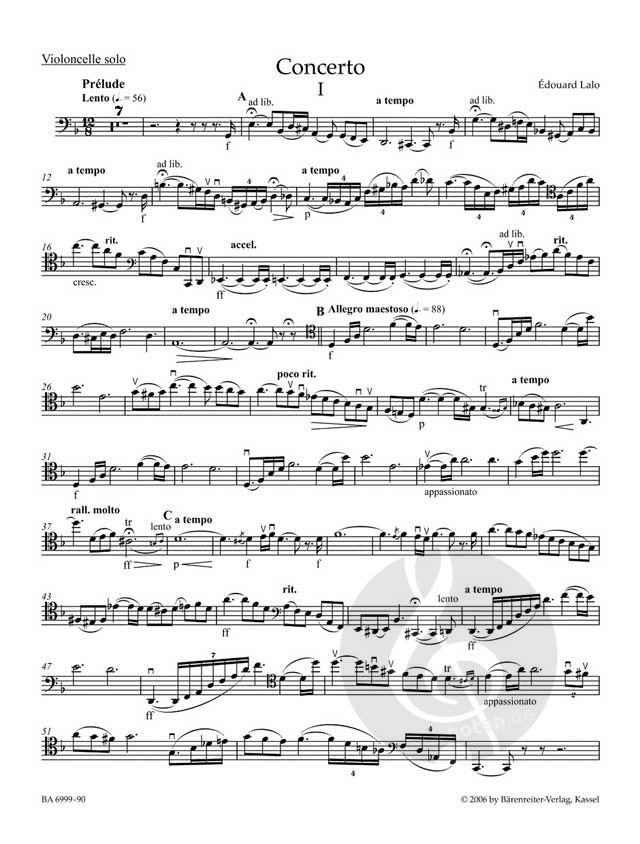
- Cello and Piano
- Piano Reduction (Urtext)
-
in stock
|
ships within 1-2 working days
- Also available for download!