
Arne, Thomas Augustine/Scarlatti, Pietro Filippo
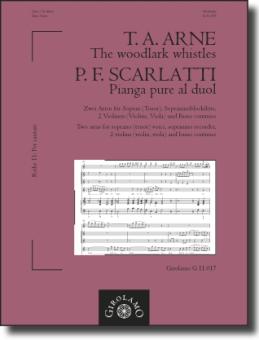
2 Arias: - The woodlark whistles - Pianga pure al duol
Two Arias for Soprano (Tenor), Soprano Recorder, 2 Violins (Violin, Viola), and B.C.
NEW
PDF
view
Arne, Thomas Augustine/Scarlatti, Pietro Filippo
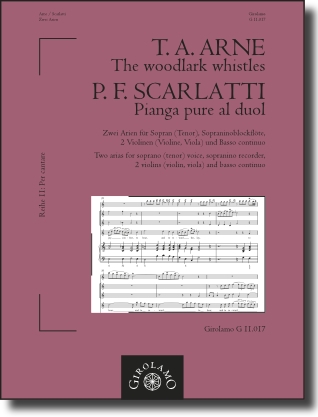
2 Arias: - The woodlark whistles - Pianga pure al duol
Two Arias for Soprano (Tenor), Soprano Recorder, 2 Violins (Violin, Viola), and B.C.
- Instrumentation Soprano, sopranino recorder, 2 violins, and basso continuo
- Optional Instrumentation Tenor, sopranino recorder, violin, viola, and basso continuo
- Composer Arne, Thomas Augustine/Scarlatti, Pietro Filippo
- Editor Peter Thalheimer
- Edition Score and Parts
- Publisher Girolamo Musikverlag
- Order no. GIRO11-017
 ships within 1-2 working days
incl. tax,
excl. shipping costs
Not available in all countries. Learn more

Description:
Two Arias for Soprano (Tenor), Soprano Recorder, 2 Violins (violin, viola), and basso continuo
Edited by Peter Thalheimer
In Baroque-era operas and cantatas, the recorder is often used to express the emotions of love and pain, as well as to imitate natural phenomena such as waves and birdsong. The two arias presented here offer two interesting examples of this genre for practical use. Although stylistically contrasting, they are largely similar in instrumentation. In both works, the soundscape is characterized by a high-pitched recorder.
Thomas Augustine Arne (1710-1778) was born in London and died in his hometown. He studied violin under Michael Christian Festing (1705-1752), who also taught him harmony and counterpoint. Arne's student Charles Burney (1726-1814) described his style as a pleasant blend of Italian, English, and Scottish elements. Arne left behind songs, cantatas, and instrumental music, but above all numerous stage works that were performed to great acclaim at various London theaters and in Dublin.
The aria "The woodlark whistles" is from Arne's opera *Eliza*, based on a libretto by Richard Rolt (1724-1770). The work premiered on May 29, 1754, at London's Haymarket Theatre. The following year, the opera was staged in Dublin, and in 1758 it returned to London for a run at the Theatre Royal on Drury Lane. The title role was performed by Arne's singing student Charlotte Brent (c. 1735-1802).
The part for "Little Flute solo" consists mainly of imitations of the lark's song. It is written for a sopranino recorder, as are the parts for "Octave Flute," "Small Flute," and "Flauto piccolo" in other works by Arne. - The wavy line notated in measure 14 should be understood as an indication of a rhythmic breath vibrato, comparable to the early Baroque tremolo and the bow vibrato used by string players.
Pietro Filippo Scarlatti (1679-1750) was born in Rome and trained as a musician by his father, Alessandro Scarlatti (1660-1725). From 1705 to 1708, Pietro Filippo served as Kapellmeister at the Cathedral of Urbino. In 1712, he succeeded the organist and opera composer Giuseppe Vignola (1662-1712) in Naples.
The cantata "Humanità e Lucifero" was composed in 1704 for the Collegio Nazareno in Rome, an educational and academic institution of the Piarist Order. There, cantatas by the most famous Roman composers were performed annually on the "Feast of the Blessed Virgin Mary." Scarlatti's cantata was performed again in 1719 and 1725. A manuscript of the work is still housed in the library of the Collegio Nazareno. However, the cantata is occasionally attributed to Alessandro Scarlatti as well, because a later copy of the score bears the notation "del Aless[andr]o Scarlatti 1706." The author of the libretto is unknown.
The aria "Pianga pure al duol," sung by Lucifero, is taken from this cantata. It is accompanied by an unusually transparent orchestral arrangement. The bass line is mostly in a high register and is played without chordal accompaniment. The melody is characterized by expressions of pain and wave-like imitations. - The "Flautino" part, notated from b1 to es3, requires only a limited range and—like Alessandro Scarlatti's Flautino parts—can be performed on both the g2 flageolet and the sopranino recorder.
We would like to thank the libraries mentioned in the review report for granting permission to publish.
Schwäbisch Hall, March 2023, Peter Thalheimer
Edited by Peter Thalheimer
In Baroque-era operas and cantatas, the recorder is often used to express the emotions of love and pain, as well as to imitate natural phenomena such as waves and birdsong. The two arias presented here offer two interesting examples of this genre for practical use. Although stylistically contrasting, they are largely similar in instrumentation. In both works, the soundscape is characterized by a high-pitched recorder.
Thomas Augustine Arne (1710-1778) was born in London and died in his hometown. He studied violin under Michael Christian Festing (1705-1752), who also taught him harmony and counterpoint. Arne's student Charles Burney (1726-1814) described his style as a pleasant blend of Italian, English, and Scottish elements. Arne left behind songs, cantatas, and instrumental music, but above all numerous stage works that were performed to great acclaim at various London theaters and in Dublin.
The aria "The woodlark whistles" is from Arne's opera *Eliza*, based on a libretto by Richard Rolt (1724-1770). The work premiered on May 29, 1754, at London's Haymarket Theatre. The following year, the opera was staged in Dublin, and in 1758 it returned to London for a run at the Theatre Royal on Drury Lane. The title role was performed by Arne's singing student Charlotte Brent (c. 1735-1802).
The part for "Little Flute solo" consists mainly of imitations of the lark's song. It is written for a sopranino recorder, as are the parts for "Octave Flute," "Small Flute," and "Flauto piccolo" in other works by Arne. - The wavy line notated in measure 14 should be understood as an indication of a rhythmic breath vibrato, comparable to the early Baroque tremolo and the bow vibrato used by string players.
Pietro Filippo Scarlatti (1679-1750) was born in Rome and trained as a musician by his father, Alessandro Scarlatti (1660-1725). From 1705 to 1708, Pietro Filippo served as Kapellmeister at the Cathedral of Urbino. In 1712, he succeeded the organist and opera composer Giuseppe Vignola (1662-1712) in Naples.
The cantata "Humanità e Lucifero" was composed in 1704 for the Collegio Nazareno in Rome, an educational and academic institution of the Piarist Order. There, cantatas by the most famous Roman composers were performed annually on the "Feast of the Blessed Virgin Mary." Scarlatti's cantata was performed again in 1719 and 1725. A manuscript of the work is still housed in the library of the Collegio Nazareno. However, the cantata is occasionally attributed to Alessandro Scarlatti as well, because a later copy of the score bears the notation "del Aless[andr]o Scarlatti 1706." The author of the libretto is unknown.
The aria "Pianga pure al duol," sung by Lucifero, is taken from this cantata. It is accompanied by an unusually transparent orchestral arrangement. The bass line is mostly in a high register and is played without chordal accompaniment. The melody is characterized by expressions of pain and wave-like imitations. - The "Flautino" part, notated from b1 to es3, requires only a limited range and—like Alessandro Scarlatti's Flautino parts—can be performed on both the g2 flageolet and the sopranino recorder.
We would like to thank the libraries mentioned in the review report for granting permission to publish.
Schwäbisch Hall, March 2023, Peter Thalheimer