
John Weldon
2 Songs upon a Ground: Peace, babbling Muse! - In vain we say
for soprano, 2 alto recorders, and B.C.
NEW
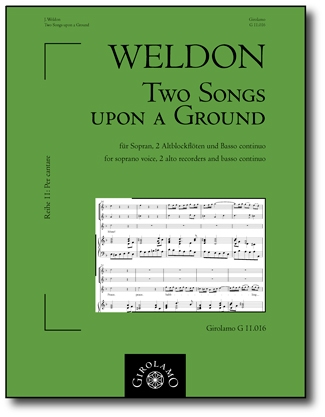
PDF
view
John Weldon
2 Songs upon a Ground: Peace, babbling Muse! - In vain we say
for soprano, 2 alto recorders, and B.C.
- Instrumentation Soprano, 2 alto recorders, and basso continuo
- Composer John Weldon
- Editor Peter Thalheimer
- Edition Score and Parts
- Publisher Girolamo Musikverlag
- Order no. GIRO11-016
 ships within 1-2 working days
incl. tax,
excl. shipping costs
Not available in all countries. Learn more

Description:
for soprano, 2 alto recorders, and basso continuo
Edited by Peter Thalheimer
John Weldon (1676-1736) was trained at Eton by the organist John Walton. From 1693 onward, he was a student of Henry Purcell and was appointed organist at New College, Oxford, as early as 1694. In 1700, he won first prize in a composition competition for the best musical setting of the masque "The Judgment of Paris," thereby surpassing his competitors Daniel Purcell, Gottfried Finger, and John Eccles. The work was performed to great acclaim in 1701 at the Dorset Gardens Theatre in London. In 1708, Weldon succeeded John Blow as organist at the Chapel Royal, and in 1714 he became organist at St. Martin-in-the-Fields. His surviving compositions include anthems, odes, sacred and secular songs, songs for plays, and several instrumental works.
The two songs presented here are taken from a printed score bearing the following title:
Mr. / Weldon's / Third Book of / SONGS /
Beginning with single SONGS /
Performedd at the Consorts in /
York Buildings and at the Theaters /
as well as Symphony Songs / for Violins and Flutes /
never before Published / Carefully Corrected /
by the Author / London (...) I: Walsh [1703]
Copy from the British Library, London, call number G 301 a (RISM A/I/9 W 633).
Both songs follow the tradition of English ground compositions. They are based on bass melodies that recur multiple times and in different registers. The text of the song "Peace, babbling Muse!" is by the English poet and politician Edmund Waller (1606-1687); the author of "In vain we say" is unknown. Stylistically, the songs are influenced by Weldon's teacher, Henry Purcell.
As the note "Sung by Mrs. Linsey" indicates, the vocal part is intended for a female voice. The recorder parts are labeled "First Flute" and "Second Flute." There are no instrumentation specifications for the ground bass. In "Peace, babbling Muse!", the bass in measures 114-117 is divided into an active upper voice and a lower voice consisting of longer note values. In a performance of the figured bass with harpsichord and a bass instrument (e.g., viola da gamba or cello), the bass instrument should take the lower part for tonal reasons, whereas in a performance with organ, the bass instrument may just as well play the upper part. If no additional bass instrument is available, the keyboard instrument must play both bass parts.
The text of the work is rendered in modern spelling. Added slurs appear in the score as dashed lines. The figured bass realisation is a suggestion by the editor and may be modified improvisationally.
Ilshofen, April 2020, Peter Thalheimer
Edited by Peter Thalheimer
John Weldon (1676-1736) was trained at Eton by the organist John Walton. From 1693 onward, he was a student of Henry Purcell and was appointed organist at New College, Oxford, as early as 1694. In 1700, he won first prize in a composition competition for the best musical setting of the masque "The Judgment of Paris," thereby surpassing his competitors Daniel Purcell, Gottfried Finger, and John Eccles. The work was performed to great acclaim in 1701 at the Dorset Gardens Theatre in London. In 1708, Weldon succeeded John Blow as organist at the Chapel Royal, and in 1714 he became organist at St. Martin-in-the-Fields. His surviving compositions include anthems, odes, sacred and secular songs, songs for plays, and several instrumental works.
The two songs presented here are taken from a printed score bearing the following title:
Mr. / Weldon's / Third Book of / SONGS /
Beginning with single SONGS /
Performedd at the Consorts in /
York Buildings and at the Theaters /
as well as Symphony Songs / for Violins and Flutes /
never before Published / Carefully Corrected /
by the Author / London (...) I: Walsh [1703]
Copy from the British Library, London, call number G 301 a (RISM A/I/9 W 633).
Both songs follow the tradition of English ground compositions. They are based on bass melodies that recur multiple times and in different registers. The text of the song "Peace, babbling Muse!" is by the English poet and politician Edmund Waller (1606-1687); the author of "In vain we say" is unknown. Stylistically, the songs are influenced by Weldon's teacher, Henry Purcell.
As the note "Sung by Mrs. Linsey" indicates, the vocal part is intended for a female voice. The recorder parts are labeled "First Flute" and "Second Flute." There are no instrumentation specifications for the ground bass. In "Peace, babbling Muse!", the bass in measures 114-117 is divided into an active upper voice and a lower voice consisting of longer note values. In a performance of the figured bass with harpsichord and a bass instrument (e.g., viola da gamba or cello), the bass instrument should take the lower part for tonal reasons, whereas in a performance with organ, the bass instrument may just as well play the upper part. If no additional bass instrument is available, the keyboard instrument must play both bass parts.
The text of the work is rendered in modern spelling. Added slurs appear in the score as dashed lines. The figured bass realisation is a suggestion by the editor and may be modified improvisationally.
Ilshofen, April 2020, Peter Thalheimer