
Giuseppe Porsile
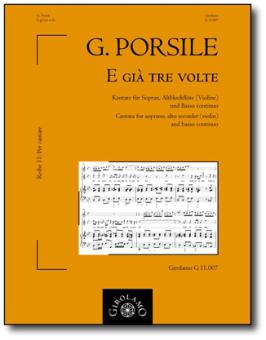
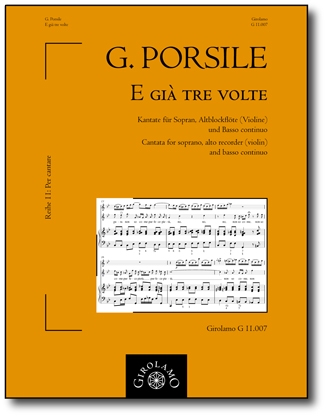
E già tre volte
Cantata for soprano, alto recorder (violin), and B.C.
NEW
PDF
view
Giuseppe Porsile
E già tre volte
Cantata for soprano, alto recorder (violin), and B.C.
- Instrumentation Soprano, alto recorder, and basso continuo
- Optional Instrumentation Soprano, violin, and basso continuo
- Composer Giuseppe Porsile
- Editor Franz Müller-Busch
- Edition Score and Parts
- Publisher Girolamo Musikverlag
- Order no. GIRO11-007
 ships within 1-2 working days
incl. tax,
excl. shipping costs
Not available in all countries. Learn more
Description:
Cantata for Soprano, Alto Recorder (Violin) and basso continuo
Edited by Franz Müller-Busch
Thorough bass realization by Eckhart Kuper
Giuseppe Porsile was born on May 5, 1680, in Naples, where he grew up in a family of musicians and received his training at the local conservatory. As early as 1695, however, Porsile was appointed to Barcelona to lead the court orchestra of Charles II. With the death of Charles II in 1700, the disputes and the War of the Spanish Succession began; these were not ended in 1703 with the proclamation of Charles III as King of Spain, but, on the contrary, intensified. During this time, Porsile remained at the court in Barcelona. In 1711, Charles III was crowned Holy Roman Emperor in Vienna as Charles VI. Porsile followed Charles VI to Vienna that same year and spent the next 39 years at the Habsburg imperial court until his death on May 29, 1750.
Along with Johann Joseph Fux (1660-1741) and Antonio Caldara (ca. 1671-1736), Porsile held important positions in the musical life of the court in Vienna. He composed about 20 operas and 13 oratorios, as well as a considerable number of cantatas and instrumental works. He also served as vocal teacher to Empress Elisabetta Cristina and her daughters Maria Josepha and Maria Amalia.
Only a few of his operas and oratorios were performed outside Vienna. In contrast, copies of his cantatas have survived in Belgium, Germany, England, Italy, and Hungary, suggesting that these works were highly popular. He was also highly regarded for his expressive and passionate arias, as well as the contrapuntal structure of his compositions. This made him the only representative of the Neapolitan School to establish himself at the Habsburg court.
The present cantata, *E già tre volte*, is preserved in the library of the Royal Conservatory in Brussels under the call number Litt. F No. 15.155. It is the first cantata in two related manuscript volumes containing 40 cantatas and 19 individual arias. None of the works in the first volume originally named a composer, but for the first cantata and five others, the notation "de Porsile" was added by a third party both in the table of contents and at the beginning of the respective cantatas. Since the second volume does indeed contain some pieces by Porsile (at least the copyist himself wrote the composer's name), it is not unlikely that E già tre volte was also composed by Porsile.
No instrumentation is specified for the solo part, but given the B-major keys and the range (G-sharp'-E'''), the alto recorder seems exceptionally well-suited as a solo instrument, although a violin or a transverse flute are, of course, also possible options.
Our first edition of the cantata follows the source as closely as possible; only the placement of accidentals and peculiarities in the spelling of the Italian text have been adapted to the form commonly used today. All additions by the editor are marked as such in the score; corrections have been noted in footnotes.
Freiburg, October 2001, Franz Müller-Busch
Edited by Franz Müller-Busch
Thorough bass realization by Eckhart Kuper
Giuseppe Porsile was born on May 5, 1680, in Naples, where he grew up in a family of musicians and received his training at the local conservatory. As early as 1695, however, Porsile was appointed to Barcelona to lead the court orchestra of Charles II. With the death of Charles II in 1700, the disputes and the War of the Spanish Succession began; these were not ended in 1703 with the proclamation of Charles III as King of Spain, but, on the contrary, intensified. During this time, Porsile remained at the court in Barcelona. In 1711, Charles III was crowned Holy Roman Emperor in Vienna as Charles VI. Porsile followed Charles VI to Vienna that same year and spent the next 39 years at the Habsburg imperial court until his death on May 29, 1750.
Along with Johann Joseph Fux (1660-1741) and Antonio Caldara (ca. 1671-1736), Porsile held important positions in the musical life of the court in Vienna. He composed about 20 operas and 13 oratorios, as well as a considerable number of cantatas and instrumental works. He also served as vocal teacher to Empress Elisabetta Cristina and her daughters Maria Josepha and Maria Amalia.
Only a few of his operas and oratorios were performed outside Vienna. In contrast, copies of his cantatas have survived in Belgium, Germany, England, Italy, and Hungary, suggesting that these works were highly popular. He was also highly regarded for his expressive and passionate arias, as well as the contrapuntal structure of his compositions. This made him the only representative of the Neapolitan School to establish himself at the Habsburg court.
The present cantata, *E già tre volte*, is preserved in the library of the Royal Conservatory in Brussels under the call number Litt. F No. 15.155. It is the first cantata in two related manuscript volumes containing 40 cantatas and 19 individual arias. None of the works in the first volume originally named a composer, but for the first cantata and five others, the notation "de Porsile" was added by a third party both in the table of contents and at the beginning of the respective cantatas. Since the second volume does indeed contain some pieces by Porsile (at least the copyist himself wrote the composer's name), it is not unlikely that E già tre volte was also composed by Porsile.
No instrumentation is specified for the solo part, but given the B-major keys and the range (G-sharp'-E'''), the alto recorder seems exceptionally well-suited as a solo instrument, although a violin or a transverse flute are, of course, also possible options.
Our first edition of the cantata follows the source as closely as possible; only the placement of accidentals and peculiarities in the spelling of the Italian text have been adapted to the form commonly used today. All additions by the editor are marked as such in the score; corrections have been noted in footnotes.
Freiburg, October 2001, Franz Müller-Busch