
Giovanni Battista Bononcini
Fuori di sua Capanna
Cantata for Alto (Mezzo-Soprano), Alto Recorder, and B.C.
NEW
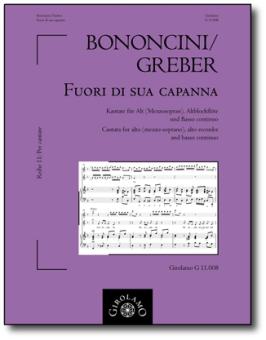
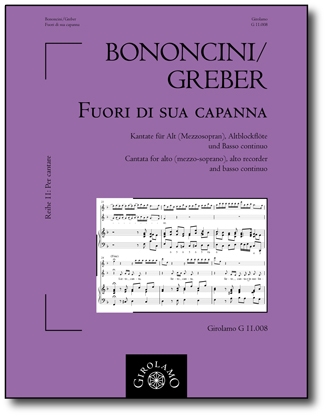
PDF
view
Giovanni Battista Bononcini
Fuori di sua Capanna
Cantata for Alto (Mezzo-Soprano), Alto Recorder, and B.C.
- Instrumentation Alto, alto recorder, and basso continuo
- Optional Instrumentation Mezzo-soprano, alto recorder, and basso continuo
- Composer Giovanni Battista Bononcini
- Editor Franz Müller-Busch
- Edition Score and Parts
- Publisher Girolamo Musikverlag
- Order no. GIRO11-008
 ships within 1-2 working days
incl. tax,
excl. shipping costs
Not available in all countries. Learn more
Description:
Cantata for Alto (Mezzo-Soprano), alto recorder, and basso continuo
Edited by Franz Müller-Busch
Thorough bass realization by Eckhart Kuper
One work, two composers: this is how the source situation of the cantata *Fuori di sua capanna* can be briefly summarized.
It has been preserved in two copies:
The musical content of the two copies is identical, but they differ significantly in the following respects:
Even after a thorough examination of the differences between the two manuscripts, determining the "authorship" of the cantata can remain only a matter of speculation. We have therefore decided to publish the cantata with both composers' names.
Since Greber's version for alto voice, alto recorder, and basso continuo is an extremely rare instrumentation and represents a genuine expansion of the recorder repertoire, Source 1 served as the basis for the present edition. However, more favorable solutions regarding the distribution of the text, as well as the more precise articulation markings from Source 2, have been incorporated into this new edition. All discrepancies between the two sources are documented in the score via footnotes and in the revision report. Only the typographical elements and the spelling of the Italian text have been modernized without explicit indication. Additions by the editor are marked as such.
Freiburg, October 2001, Franz Müller-Busch
Edited by Franz Müller-Busch
Thorough bass realization by Eckhart Kuper
One work, two composers: this is how the source situation of the cantata *Fuori di sua capanna* can be briefly summarized.
It has been preserved in two copies:
- Source 1 (Q1): Cantata a Voce sola / e Flauto solo / Giacomo Greber; Manuscript D-MÜs 3975 (Münster, Episcopal Diocesan Library, Santini Collection). This source is part of a comprehensive volume containing various vocal and instrumental works by G. Greber, A. Scarlatti, and of unknown origin. Giacomo (Jakob) Greber died in 1731.
- Source 2 (Q2): Cantata Del Signor / Bononcini: / e flautto; Manuscript F-Pn Vm7. 55 (Paris, Bibliothèque nationale). It is part of a volume containing 25 Italian cantatas by various composers. Bononcini's first name is missing both from the table of contents and at the beginning of the cantata. It is listed in the catalog of works by Giovanni Bononcini (1670-1747), but could just as easily have been composed by Antonio M. Bononcini (1677-1726).
The musical content of the two copies is identical, but they differ significantly in the following respects:
- The flute part in Q1 is certainly intended for the alto recorder due to its range (f'-f'''), whereas in Q2, due to some octave transpositions, it is written for the transverse flute in a lower register (d'-c''').
- The bass part in Q2 is an octave lower than in Q1 at various points, though the opposite also occurs (rarely).
- The figured bass notation in Q2 is more precise than in Q1. However, there are figures in Q1 that are not present in Q2.
- In Q2, there are only four slurs in total, whereas Q1 contains significantly more slurs.
Even after a thorough examination of the differences between the two manuscripts, determining the "authorship" of the cantata can remain only a matter of speculation. We have therefore decided to publish the cantata with both composers' names.
Since Greber's version for alto voice, alto recorder, and basso continuo is an extremely rare instrumentation and represents a genuine expansion of the recorder repertoire, Source 1 served as the basis for the present edition. However, more favorable solutions regarding the distribution of the text, as well as the more precise articulation markings from Source 2, have been incorporated into this new edition. All discrepancies between the two sources are documented in the score via footnotes and in the revision report. Only the typographical elements and the spelling of the Italian text have been modernized without explicit indication. Additions by the editor are marked as such.
Freiburg, October 2001, Franz Müller-Busch