
Georg Philipp Telemann
Gott weiß, ich bin von Seufzern müde
Cantata for Alto (Bass), 2 Violins (Alto Recorders), and B.C.
NEW
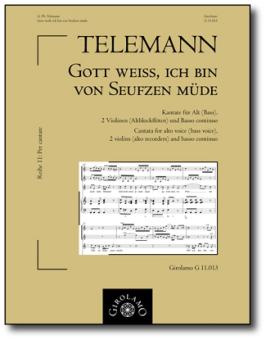
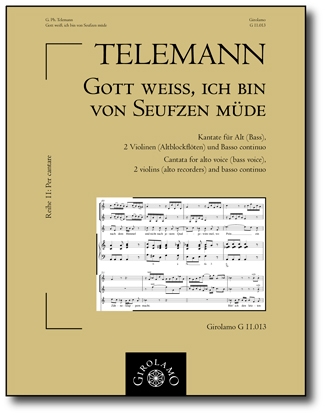
PDF
view
Georg Philipp Telemann
Gott weiß, ich bin von Seufzern müde
Cantata for Alto (Bass), 2 Violins (Alto Recorders), and B.C.
- Instrumentation Alto, 2 violins, and basso continuo
- Optional Instrumentation Bass, 2 alto recorders, and basso continuo
- Composer Georg Philipp Telemann
- Editor Franz Müller-Busch
- Edition Score and Parts
- Publisher Girolamo Musikverlag
- Order no. GIRO11-013
 ships within 2-4 working days
incl. tax,
excl. shipping costs
Not available in all countries. Learn more

Description:
From "Continuation of the Harmonious Divine Service"
Edited by Franz Müller-Busch
Thoroughbass arrangement by Eckhart Kuper
In late 1725, Georg Philipp Telemann published his annual collection of cantatas, "Harmonischer Gottes-Dienst." This was evidently a great success. At the end of 1731—almost exactly six years later—Telemann published the
Continuation / of /
the Harmonious / Divine Service; /
or / sacred / cantatas /
based on the customary Sunday and feast-day /
Gospels throughout the year; / ...
, which in turn contained 72 cantatas for all Sundays and feast days of the church year. The title itself lists the various possible instrumentations. Thus, all instrumental parts can in principle also be performed with just two violins. The score includes the instrumental parts in "staccato notation" at points where the singing pauses. This allows the instruments to be replaced (if necessary) by a keyboard instrument. Larger ensembles were also taken into account: "Tutti" and "Solo" markings in the parts indicate, when a part is played by multiple voices, where to play with a full sound or as a solo. In the case of a single-voice part, the terms "Forte" and "Piano" apply analogously. The soprano part can also be performed by a tenor. The same applies to the alto part, which can be sung by a bass.
The cantata presented here, "Gott weiß, ich bin von Seufzen müde," dates from 1731 and is dedicated to the third Sunday after Epiphany (Three Kings). The two parts marked "Violino ò Flauto dolce, l'ottava più alta" have a range of g-g2 and are to be played by violins in their original pitch or by two alto recorders an octave higher.
The text for the 1731 edition is based on excerpts from the volume *Ruhe nach geschehener Arbeit* by Tobias Heinrich Schubart (1699-1747), published in 1733 by Kißner in Hamburg. Telemann must have had access to the texts years before their publication, which is not surprising given that Schubart had been a pastor at St. Michael's in Hamburg since 1728. The vivid, at times quite graphic language of Schubart's short religious "dramas" or "operas" seems somewhat out of step with the times, with its promise focused on the afterlife and its portrayal of the present as a vale of tears. Since Telemann's artful music ennobles the texts and their interpretation, they should be understood as a testament to their time and not rejected. After all, Bach's cantatas with similar texts are also performed time and again.
Our edition strictly adheres to the 1731 printing, which is preserved in the form of a score and two instrumental parts at the Royal Library in Copenhagen. Additions by the editor are marked as such in the score.
Celle, August 2012, Franz Müller-Busch
Edited by Franz Müller-Busch
Thoroughbass arrangement by Eckhart Kuper
In late 1725, Georg Philipp Telemann published his annual collection of cantatas, "Harmonischer Gottes-Dienst." This was evidently a great success. At the end of 1731—almost exactly six years later—Telemann published the
the Harmonious / Divine Service; /
or / sacred / cantatas /
based on the customary Sunday and feast-day /
Gospels throughout the year; / ...
, which in turn contained 72 cantatas for all Sundays and feast days of the church year. The title itself lists the various possible instrumentations. Thus, all instrumental parts can in principle also be performed with just two violins. The score includes the instrumental parts in "staccato notation" at points where the singing pauses. This allows the instruments to be replaced (if necessary) by a keyboard instrument. Larger ensembles were also taken into account: "Tutti" and "Solo" markings in the parts indicate, when a part is played by multiple voices, where to play with a full sound or as a solo. In the case of a single-voice part, the terms "Forte" and "Piano" apply analogously. The soprano part can also be performed by a tenor. The same applies to the alto part, which can be sung by a bass.
The cantata presented here, "Gott weiß, ich bin von Seufzen müde," dates from 1731 and is dedicated to the third Sunday after Epiphany (Three Kings). The two parts marked "Violino ò Flauto dolce, l'ottava più alta" have a range of g-g2 and are to be played by violins in their original pitch or by two alto recorders an octave higher.
The text for the 1731 edition is based on excerpts from the volume *Ruhe nach geschehener Arbeit* by Tobias Heinrich Schubart (1699-1747), published in 1733 by Kißner in Hamburg. Telemann must have had access to the texts years before their publication, which is not surprising given that Schubart had been a pastor at St. Michael's in Hamburg since 1728. The vivid, at times quite graphic language of Schubart's short religious "dramas" or "operas" seems somewhat out of step with the times, with its promise focused on the afterlife and its portrayal of the present as a vale of tears. Since Telemann's artful music ennobles the texts and their interpretation, they should be understood as a testament to their time and not rejected. After all, Bach's cantatas with similar texts are also performed time and again.
Our edition strictly adheres to the 1731 printing, which is preserved in the form of a score and two instrumental parts at the Royal Library in Copenhagen. Additions by the editor are marked as such in the score.
Celle, August 2012, Franz Müller-Busch