
Georg Philipp Telemann
Lauter Wonne, lauter Freude
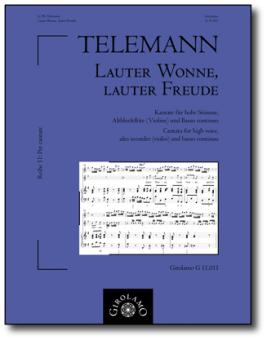
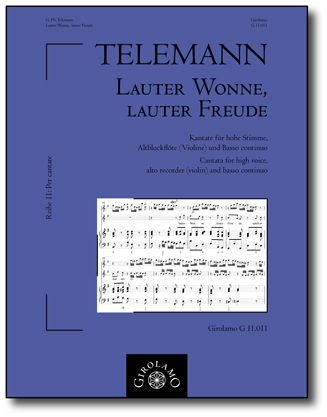
Cantata for voice (high), alto recorder (violin), and B.C.
NEW
PDF
view
Georg Philipp Telemann
Lauter Wonne, lauter Freude
Cantata for voice (high), alto recorder (violin), and B.C.
- Instrumentation Voice (high), alto recorder, and basso continuo
- Optional Instrumentation Voice (high), violin, and basso continuo
- Composer Georg Philipp Telemann
- Editor Franz Müller-Busch
- Edition Score and Parts
- Publisher Girolamo Musikverlag
- Order no. GIRO11-011
 ships within 1-2 working days
incl. tax,
excl. shipping costs
Not available in all countries. Learn more
Description:
Cantata for high voice, alto recorder (violin), and basso continuo
From "Harmonischer Gottesdienst," TWV 1:1040
Edited by Franz Müller-Busch
Thorough bass setting by Eckhart Kuper
In 1725, Georg Philipp Telemann's annual collection of cantatas was published in Hamburg under the title:
Harmonischer / Gottes-Dienst / oder / geistliche / Cantaten / zum allgemeinen Gebrauche /
which / are intended to promote both private / and public / church worship /
based on the customary Sunday and feast-day epistles throughout the year / … /
Set to music and prepared for printing by /
Georg Philipp Telemann / Chori Musici Hamb. Director / …
The cantata "Lauter Wonne, lauter Freude" is assigned to the fourth Sunday of Advent. The TVWV lists the cantata under number 1:1040. The text was written by Matthäus Arnold Wilkens (1691-1745) and is based primarily on chapter 4 of Paul's Epistle to the Philippians, verses 4 through 9.
The 1725 edition, preserved in the Royal Library of Copenhagen, Giedde's Music Collection, under the call number [mu 6208.0586 (XI, 8)], served as the basis for this edition. We would like to express our sincere thanks to the Music Department, and in particular to Ms. Susanne Thorbek, for their kind support and permission to reprint this work.
The notation (clefs, accidentals, etc.) has been adapted to current standards, but the text has been deliberately left in its original form. Additions by the editor are indicated directly in the musical text using parentheses or strikethroughs. A few errors have been corrected without comment.
Measures 7 (second half) through 17 (first half) of the first aria are marked with repeat signs in the original manuscript. In this edition, the repeat has been written out in full to improve the transition points in the score. If necessary, however, the section marked "Vi-de" may be omitted.
In his preliminary report on the "Harmonischer Gottesdienst," Telemann discusses various aspects of performance practice in detail. Thus, the present cantata is written for a high voice—specifically for soprano or tenor. It is possible that in the ripieno passages marked "forte," the recorder may be supported by a violin playing an octave lower than notated. The recorder part can be taken over entirely by a violin, in which case, too, at least the ripieno passages should be transposed down an octave.
Telemann discusses the treatment of the singing voice in the recitative in detail and uses numerous musical examples to illustrate that the notation often deviates significantly from the intended performance. This applies in particular to the last two notes before rests, though passing notes and appoggiaturas may also be inserted in other places. Naturally, the recitative should be sung with free rhythm. Detailed explanations regarding the performance of recitatives in church can be found, among other places, in Tosi/Agricola's Guide to the Art of Singing.
Celle, February 2009, Franz Müller-Busch
From "Harmonischer Gottesdienst," TWV 1:1040
Edited by Franz Müller-Busch
Thorough bass setting by Eckhart Kuper
In 1725, Georg Philipp Telemann's annual collection of cantatas was published in Hamburg under the title:
which / are intended to promote both private / and public / church worship /
based on the customary Sunday and feast-day epistles throughout the year / … /
Set to music and prepared for printing by /
Georg Philipp Telemann / Chori Musici Hamb. Director / …
The cantata "Lauter Wonne, lauter Freude" is assigned to the fourth Sunday of Advent. The TVWV lists the cantata under number 1:1040. The text was written by Matthäus Arnold Wilkens (1691-1745) and is based primarily on chapter 4 of Paul's Epistle to the Philippians, verses 4 through 9.
The 1725 edition, preserved in the Royal Library of Copenhagen, Giedde's Music Collection, under the call number [mu 6208.0586 (XI, 8)], served as the basis for this edition. We would like to express our sincere thanks to the Music Department, and in particular to Ms. Susanne Thorbek, for their kind support and permission to reprint this work.
The notation (clefs, accidentals, etc.) has been adapted to current standards, but the text has been deliberately left in its original form. Additions by the editor are indicated directly in the musical text using parentheses or strikethroughs. A few errors have been corrected without comment.
Measures 7 (second half) through 17 (first half) of the first aria are marked with repeat signs in the original manuscript. In this edition, the repeat has been written out in full to improve the transition points in the score. If necessary, however, the section marked "Vi-de" may be omitted.
In his preliminary report on the "Harmonischer Gottesdienst," Telemann discusses various aspects of performance practice in detail. Thus, the present cantata is written for a high voice—specifically for soprano or tenor. It is possible that in the ripieno passages marked "forte," the recorder may be supported by a violin playing an octave lower than notated. The recorder part can be taken over entirely by a violin, in which case, too, at least the ripieno passages should be transposed down an octave.
Telemann discusses the treatment of the singing voice in the recitative in detail and uses numerous musical examples to illustrate that the notation often deviates significantly from the intended performance. This applies in particular to the last two notes before rests, though passing notes and appoggiaturas may also be inserted in other places. Naturally, the recitative should be sung with free rhythm. Detailed explanations regarding the performance of recitatives in church can be found, among other places, in Tosi/Agricola's Guide to the Art of Singing.
Celle, February 2009, Franz Müller-Busch