
Georg Friedrich Händel
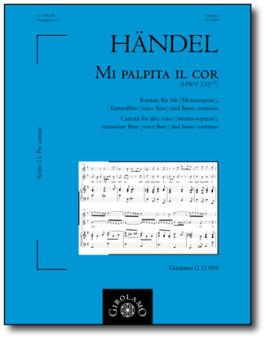
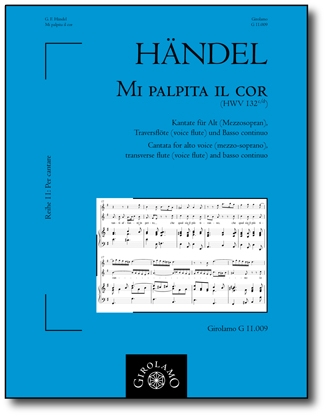
Mi palpita il cor HWV 132c/d
Cantata for Alto (Mezzo-Soprano), Transverse Flute, and B.C.
NEW
PDF
view
Georg Friedrich Händel
Mi palpita il cor HWV 132c/d
Cantata for Alto (Mezzo-Soprano), Transverse Flute, and B.C.
- Instrumentation Alto, flute, and basso continuo
- Optional Instrumentation Mezzo-soprano, flute, and basso continuo
- Composer Georg Friedrich Händel
- Editor Franz Müller-Busch
- Edition Score and Parts
- Publisher Girolamo Musikverlag
- Order no. GIRO11-009
 ships within 1-2 working days
incl. tax,
excl. shipping costs
Not available in all countries. Learn more
Description:
Cantata for alto (mezzo-soprano), (traverso) flute (voice flute), and basso continuo
Edited by Franz Müller-Busch
Thorough bass realization by Eckhart Kuper
During his early years in England, from about 1710 to 1713, George Frideric Handel (1685-1759) wrote at least three versions of the cantata with the text "Mi palpita il cor," whose musical material only partially overlaps.
The source situation is relatively complex: while the Handel Works Catalog lists four versions of the cantata (a-d), at least six versions of complete cantatas or individual arias exist. Furthermore, various manuscripts exhibit significant variations and ornamentations, the origins of which have only been partially clarified.
This edition is based on Handel's autographs for the cantata, which specify the transverse flute as the solo instrument. These are preserved at the British Library in London under the call numbers R.M.20.g.8. (HWV 132c, complete cantata) and R.M.20.e.4. (HWV 132d, 1st aria only).
The various copies indicate that the first two arias, "Ho tanti affani in petto," are of equal standing and that either one or the other may be used in the overall structure of the cantata; for this reason, both have been included here.
The edition follows the autograph as closely as is possible and practical for everyday use, though other versions and additional copies by different hands have been partially taken into account. Some obviously missing key signatures have been added, and spelling errors have been corrected (see footnotes in the score). Additional additions, some of which are taken from manuscripts not classified as primary sources, have been marked as such. The Italian text has been adapted in a few details to standard spelling conventions and punctuated.
To perform the cantata on the recorder rather than the transverse flute, it is recommended—in accordance with the customary practice of the late Baroque period, as it was particularly cultivated in England—to use a "voice flute," that is, a recorder with a fundamental pitch of D'. For players who are not sufficiently practiced in the necessary technique of transposition, a separate part is included that is to be played using alto recorder fingering.
Freiburg, July 2003, Franz Müller-Busch
Edited by Franz Müller-Busch
Thorough bass realization by Eckhart Kuper
During his early years in England, from about 1710 to 1713, George Frideric Handel (1685-1759) wrote at least three versions of the cantata with the text "Mi palpita il cor," whose musical material only partially overlaps.
The source situation is relatively complex: while the Handel Works Catalog lists four versions of the cantata (a-d), at least six versions of complete cantatas or individual arias exist. Furthermore, various manuscripts exhibit significant variations and ornamentations, the origins of which have only been partially clarified.
This edition is based on Handel's autographs for the cantata, which specify the transverse flute as the solo instrument. These are preserved at the British Library in London under the call numbers R.M.20.g.8. (HWV 132c, complete cantata) and R.M.20.e.4. (HWV 132d, 1st aria only).
The various copies indicate that the first two arias, "Ho tanti affani in petto," are of equal standing and that either one or the other may be used in the overall structure of the cantata; for this reason, both have been included here.
The edition follows the autograph as closely as is possible and practical for everyday use, though other versions and additional copies by different hands have been partially taken into account. Some obviously missing key signatures have been added, and spelling errors have been corrected (see footnotes in the score). Additional additions, some of which are taken from manuscripts not classified as primary sources, have been marked as such. The Italian text has been adapted in a few details to standard spelling conventions and punctuated.
To perform the cantata on the recorder rather than the transverse flute, it is recommended—in accordance with the customary practice of the late Baroque period, as it was particularly cultivated in England—to use a "voice flute," that is, a recorder with a fundamental pitch of D'. For players who are not sufficiently practiced in the necessary technique of transposition, a separate part is included that is to be played using alto recorder fingering.
Freiburg, July 2003, Franz Müller-Busch