
Benedetto Marcello
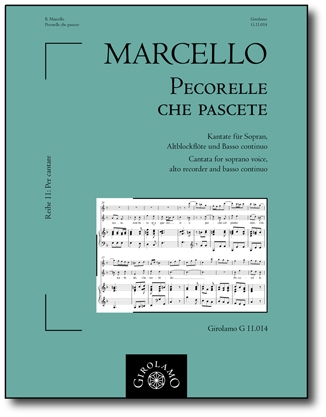
Pecorelle che pascete
Cantata for Soprano, Alto Recorder, and B.C.
NEW
PDF
view
Benedetto Marcello
Pecorelle che pascete
Cantata for Soprano, Alto Recorder, and B.C.
- Instrumentation Soprano, alto recorder and basso continuo
- Composer Benedetto Marcello
- Editor Enrico Zanoni
- Edition Score and Parts
- Publisher Girolamo Musikverlag
- Order no. GIRO11-014
 ships within 1-2 working days
incl. tax,
excl. shipping costs
Not available in all countries. Learn more
Description:
Cantata for soprano, alto recorder, and basso continuo
Edited by Enrico Zanoni
Thorough bass realization by Eckhart Kuper
The cantata *Pecorelle che pascete* is titled "Cantata a Flauto solo" and is part of the manuscript *Cantate 26*, which is preserved in the famous and extensive library of the Conservatorio di musica S. Pietro a Majella in Naples (RISM: I-Nc Cantate 26). The volume consists of 156 pages and contains more than 20 secular cantatas by various composers from northern and southern Italy, such as A. Scarlatti, P. Sammartini, B. Marcello, F. Gasparini, N. Porpora, and D. N. Sarro, from the first half of the 18th century. It contains a total of five cantatas for voice, recorder, and basso continuo, mostly by anonymous composers.
Although "Pecorelle che pascete" appears in the manuscript as Cantata 26 without the composer's name, research has revealed that it is a cantata by Benedetto Marcello (1686-1739). This Venetian nobleman—a composer, music theorist, poet, and writer—was also known as Driante Sacreo, a name he adopted upon his admission to the Accademia d'Arcadia. An earlier version of this work was written for soprano and basso continuo without any additional obbligato instrument. The fact that this version is included in various manuscript volumes demonstrates how highly it was regarded at the time. A manuscript of the two-voice version (GB-Lbl Add MS 14215) contains the important note:. The Neapolitan version with an obbligato recorder part is dated 1724, which is why this is presumably an arrangement of the earlier two-part cantata.
Although there is no evidence that Marcello personally added the recorder part to his cantata, there is also nothing to prevent us from assuming that Marcello himself prepared the arrangement of one of his most famous cantatas. The addition of a recorder part seems logical for a composer who published the collection of recorder sonatas *Suonate a flauto solo con il suo basso continuo*, Op. 2, Venice 1712.
Despite the absence of the composer's name in the source, there are several reasons that support the assumption that Marcello might be the author of the arrangement published here. Two facts in particular support this theory: First, the manuscript containing Cantata 26 includes another cantata by Marcello, *Se nel mondo v'e' mai*, scored for soprano and basso continuo and dated 1726. Second, there are other Neapolitan manuscripts with recorder music from the same period that contain arias without composer attributions. Nevertheless, we know for certain that these pieces are by the same composer as other works in the same manuscript. The absence of the composer's name may have been an oversight on the part of the copyist. Or perhaps the piece was so famous in its day that a mention was simply unnecessary.
The added recorder part is not the only significant difference between the two versions: All two-part versions we have seen contain the same recitative, whose text matches that of the three-part version, but which has been set to music completely differently here. We would also like to point out that the pastoral verses of the cantata may also have been written by Benedetto Marcello, who was, as is well known, an accomplished poet and writer.
Translation: F. Müller-Busch
London, August 2011, Enrico Zanoni
Edited by Enrico Zanoni
Thorough bass realization by Eckhart Kuper
The cantata *Pecorelle che pascete* is titled "Cantata a Flauto solo" and is part of the manuscript *Cantate 26*, which is preserved in the famous and extensive library of the Conservatorio di musica S. Pietro a Majella in Naples (RISM: I-Nc Cantate 26). The volume consists of 156 pages and contains more than 20 secular cantatas by various composers from northern and southern Italy, such as A. Scarlatti, P. Sammartini, B. Marcello, F. Gasparini, N. Porpora, and D. N. Sarro, from the first half of the 18th century. It contains a total of five cantatas for voice, recorder, and basso continuo, mostly by anonymous composers.
Although "Pecorelle che pascete" appears in the manuscript as Cantata 26 without the composer's name, research has revealed that it is a cantata by Benedetto Marcello (1686-1739). This Venetian nobleman—a composer, music theorist, poet, and writer—was also known as Driante Sacreo, a name he adopted upon his admission to the Accademia d'Arcadia. An earlier version of this work was written for soprano and basso continuo without any additional obbligato instrument. The fact that this version is included in various manuscript volumes demonstrates how highly it was regarded at the time. A manuscript of the two-voice version (GB-Lbl Add MS 14215) contains the important note:
Although there is no evidence that Marcello personally added the recorder part to his cantata, there is also nothing to prevent us from assuming that Marcello himself prepared the arrangement of one of his most famous cantatas. The addition of a recorder part seems logical for a composer who published the collection of recorder sonatas *Suonate a flauto solo con il suo basso continuo*, Op. 2, Venice 1712.
Despite the absence of the composer's name in the source, there are several reasons that support the assumption that Marcello might be the author of the arrangement published here. Two facts in particular support this theory: First, the manuscript containing Cantata 26 includes another cantata by Marcello, *Se nel mondo v'e' mai*, scored for soprano and basso continuo and dated 1726. Second, there are other Neapolitan manuscripts with recorder music from the same period that contain arias without composer attributions. Nevertheless, we know for certain that these pieces are by the same composer as other works in the same manuscript. The absence of the composer's name may have been an oversight on the part of the copyist. Or perhaps the piece was so famous in its day that a mention was simply unnecessary.
The added recorder part is not the only significant difference between the two versions: All two-part versions we have seen contain the same recitative, whose text matches that of the three-part version, but which has been set to music completely differently here. We would also like to point out that the pastoral verses of the cantata may also have been written by Benedetto Marcello, who was, as is well known, an accomplished poet and writer.
Translation: F. Müller-Busch
London, August 2011, Enrico Zanoni