
Giuseppe Porsile
Posa sopra d'un faggio
Cantata for Soprano, Alto Recorder, and B.C.
NEW
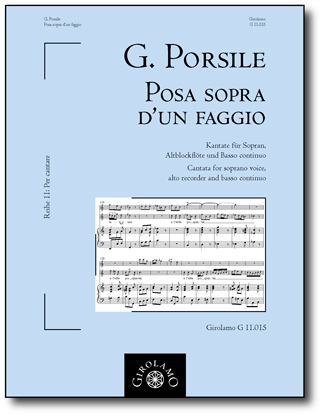
PDF
view
Giuseppe Porsile
Posa sopra d'un faggio
Cantata for Soprano, Alto Recorder, and B.C.
- Instrumentation Soprano, alto recorder and basso continuo
- Composer Giuseppe Porsile
- Editor Franz Müller-Busch
- Edition Score and Parts
- Publisher Girolamo Musikverlag
- Order no. GIRO11-015
 ships within 1-2 working days
incl. tax,
excl. shipping costs
Not available in all countries. Learn more
Description:
Cantata for Soprano, Alto Recorder, and Basso Continuo
Edited by Franz Müller-Busch
Thorough bass realization by Eckhart Kuper
Giuseppe Porsile was born on May 5, 1680, in Naples, where he grew up in a family of musicians and received his training at the local conservatory. As early as 1695, however, Porsile was appointed to Barcelona to lead the court orchestra of Charles II. With the death of Charles II in 1700, the disputes and the War of the Spanish Succession began; these were not ended in 1703 with the proclamation of Charles III as King of Spain, but, on the contrary, intensified. During this time, Porsile remained at the court in Barcelona. In 1711, Charles III was crowned Holy Roman Emperor in Vienna as Charles VI. Porsile followed Charles VI to Vienna that same year and spent the next 39 years at the Habsburg imperial court until his death on May 29, 1750.
Along with Johann Joseph Fux (1660-1741) and Antonio Caldara (ca. 1671-1736), Porsile held important positions in the musical life of the court in Vienna. He composed about 20 operas and 13 oratorios, as well as a considerable number of cantatas and instrumental works. He also served as vocal teacher to Empress Elisabetta Cristina and her daughters Maria Josepha and Maria Amalia.
Only a few of his operas and oratorios were performed outside Vienna. In contrast, copies of his cantatas have survived in Belgium, Germany, England, Italy, and Hungary, suggesting that these works were highly popular. He was also highly regarded for his expressive and passionate arias, as well as the contrapuntal structure of his compositions. This made him the only representative of the Neapolitan School to establish himself at the Habsburg court.
The present cantata, *Posa sopra d'un faggio*, comes from a manuscript volume with the call number "Manuscript 1577a," which is preserved at the Liszt Ferenc Academy of Music in Budapest, Hungary. The volume, compiled around 1840, bears the title "Cantate / per una voce / del Signor Giuseppe Porsile" and originally came from the singing school of the Ofen-Buda Choral Society. It contains a total of 28 cantatas. The cantata itself is titled "Cantata. 26. à Flauto solo." and does not bear the composer's name.
Our first edition of the cantata follows the source as closely as possible; only the typographical marks and peculiarities of the Italian text's spelling have been adapted to today's standard form. All additions by the editor are clearly marked as such in the score.
Celle, June 2015, Franz Müller-Busch
Edited by Franz Müller-Busch
Thorough bass realization by Eckhart Kuper
Giuseppe Porsile was born on May 5, 1680, in Naples, where he grew up in a family of musicians and received his training at the local conservatory. As early as 1695, however, Porsile was appointed to Barcelona to lead the court orchestra of Charles II. With the death of Charles II in 1700, the disputes and the War of the Spanish Succession began; these were not ended in 1703 with the proclamation of Charles III as King of Spain, but, on the contrary, intensified. During this time, Porsile remained at the court in Barcelona. In 1711, Charles III was crowned Holy Roman Emperor in Vienna as Charles VI. Porsile followed Charles VI to Vienna that same year and spent the next 39 years at the Habsburg imperial court until his death on May 29, 1750.
Along with Johann Joseph Fux (1660-1741) and Antonio Caldara (ca. 1671-1736), Porsile held important positions in the musical life of the court in Vienna. He composed about 20 operas and 13 oratorios, as well as a considerable number of cantatas and instrumental works. He also served as vocal teacher to Empress Elisabetta Cristina and her daughters Maria Josepha and Maria Amalia.
Only a few of his operas and oratorios were performed outside Vienna. In contrast, copies of his cantatas have survived in Belgium, Germany, England, Italy, and Hungary, suggesting that these works were highly popular. He was also highly regarded for his expressive and passionate arias, as well as the contrapuntal structure of his compositions. This made him the only representative of the Neapolitan School to establish himself at the Habsburg court.
The present cantata, *Posa sopra d'un faggio*, comes from a manuscript volume with the call number "Manuscript 1577a," which is preserved at the Liszt Ferenc Academy of Music in Budapest, Hungary. The volume, compiled around 1840, bears the title "Cantate / per una voce / del Signor Giuseppe Porsile" and originally came from the singing school of the Ofen-Buda Choral Society. It contains a total of 28 cantatas. The cantata itself is titled "Cantata. 26. à Flauto solo." and does not bear the composer's name.
Our first edition of the cantata follows the source as closely as possible; only the typographical marks and peculiarities of the Italian text's spelling have been adapted to today's standard form. All additions by the editor are clearly marked as such in the score.
Celle, June 2015, Franz Müller-Busch