
Johann Christoph Pepusch
When Loves Soft Passion
Cantata for Soprano, Alto Recorder, and B.C.
NEW
PDF
view
Johann Christoph Pepusch
When Loves Soft Passion
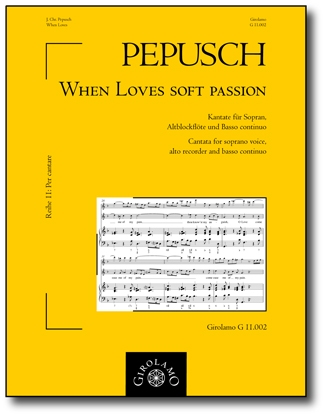
Cantata for Soprano, Alto Recorder, and B.C.
- Instrumentation Soprano, alto recorder and basso continuo
- Composer Johann Christoph Pepusch
- Editor Franz Müller-Busch
- Edition Score and Parts
- Publisher Girolamo Musikverlag
- Order no. GIRO11-002
 ships within 1-2 working days
incl. tax,
excl. shipping costs
Not available in all countries. Learn more
Description:
Cantata for Soprano, alto recorder, and basso continuo
Edited by Franz Müller-Busch
Thorough bass notation by Eckhart Kuper
This edition is based on the print published around 1720 by Walsh in London under the title
Six / English Cantatas / ... / Compos'd by / J.C. Pepusch / Book the Second
Of the six cantatas in this volume, four are scored for soprano, alto recorder, and basso continuo. The use of the alto recorder likely stems, on the one hand, from the general popularity of this instrument in England at the time, and on the other hand, from the fact that James, Duke of Chandos—to whom this volume is dedicated—played the recorder himself. The cantata *When Loves soft passion* is based on a text by James Blackley.
Obvious typographical errors in the original have been silently corrected, and the use of musical accidentals has been adapted to modern conventions. The original figureation has been retained, as have the bar lines for the eighth and sixteenth notes. The editor's few additions are marked. The recitatives are to be performed with free rhythm.
Johann Christoph Pepusch was born in Berlin in 1667 and died in London in 1752. He received his early education in Germany and was appointed to a position at the Prussian court at the age of 14. There, he later witnessed the execution of an officer without a trial—an arbitrary act that prompted the then-30-year-old to set out in search of a country whose political system was founded on better principles. In 1704, he arrived in England, his future home, where he first made a name for himself as a violist but soon became known as a composer, music director, music theorist, and organist. In 1713, he received the title of Doctor of Music from the University of Oxford. As early as 1710, he founded the Academy of Ancient Music in London, which was dedicated to the performance and study of music from bygone eras, dating back to Greco-Roman antiquity. Pepusch became famous for his involvement in several pieces from *The Beggar's Opera*. His most productive period spanned the years 1710 to 1730, from which a relatively large number of his compositions have survived, primarily in printed form. He devoted the last 20 years of his life increasingly to research in the field of early music and to collecting old books and musical manuscripts.
Calw, November 1993/95, Franz Müller-Busch
Edited by Franz Müller-Busch
Thorough bass notation by Eckhart Kuper
This edition is based on the print published around 1720 by Walsh in London under the title
Of the six cantatas in this volume, four are scored for soprano, alto recorder, and basso continuo. The use of the alto recorder likely stems, on the one hand, from the general popularity of this instrument in England at the time, and on the other hand, from the fact that James, Duke of Chandos—to whom this volume is dedicated—played the recorder himself. The cantata *When Loves soft passion* is based on a text by James Blackley.
Obvious typographical errors in the original have been silently corrected, and the use of musical accidentals has been adapted to modern conventions. The original figureation has been retained, as have the bar lines for the eighth and sixteenth notes. The editor's few additions are marked. The recitatives are to be performed with free rhythm.
Johann Christoph Pepusch was born in Berlin in 1667 and died in London in 1752. He received his early education in Germany and was appointed to a position at the Prussian court at the age of 14. There, he later witnessed the execution of an officer without a trial—an arbitrary act that prompted the then-30-year-old to set out in search of a country whose political system was founded on better principles. In 1704, he arrived in England, his future home, where he first made a name for himself as a violist but soon became known as a composer, music director, music theorist, and organist. In 1713, he received the title of Doctor of Music from the University of Oxford. As early as 1710, he founded the Academy of Ancient Music in London, which was dedicated to the performance and study of music from bygone eras, dating back to Greco-Roman antiquity. Pepusch became famous for his involvement in several pieces from *The Beggar's Opera*. His most productive period spanned the years 1710 to 1730, from which a relatively large number of his compositions have survived, primarily in printed form. He devoted the last 20 years of his life increasingly to research in the field of early music and to collecting old books and musical manuscripts.
Calw, November 1993/95, Franz Müller-Busch