
Johannes Brahms
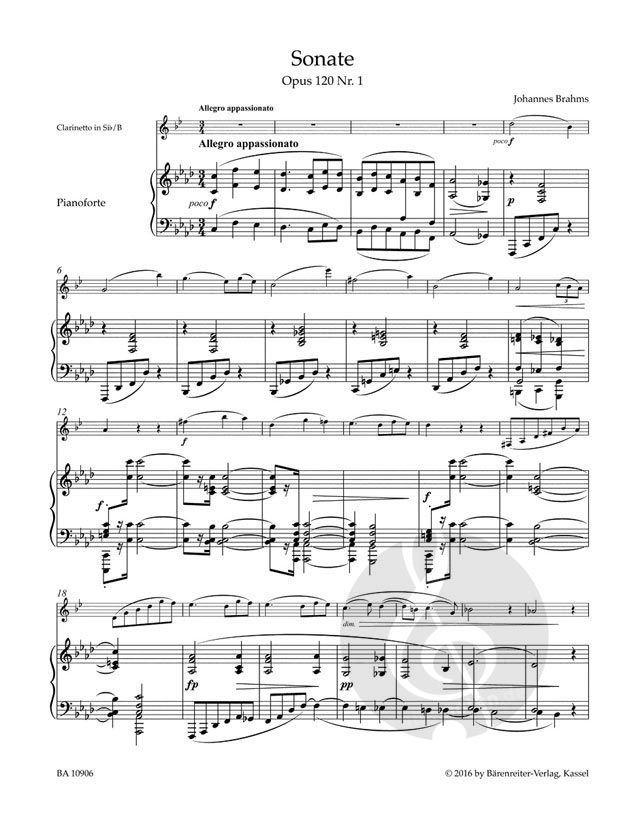
Sonatas in F minor and E-flat major op. 120
for Bb clarinet and piano

PDF
view
Recommend
recommend item
Johannes Brahms
Sonatas in F minor and E-flat major op. 120
for Bb clarinet and piano
- Instrumentation Clarinet and Piano
- Edition Score and Parts (Urtext)
-
Difficulty Level
- Composer Johannes Brahms
- Publisher Bärenreiter Verlag
- Series Bärenreiter Urtext
- Editor Clive Brown
- Order no. BA10906
incl. tax,
excl. shipping costs
 in stock
|
ships within 1-2 working days

Description:
> A pioneering Urtext edition
> With an extensive Performance Practice Commentary
> For further information on Romantic performance practice we recommend the text booklet: 'Performance Practices in Johannes Brahms' Chamber Music', BA9600
Brahms had already announced his 'retirement' from composition when in the spring of 1894 he played chamber music with the cellist Robert Hausmann and the clarinettist Richard Mühlfeld. This encounter apparently renewed his enthusiasm for Mühlfeld's much admired playing and inspired him to write two clarinet sonatas in the summer of the same year. Brahms and Mühlfeld premiered the works and played them in several performances until the sonatas op. 120 were first published in June of 1895. They remain pivotal works in the clarinet's recital repertoire establishing the clarinet sonata as a distinct and viable chamber music genre.
An important part of this edition is the extensive preface. Firstly it informs about the sonatas' origins, their compositional process, pre-publication performances, their publication history as well as early reception. Truly remarkable is the unique Performance Practice Commentary. Here the editors start from the premise that already a few decades after Brahms' death, a widening gulf developed between the composer's expectations and the performance practices of the early 20th century. On the basis of manifold sources which include memoirs by pupils and chamber music partners, treatises and essays, early instructive editions and historical recordings, the editors deal with key issues in understanding Brahms' notation. By a section-by-section analysis of rhythm and timing, dynamics and accentuation, dots and strokes, slurring and non legato, piano pedalling and overholding, piano arpeggiation and dislocation, clarinet vibrato and portamento, the editors provide an indispensable assistance for a historically informed interpretation of the work. At the same time, the edition offers an exciting and often surprising insight into musical interpretation of the German Romantic Era in general.
-
Vorwort Preface
-
Hinweise zur Aufführungspraxis Performance Practice Commentary
-
Sonate f-Moll op. 120/1
-
Sonate Es-Dur op. 120/2
-
Critical Report
Customers rated this product:
Bärenreiter-Verlag Karl Vötterle GmbH & Co. KG
Heinrich-Schütz-Allee 35-37
34131
Kassel
Deutschland
Sheet music shipping since 1969

Since 1969, over 500,000 customers have trusted us. With a huge selection of over 1,000,000 sheet music titles, we are one of the largest providers in Europe. Thanks to our large stock we can often ship sheet music within 24 hours. No matter what sheet music you are looking for: you are in the right place!
Yours, Stefanie Reichert
Head of Customer Service
Related products:


- Clarinet and Piano
- Instrumental Score & Parts (Urtext) (Download)
- Bärenreiter Verlag
-
-
in stock
|
Delivery time: 1-3 working days
- Download
Other customers also bought:

Alfred Uhl
- Clarinet
- Sheet Music
-
in stock
|
ships within 1-2 working days
- Also available for download!

Alfred Uhl
- Clarinet
- Sheet Music
-
in stock
|
ships within 1-2 working days
- Also available for download!

Fritz Kröpsch
167 Studies for Beginners (Revised Edition)
- Clarinet
- Sheet Music
-
in stock
|
ships within 1-2 working days

- Clarinet
- Sheet Music
-
in stock
|
ships within 1-2 working days

Camille Saint-Saëns
- Clarinet and Piano
- Piano Score and Part(s) (Urtext)
- Klaus Schilde
-
in stock
|
ships within 1-2 working days

Luciano Berio
- Clarinet
- Sheet Music
-
in stock
|
ships within 1-2 working days

Alexander Skrjabin
- Piano
- Sheet Music (Urtext)
-
ships within 2-4 working days
- Also available for download!

Alexander Skrjabin
- Piano
- Sheet Music (Urtext)
-
ships within 2-4 working days

Johannes Brahms
- Violin, Viola, Cello and Piano
- Set of Parts (Urtext)
-
in stock
|
ships within 1-2 working days

- Piano
- Sheet Music (Urtext)
-
ships within 2-4 working days
- Also available for download!

- Violin and Piano
- Piano Score and Part(s) (Urtext)
-
in stock
|
ships within 1-2 working days
- Also available for download!

Gustav Mahler
- Piano, Violin, Viola and Cello
- Piano Score and Part(s)
- Klaus Schilde
-
in stock
|
ships within 1-2 working days

for Two Eb Alto and Bb Tenor Saxophones (Easy To Medium)
- Saxophone Trio (AAT)
- Sheet Music
-
in stock
|
ships within 1-2 working days



Claude Debussy
- Clarinet and Piano
- Piano Reduction
-
ships within 3-6 working days

James Rae
10 Popular Pieces from Bach to Duke Ellington for Alto or Tenor Saxophone and Piano
- Saxophone and Piano
- Sheet Music
- James Rae
-
in stock
|
ships within 1-2 working days