
Georg Friedrich Händel
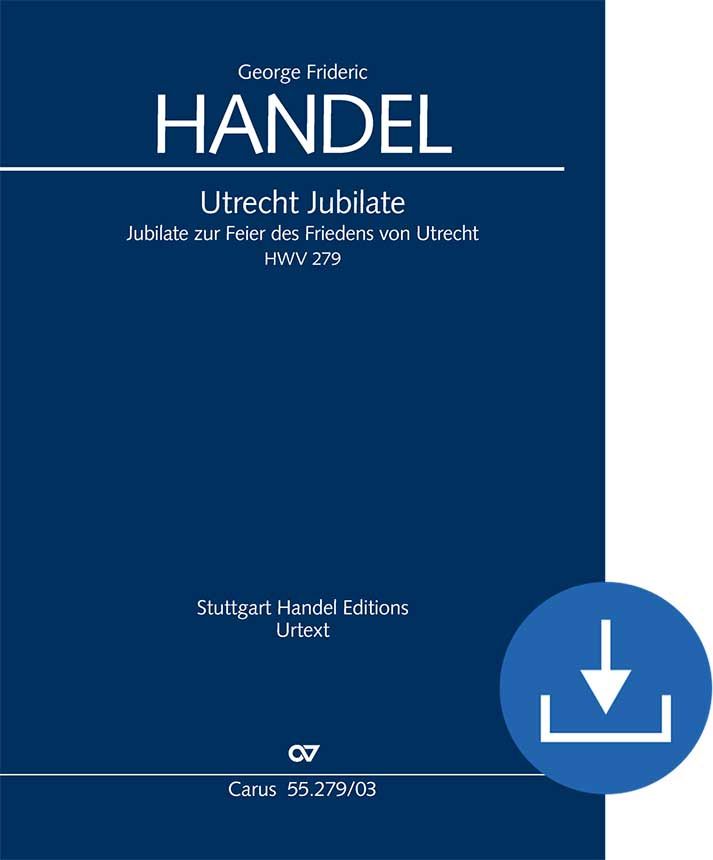
Utrechter Jubilate HWV 279
Jubilate to celebrate the Peace of Utrecht
PDF
1
view
PDF
2
view
Georg Friedrich Händel
Utrechter Jubilate HWV 279
Jubilate to celebrate the Peace of Utrecht
- Instrumentation Soloists (AAB), Mixed Choir (SSATB), 2 Oboes, 2 Trumpets, 2 Violins, Viola and Continuo
- Optional Instrumentation Soloists (AAB), Mixed Choir (SSAATTBB), 2 Oboes, 2 Trumpets, 3 Violins, Viola and Continuo
- Composer Georg Friedrich Händel
- Editor Uwe Wolf
-
Difficulty Level
- Edition Piano Reduction Download
- Publisher Carus-Verlag
- Order no. CV55279-03-DL
 immediately available
Download immediately after ordering
incl. tax,
excl. shipping costs
Not available in all countries. Learn more

Description:
Handel's Jubilate HWV 279 from Utrecht thrilled London audiences at its very first performance and continues to do so today in concert halls and churches around the world, partly due to its wide range of uses. It was heard for the first time in a festive service on July 7, 1713 in St. Paul's Cathedral to celebrate the peace that had ended the War of the Spanish Succession after twelve years of war. The Utrecht Te Deum and Jubilate are Handel's first sacred works in English and important milestones at the beginning of his London career.
The edition is based on Handel's (unfortunately incomplete) autograph as well as on a copy from Handel's circle, which in some respects goes beyond the autograph and provided valuable details for the edition. In 1717 Handel reworked the Jubilate for the chapel in Cannons in a smaller instrumentation (HWV 246) and preceded it with a two-part Sinfonia, which is also reproduced in the appendix to this edition.
The choir is predominantly four-part, only in one short movement eight-part, in two other movements the soprano is divided. The second alto solo part can also be taken by a high tenor.
The edition is based on Handel's (unfortunately incomplete) autograph as well as on a copy from Handel's circle, which in some respects goes beyond the autograph and provided valuable details for the edition. In 1717 Handel reworked the Jubilate for the chapel in Cannons in a smaller instrumentation (HWV 246) and preceded it with a two-part Sinfonia, which is also reproduced in the appendix to this edition.
The choir is predominantly four-part, only in one short movement eight-part, in two other movements the soprano is divided. The second alto solo part can also be taken by a high tenor.
Related products:
Here is how the download works:
1 Buy download sheet music
Purchase the download score from our online store
2 Order confirmation with download link
Immediately after completing your order, you will receive an order confirmation by email listing all items. You will find the download link next to each item. You can use this link to start the download right away. Please also check your spam folder if necessary.
Customers rated this product:
Manufacturer Information:
Carus-Verlag GmbH & Co. KG
Sielminger Str. 51
70771
Leinfelden-Echterdingen
Deutschland
Other customers also bought:
Georg Friedrich Händel
- Soloists (SSAATB), Mixed Choir (SSATB) and Orchestra
- Piano Reduction
-
in stock
ships within 1-2 working days

- Soloists, Mixed Choir (SATB) and Chamber Orchestra
- Piano Reduction (Urtext)
- Martin Focke
-
in stock
ships within 1-2 working days
- Soloists (SSAATB), Mixed Choir (SSATB) and Orchestra
- Piano Reduction
-
ships within 2-5 working days
- Soloists, 2 Mixed Choirs (SATB) and Piano
- Piano Reduction
- Paul Horn
-
in stock
ships within 1-2 working days