
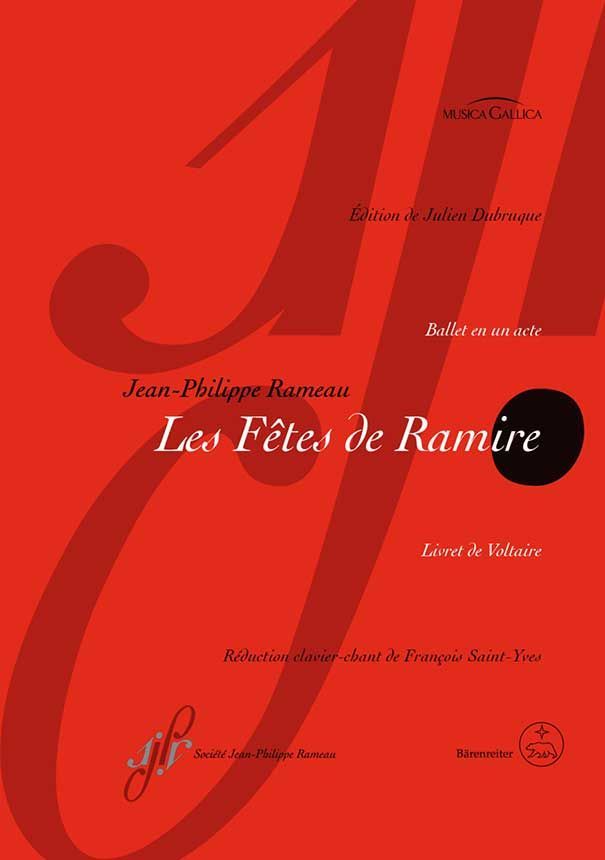
Jean-Philippe Rameau
Les Fêtes de Ramire RCT 40
Ballet in one act

Jean-Philippe Rameau
Les Fêtes de Ramire RCT 40
Ballet in one act
- Instrumentation Soloists, Mixed Choir (SATB) and Orchestra
- Composer Jean-Philippe Rameau
- Editor Jean-Jacques Rousseau François Saint-Yves
- Editor Julien Dubruque
- Lyricist Voltaire
- Edition Piano Reduction
- Publisher Bärenreiter Verlag
- Order no. BA8876-90
 in stock
ships within 1-2 working days
incl. tax,
excl. shipping costs
Not available in all countries. Learn more

Description:
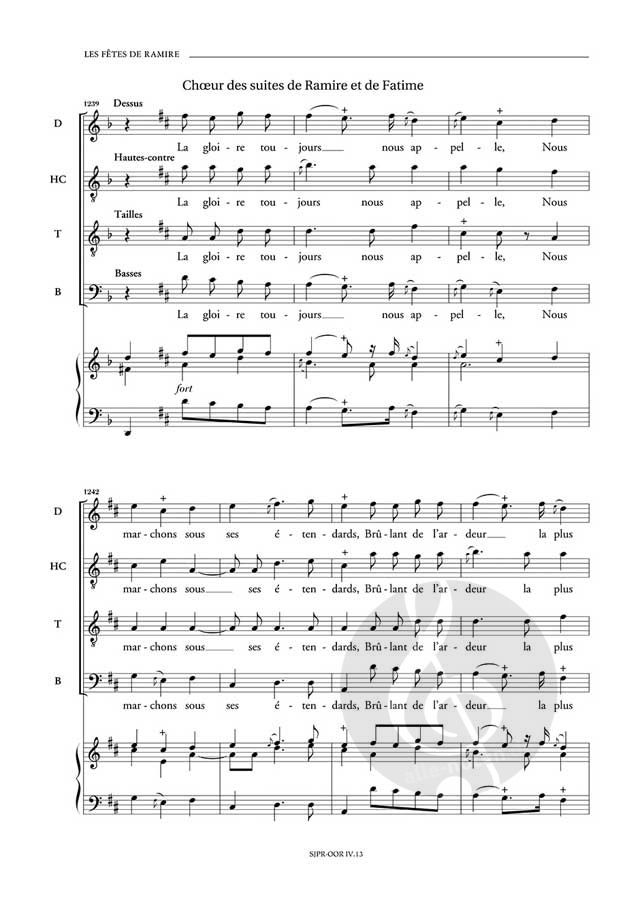
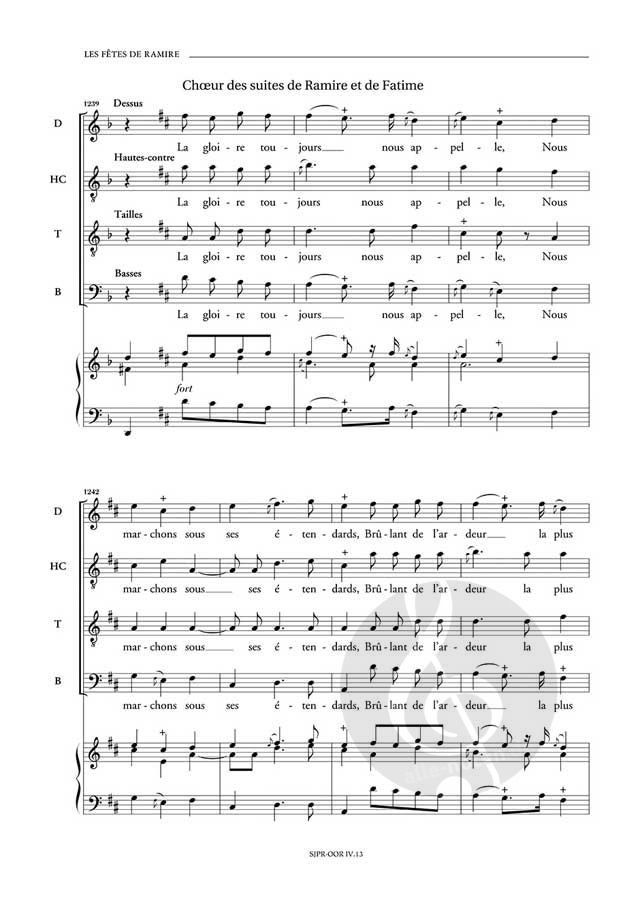
It tells the love story between Fatima, who is accused of murdering her father, and the king's son Ramire, who is in love with her and frees her from the captivity of his father Alphonse, the King of Castile.
The opera in the form of a one-act ballet was performed only once on 22 December 1745 in Versailles and is one of Rameau's little-known works. It was only in the recent past that it was performed again.
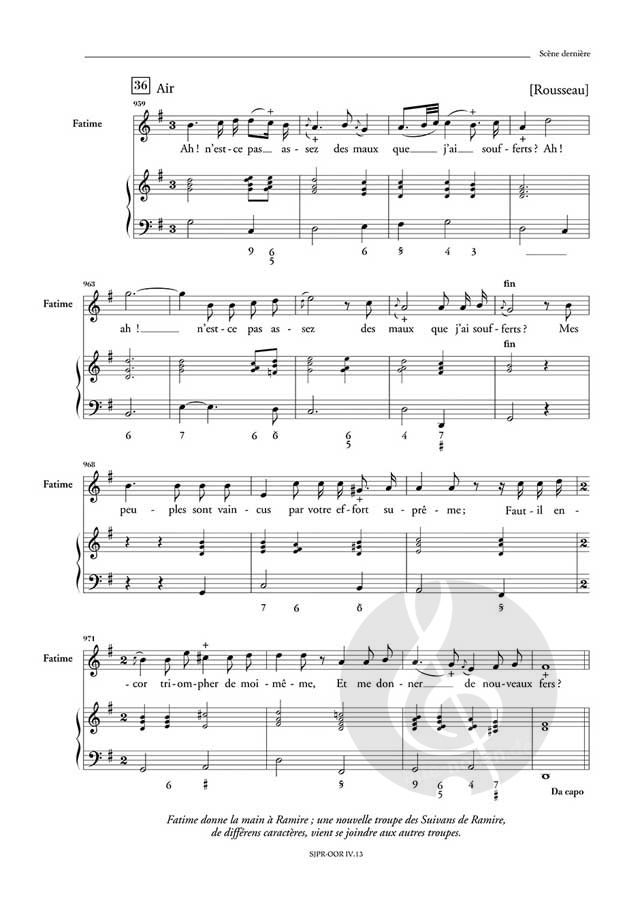
However, the commission for "Les Fêtes de Ramire" did not go to Rameau himself, but to Jean-Jacques Rousseau. Nevertheless, the opera is based on Rameau's Comédie-ballet "La Princess de Navarre", which was performed only a few months earlier, whose libretto was written by Voltaire and which he shortened for "Les Fêtes de Ramire". Rousseau added the overture and new transitions to the work. According to Rousseau, these changes were reviewed at the last minute by Rameau, who did not have enough time to compose new music.
Although Voltaire described his own libretto as "pathetic", and the few minutes of music by Rousseau have above all curiosity value, the density of outstanding compositions by Rameau, many of which were later incorporated into his other works, makes it well worth performing.
The opera in the form of a one-act ballet was performed only once on 22 December 1745 in Versailles and is one of Rameau's little-known works. It was only in the recent past that it was performed again.
However, the commission for "Les Fêtes de Ramire" did not go to Rameau himself, but to Jean-Jacques Rousseau. Nevertheless, the opera is based on Rameau's Comédie-ballet "La Princess de Navarre", which was performed only a few months earlier, whose libretto was written by Voltaire and which he shortened for "Les Fêtes de Ramire". Rousseau added the overture and new transitions to the work. According to Rousseau, these changes were reviewed at the last minute by Rameau, who did not have enough time to compose new music.
Although Voltaire described his own libretto as "pathetic", and the few minutes of music by Rousseau have above all curiosity value, the density of outstanding compositions by Rameau, many of which were later incorporated into his other works, makes it well worth performing.
Customers rated this product:
Manufacturer Information:
Bärenreiter-Verlag Karl Vötterle GmbH & Co. KG
Heinrich-Schütz-Allee 35-37
34131
Kassel
Deutschland
Related products:

- Soloists, Mixed Choir (SATB) and Orchestra
- Piano Reduction Download
- Jean-Jacques Rousseau François Saint-Yves
- Bärenreiter Verlag
-
immediately available
Download immediately after ordering - Instant download