
Christoph Willibald Gluck
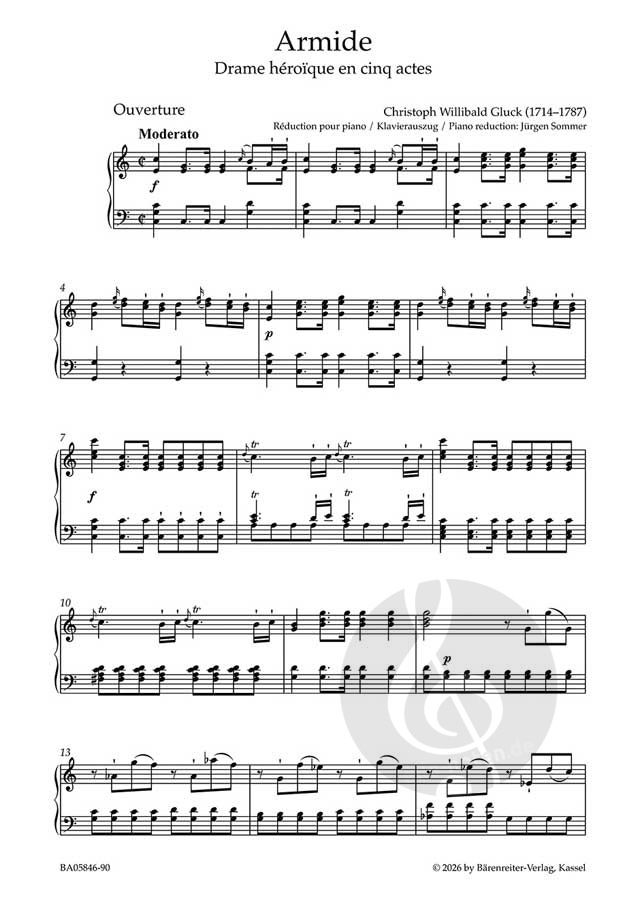
Armide
Heroic drama in 5 Acts

Christoph Willibald Gluck
Armide
Heroic drama in 5 Acts
- Instrumentation Soloists and Orchestra
- Edition Piano Reduction
- Composer Christoph Willibald Gluck
- Editor Jürgen Sommer
- Publisher Bärenreiter Verlag
- Series Bärenreiter Urtext
- Editor Klaus Hortschansky
- Lyricist Philippe Quinault
- Order no. BA5846-90
incl. tax,
excl. shipping costs
 ships within 2-4 working days

Description:
The episode of Armida from Torquato Tasso's epic poem La Gerusalemme liberata (1575) has been one of the most popular opera subjects since the 17th century and has inspired numerous composers, including Lully, Haydn, Rossini and Dvorák, to set it to music. Gluck's Armide, which had its successful premiere in Paris in 1777, is the third opera that the composer wrote for the Académie Royale de Musique.
The beautiful sorceress Armide holds the crusader Renaud captive on her island. After the brave hero is initially unimpressed by Armide's charms, the two eventually fall in love. Only when Renaud is reminded of his crusade vows by the other knights does he leave the desperate Armide, whereupon she curses the unfaithful man, destroys her magical castle and disappears on a winged chariot. Intimate monologues alternate with large choral and ballet scenes. The characterization is musically finely differentiated. In stark contrast to the pastoral moments are the effective intrusions of the supernatural, such as the appearance of hatred personified and the spirits of hell.
The beautiful sorceress Armide holds the crusader Renaud captive on her island. After the brave hero is initially unimpressed by Armide's charms, the two eventually fall in love. Only when Renaud is reminded of his crusade vows by the other knights does he leave the desperate Armide, whereupon she curses the unfaithful man, destroys her magical castle and disappears on a winged chariot. Intimate monologues alternate with large choral and ballet scenes. The characterization is musically finely differentiated. In stark contrast to the pastoral moments are the effective intrusions of the supernatural, such as the appearance of hatred personified and the spirits of hell.
Customers rated this product:
Bärenreiter-Verlag Karl Vötterle GmbH & Co. KG
Heinrich-Schütz-Allee 35-37
34131
Kassel
Deutschland
alle-noten.de: Sheet music shipping since 1969

Since 1969, over 500,000 customers have trusted us. With a huge selection of over 1,000,000 sheet music titles, we are one of the largest providers in Europe. Thanks to our large stock we can often ship sheet music within 24 hours. No matter what sheet music you are looking for: you are in the right place!
Yours, Stefanie Reichert
Head of Customer Service
Related products:


- Soloists and Orchestra
- Piano Reduction Download
- Jürgen Sommer
- Bärenreiter Verlag
-
in stock
|
Delivery time: 1-3 working days
- Download